On this page
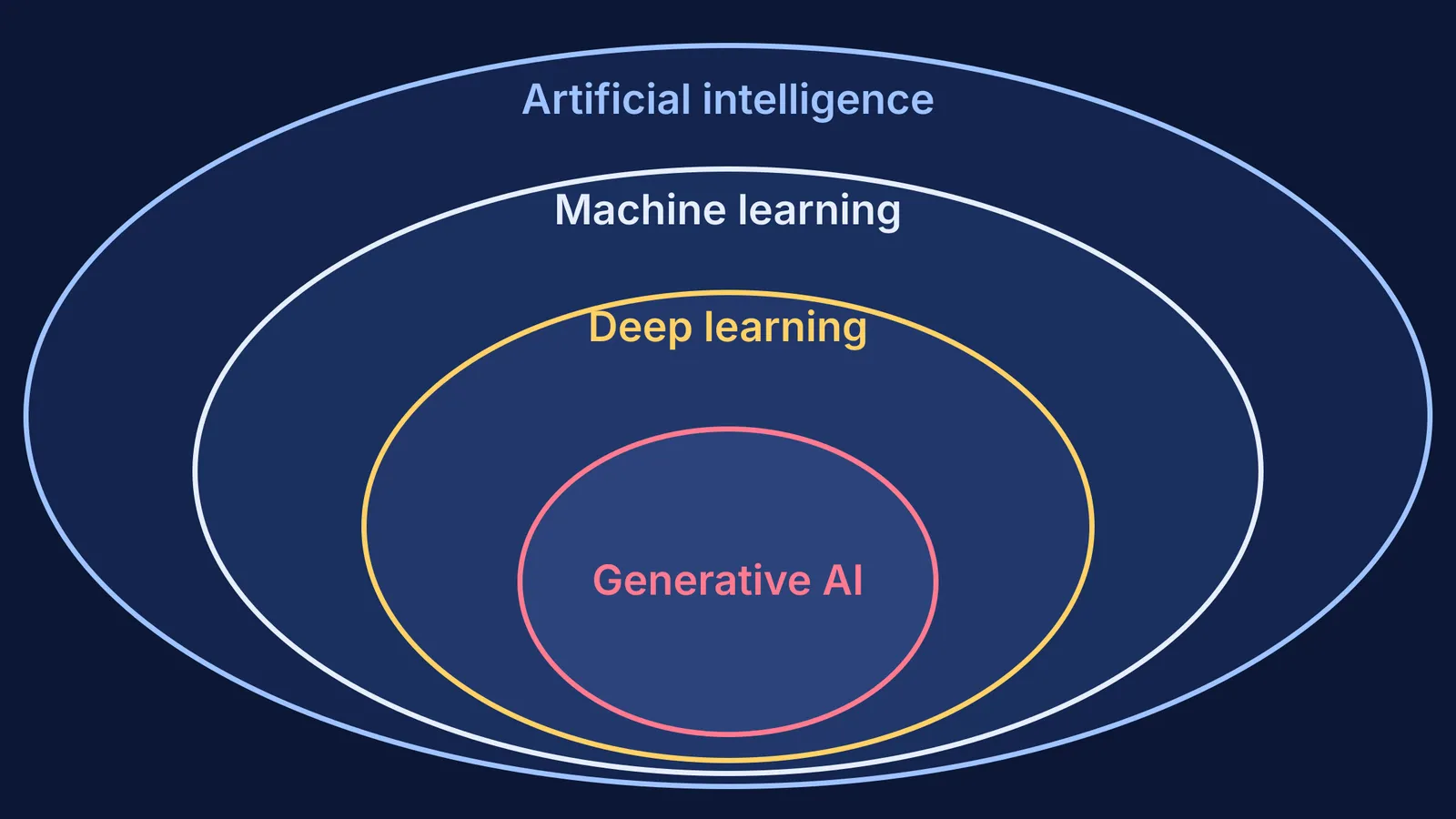
People use "AI", "machine learning" and "deep learning" as if they were the same thing. They are not, but they are related in a simple way: each one sits inside the one before it, like circles drawn one inside another. Once you see that, each word is easy to use correctly.
What is the difference between AI, machine learning and deep learning?
Start with the biggest circle. John McCarthy (his story is in our piece on John McCarthy and the Dartmouth proposal) defined artificial intelligence as "the science and engineering of making intelligent machines, especially intelligent computer programs". AI is the goal, not one method. A program can be AI even if people wrote every rule by hand.
Inside it is machine learning: programs that get better at a task from data or experience instead of only following rules a person wrote. An early use of the term is the title of Arthur Samuel's 1959 paper, Some Studies in Machine Learning Using the Game of Checkers.
Inside machine learning is deep learning. In the words of the 2015 Nature review by LeCun, Bengio and Hinton, deep learning "allows computational models that are composed of multiple processing layers to learn representations of data with multiple levels of abstraction". "Deep" means many layers, not deep thinking.
Generative AI is the newest label. A NIST report from July 2024 quotes the definition from a 2023 US executive order: "the class of AI models that emulate the structure and characteristics of input data in order to generate derived synthetic content", such as images, videos, audio and text. Most of today's chatbots and image generators are deep-learning models, which is why the diagram puts generative AI in the smallest circle.
What is one example of each?
AI without learning: a noughts-and-crosses program that follows rules a programmer wrote ("if you can win, win; if the other player can win, block"). It behaves intelligently, but it never improves, because nothing in it learns.
Machine learning: Samuel's checkers program. His paper reports that a computer could be programmed to learn to play a better game of checkers than the person who wrote the program, in 8 or 10 hours of machine-playing time (Samuel, 1959).
Deep learning: a phone app that recognises what is in a photo. Its network has many layers: early ones respond to simple patterns, later ones combine them into objects. The 2015 Nature review names visual object recognition and speech recognition among the areas deep learning improved.
Generative AI: a chatbot that writes a fresh explanation of Newton's third law when you ask. It is not looking the answer up; it produces new text. Our explainer on how large language models work shows how.
How do you know which term to use?
Work through these four questions in order and use the last "yes".
Does the system do a task we would call intelligent, like playing a game, planning a route or answering questions? If yes, it is AI.
Did it get good at the task by learning from data or experience, rather than from rules a person typed in? If yes, it is machine learning.
Does it learn with a neural network that has many layers? If yes, it is deep learning.
Does it produce new content, such as text, images or audio? If yes, you can also call it generative AI.
Try it on three sentences students often write.
"ChatGPT is AI, not machine learning." Wrong: it passes all four questions, so it is AI, machine learning, deep learning and generative AI at once.
"All AI learns by itself." Wrong: the noughts-and-crosses program fails question 2 and is still AI.
"Deep learning is AI that understands deeply." Wrong: "deep" counts layers, nothing more.
Why does the difference matter when you study with AI?
Knowing which kind of tool you are using tells you what can go wrong. A rule-based calculator is either right or has a bug you can find. A generative model makes new text each time, and the NIST report lists "confabulation" among the risks of generative AI: systems that "generate and confidently present erroneous or false content". The same report notes that language models sometimes give logical-looking steps even when the answer is wrong. That is how a chatbot can write a neat physics solution with a wrong step in the middle.
So treat generative AI as a study partner to check, not an answer key. Our guide to why AI chatbots get maths wrong gives a five-step way to check a solution.
This is also why Fermi's AI tutor teaches rather than only answering: it notices where you are stuck and checks your understanding as it goes, so you are not left trusting one generated answer.
Next time someone says "AI", picture the four circles and ask which one they mean.