

On this page
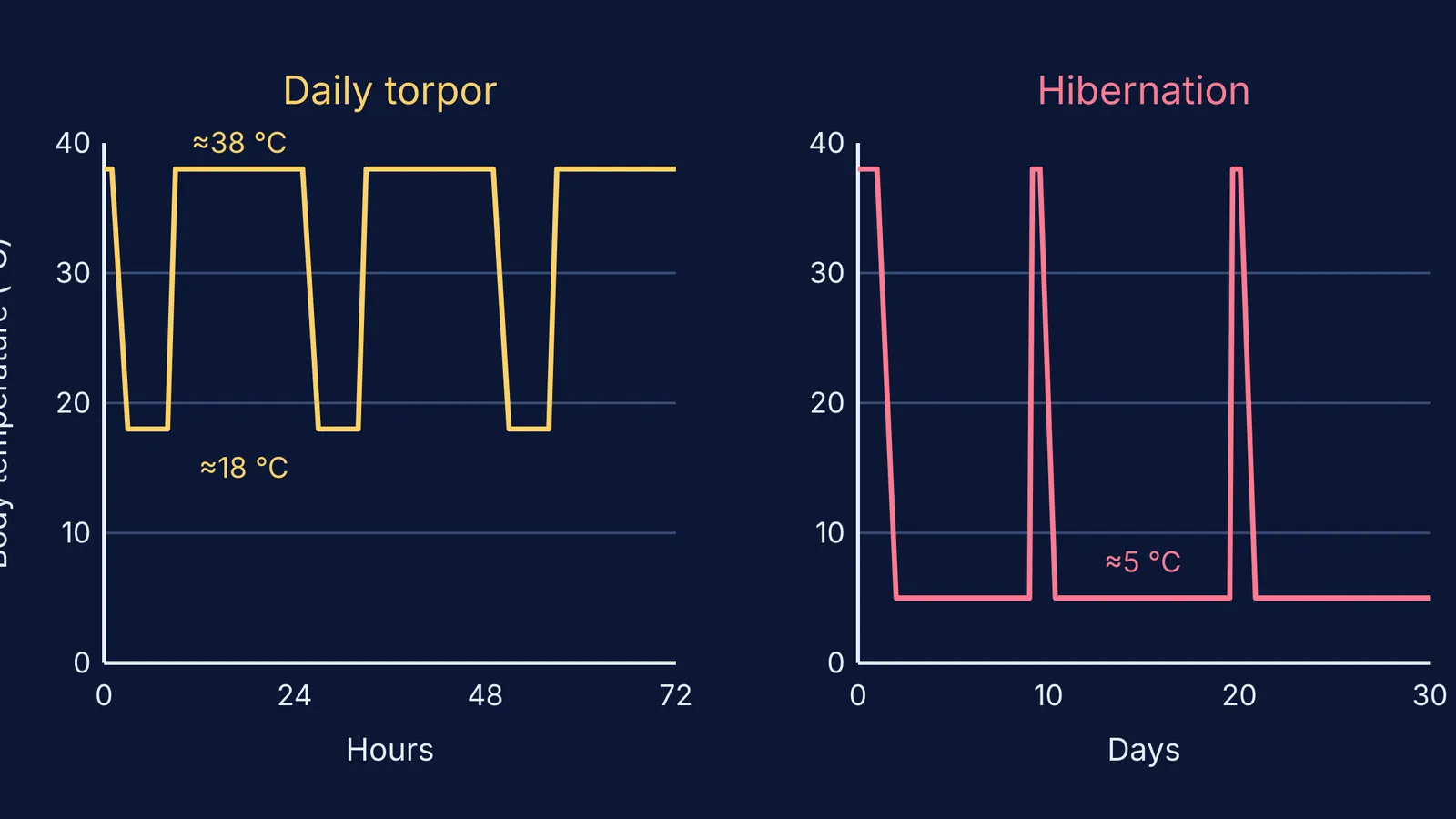
A bat cold and still in a tree hollow on a summer morning and a squirrel curled underground all winter are doing related things. Both have turned down the internal furnace that normally keeps a mammal warm. What separates them is how long the furnace stays down, and how far the temperature falls, as the two graphs above show.
What is torpor in animals?
Torpor is a controlled drop in body temperature and metabolic rate that a warm-blooded animal uses to save energy and then reverses. In a review of 214 bird and mammal species, Thomas Ruf and Fritz Geiser define daily torpor as lasting less than 24 hours, with the animal still foraging between bouts (Biological Reviews, 2015). In species that use only daily torpor, body temperature falls to about 18 °C and metabolic rate to about 30% of basal metabolic rate on average (Geiser, Frontiers in Physiology, 2020).
Bats: two small Australian desert bats tracked by temperature telemetry in summer spent about 7 hours a day torpid, with skin temperatures as low as about 15 °C, and many of their arousals were passive, driven by the morning rise in air temperature (Bondarenco, Körtner and Geiser, 2016).
Sunbirds: malachite sunbirds fitted with implanted temperature transmitters showed torpor at night at air temperatures of 10 °C and below; at 5 °C their body temperature fell by 15 °C, and they warmed back up at the onset of light (Downs and Brown, The Auk, 2002).
Size is the common thread: animals that use torpor tend to be small, and hibernators are heavier than daily heterotherms (Ruf and Geiser, 2015). A small body loses heat fast, so running the body's thermostat at full heat through a cold night costs a lot of food.
How is hibernation different from torpor?
Hibernation is torpor held for days, pushed colder and repeated through a season. Ruf and Geiser describe hibernation torpor bouts as lasting consecutive days to several weeks, in animals that usually do not forage but live on fat or a food store (Biological Reviews, 2015).
Hibernators reduce body temperature from about 38 °C to about 5 °C, many to between 0 and 5 °C, and metabolic rate to about 5% of basal metabolic rate on average (Geiser, 2020). At the extreme, hibernating arctic ground squirrels reached core body temperatures as low as −2.9 °C without freezing (Barnes, Science, 1989).
The long bouts are not continuous. In most hibernators each one is broken by a periodic arousal, a short rewarming to normal body temperature before cooling again, and in greater horseshoe bats bouts ranged from about 1.5 to 12 days (Geiser, 2020).
For an average 30 g animal, a hibernator's longest bouts were more than 30 times longer than a daily heterotherm's, and its lowest metabolic rate was 6% of basal instead of about 35% (Ruf and Geiser, 2015). The authors argue the root difference is timing: the circadian clock governs daily torpor but apparently not hibernation.
How do you tell torpor from hibernation in a question?
Run any example through four checks:
How long is one bout? Under 24 hours means daily torpor; days to weeks means hibernation.
Does the animal feed between bouts? Daily torpor, yes. Hibernation, usually no.
How cold does it get? About 18 °C on average in daily torpor; about 5 °C, often 0 to 5 °C, in hibernation (Geiser, 2020).
Is it tied to the time of day? Daily torpor follows the body clock; hibernation apparently does not, and runs through a season.
One trap: the label describes the behaviour, not the species. Wild Canadian long-eared myotis bats hibernate in winter yet use torpor every day from May to August (Geiser, 2020). And insects are not warm-blooded, so their seasonal pause has its own name, diapause.
How much energy does each one save?
Count energy in basal-hours (one hour at basal metabolic rate), using the averages above: about 30% of basal in daily torpor and about 5% in hibernation (Geiser, 2020).
Daily torpor: 7 hours at 30% of basal costs 7 × 0.30 = 2.1 basal-hours instead of 7. Over a 24-hour day at rest that is 17 + 2.1 = 19.1 instead of 24, a saving of about 20%.
Hibernation: a 9-day bout is 216 hours. At 5% of basal it costs 216 × 0.05 = 10.8 basal-hours instead of 216, a saving of 95% across the bout.
This rough model ignores the cost of rewarming, but it shows why a short daily dip suits an animal that can still feed, and a long, deep one suits an animal that must last until spring.
If basal metabolic rate still feels hazy, the Fermi Concept Library gives every concept in biology, physics and chemistry its own lesson and its place in the map. For energy sums like this one, the Fermi Problem Library has a step-by-step solver that explains the reasoning rather than printing an answer.
So when a question says an animal 'goes dormant', ask first how long one bout lasts: hours point to torpor, days to hibernation.


