

On this page
The rainfall figures you see for automatic weather stations are not read off a measuring cylinder by an observer. They come from a small see-saw inside a metal cylinder. Rain runs down a funnel into one of two little buckets. When that bucket holds a set amount, it tips over, empties, and brings the other bucket under the funnel. A magnet on the see-saw sends one electrical pulse per tip, and the logger counts pulses. Each pulse is a fixed depth of rain. The physics is volume, flow rate and moments, and it also explains why these gauges read low in the heaviest downpours.
How does a tipping-bucket rain gauge measure rainfall?
Rainfall is reported as a depth: the depth of water that would stand on flat ground if none ran off or soaked in. A gauge turns caught volume into depth by dividing by the area of its opening, as explained in what 100 mm of rainfall means in litres per square metre.
A tipping-bucket gauge does the division ahead of time. Its bucket is made to tip at one fixed volume, so every tip stands for one fixed depth. The logger only has to count.
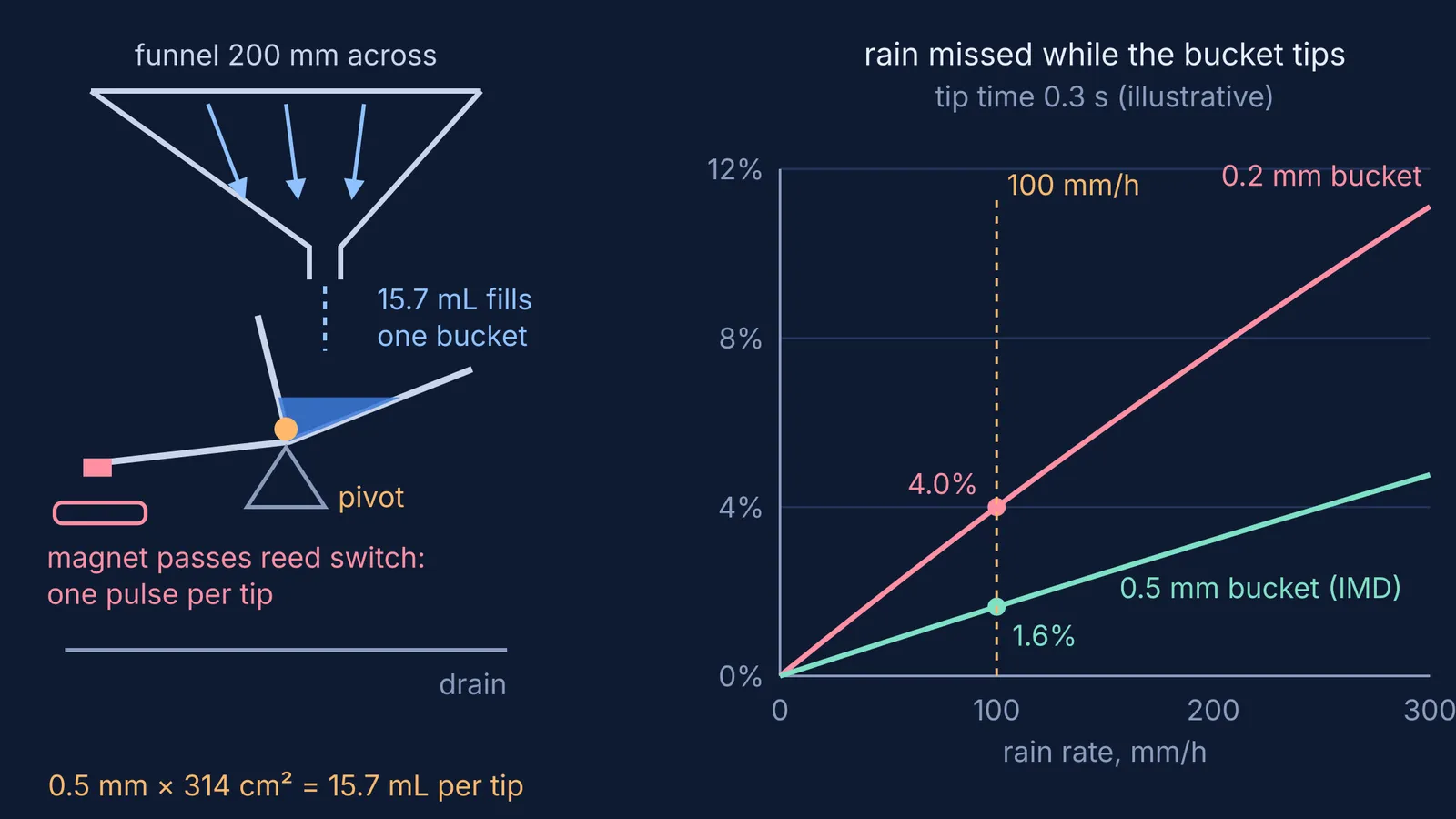
IMD's training notes on automatic weather stations and rain gauges describe the gauge used in its AWS and ARG (automatic rain gauge) network. They list a funnel 200 mm across, a sensitivity of 0.5 mm per tip and 15.7 mL of water per tip, with the tip sensed by a magnet passing a switch. Many gauges elsewhere use a smaller bucket of 0.2 mm or 0.1 mm per tip.
Why is one tip 0.5 mm of rain?
Check IMD's numbers yourself.
Area of the funnel opening. d = 200 mm, so r = 0.100 m and A = πr² = π × 0.100² = 0.0314 m², or 314 cm².
Volume for 0.5 mm of rain. V = A × depth = 0.0314 m² × 0.0005 m = 1.571 × 10⁻⁵ m³ = 15.7 mL.
Mass of that water. 15.7 mL of water is about 15.7 g.
So the bucket is set to tip when it holds about 15.7 g of water, which matches IMD's figure. A 0.2 mm bucket on the same funnel would tip at 6.28 mL.
The resolution sets the smallest shower the gauge can see. With a 0.5 mm bucket, a passing shower of 0.4 mm leaves water in the bucket but no tip, so it shows up only when the next shower adds to it.
Why does the bucket tip at a fixed amount?
The see-saw is a moment problem. The bucket assembly rests against a stop, tilted so that the bucket under the funnel is raised. Its own weight gives a moment that holds it there. As water collects, the water's weight acts at some horizontal distance d from the pivot and gives a moment m g d in the opposite sense.
When m g d exceeds the moment holding the assembly against its stop, the net moment changes sign and the see-saw rotates. As it turns, the water slides to the outer end, d grows, and the tip speeds up until the bucket hits the opposite stop and empties. The other bucket now sits raised under the funnel, and the cycle repeats.
For a rough feel, take 15.7 g of water acting 3 cm from the pivot (an illustrative distance, not a design value): m g d = 0.0157 × 9.81 × 0.03 ≈ 4.6 × 10⁻³ N m. The tipping volume is set by the geometry and the stop positions, which is why each gauge is calibrated with a measured volume of water.
Worked example: how much rain does the gauge miss at 100 mm/h?
A rate of about 100 mm in an hour is the kind of downpour described in what a cloudburst is. Take IMD's gauge: funnel area 0.0314 m², 15.7 mL per tip. Assume the bucket takes 0.3 s to tip (an illustrative value; it differs between designs), and that rain arriving during the tip is not counted.
Flow into the funnel. 100 mm/h = 0.1 m ÷ 3600 s = 2.78 × 10⁻⁵ m/s. Flow q = A × rate = 0.0314 × 2.78 × 10⁻⁵ = 8.73 × 10⁻⁷ m³/s = 0.873 mL/s.
Time to fill one bucket. 15.7 ÷ 0.873 = 18.0 s.
Water that arrives during one tip. 0.873 mL/s × 0.3 s = 0.262 mL.
Fraction missed. Each cycle brings 15.7 + 0.262 = 15.97 mL but records 15.7 mL. Missed = 0.262 ÷ 15.97 = 1.6%.
Effect over the hour. One cycle takes 18.3 s, so there are about 197 tips in an hour. 197 × 0.5 mm ≈ 98.4 mm recorded out of 100 mm.
Now repeat for a 0.2 mm bucket (6.28 mL) on the same funnel. It fills in 7.2 s, and the same 0.262 mL per tip is 0.262 ÷ 6.54 = 4.0% of each cycle. The loss grows with the rain rate:
10 mm/h: 0.4% for 0.2 mm, 0.2% for 0.5 mm.
100 mm/h: 4.0% for 0.2 mm, 1.6% for 0.5 mm.
300 mm/h: 11.1% for 0.2 mm, 4.8% for 0.5 mm.
Units check: mL/s × s = mL, and mL ÷ mL is a pure ratio.
A technical note by Claude Lelièvre on tipping-time errors in tipping-bucket gauges gives a matching example: for a 0.2 mm gauge at 50 mm/h, about 2% of the rain falls into the full bucket during tipping. Our model gives 2.0% at that rate with a 0.3 s tip.
Do real gauges correct for this?
Yes, and this is where the simple model stops. Makers usually calibrate at one chosen rain rate, setting the bucket to tip a little early so that the water added during the tip brings the total to the right amount. That fixes one rate exactly, but the gauge then reads slightly low at higher rates and slightly high at lower ones, as Lelièvre's note explains. Better gauges apply a rate-dependent correction found by dynamic calibration.
WMO's first laboratory intercomparison of rainfall intensity gauges, run in 2004–2005, found that only tipping-bucket gauges that apply a proper correction for these mechanical errors met WMO's accuracy requirements for rainfall intensity (results reported by Luca Lanza at WMO TECO-2006_Lanza_Italy.pdf)).
The tipping loss is not the only error. Wind carries drops past any raised gauge, a loss that can be larger. Water wetting the funnel and evaporating is another. Snow and hail must melt before they tip anything.
If you want to watch a rate problem like this unfold step by step, the Fermi Problem Library has a step-by-step solver that explains the reasoning.
Quick checklist
Each tip is a fixed volume, so a fixed depth: V = A × depth.
IMD's gauge: 200 mm funnel, 0.5 mm per tip, 15.7 mL per tip.
The bucket tips when the water's moment m g d beats the moment holding it on its stop.
Rain that arrives during the tip is missed: fraction ≈ q t_tip ÷ (V + q t_tip).
Smaller buckets resolve light rain better but lose more in heavy rain.
Real gauges calibrate and correct; wind is a separate, often larger error.


