

On this page
When the news says a city got 100 mm of rain, it does not mean the roads were 10 cm under water. The India Meteorological Department (IMD) glossary expresses rainfall as the depth to which it would cover a horizontal projection of the earth's surface if there were no loss by evaporation, run-off or infiltration.
What does 100 mm of rainfall actually mean?
Rainfall is measured as a depth, not a volume. The World Meteorological Organization's guide to instruments, chapter 6 says the unit of precipitation is linear depth, usually in millimetres, and describes it as volume divided by area.
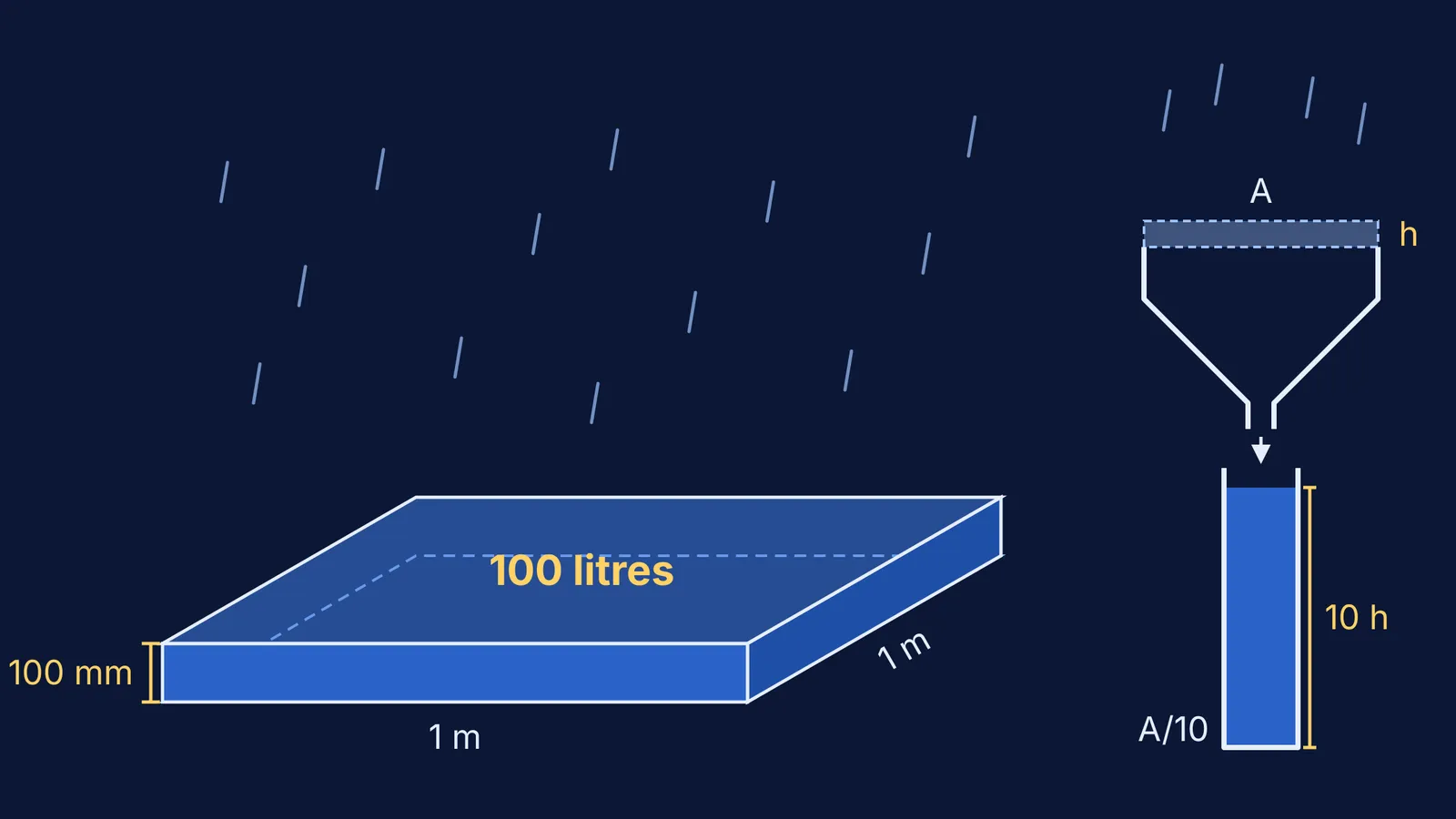
Multiply depth by area and you get volume back. For 100 mm of rain on one square metre:
depth: 100 mm = 0.1 m
area: 1 m x 1 m = 1 m²
volume: 0.1 m x 1 m² = 0.1 m³
in litres: 0.1 m³ x 1,000 L per m³ = 100 L
So every square metre gets 100 litres, about five 20-litre water cans. A flat terrace measuring 10 m by 10 m (100 m²) receives 10,000 litres from the same rain.
Why does 1 mm of rain equal 1 litre per square metre?
Using the same depth-times-area rule from the WMO guide, here is the calculation for 1 mm: 1 m² x 0.001 m = 0.001 m³, which is exactly 1 litre.
Or picture it: a litre is a 10 cm cube, 1,000 cm³. Squash it into a sheet 0.1 cm thick and it covers 10,000 cm², one square metre.
The WMO guide also lists kilograms per square metre for liquid precipitation. A litre of water has a mass of about 1 kg, so 100 mm of rain is roughly 100 kg of water on every square metre of a flat roof.
How does a rain gauge measure rainfall in mm?
An ordinary rain gauge is a collector above a funnel that drains into a container, which is measured at fixed observation times. The WMO guide says the size of the opening is not critical for rain, that 200 to 500 cm² will probably be most convenient, and that the area should be known to the nearest 0.5%.
Size does not matter because the gauge divides the volume by the area. Worked example with a 200 cm² funnel during 100 mm (10 cm) of rain:
Water caught: 200 cm² x 10 cm = 2,000 cm³, or 2 litres.
Depth recovered: 2,000 cm³ / 200 cm² = 10 cm = 100 mm.
The measuring cylinder works like a magnifier. WMO says its diameter should be less than 33% of the rim's diameter, with marks every 0.2 mm, and daily amounts read to the nearest 0.2 mm (0.1 mm where feasible). If the cylinder's cross-section is one-tenth of the funnel's area, 1 mm of rain stands 10 mm tall in the cylinder and is easy to read.
Is 100 mm of rain in a day a lot?
Yes. IMD's forecast days run from 0830 IST one morning to 0830 IST the next, and its Hyderabad forecast bulletin prints the daily rainfall categories:
very light: trace to 2.4 mm
light: 2.5 to 15.5 mm
moderate: 15.6 to 64.4 mm
heavy: 64.5 to 115.5 mm
very heavy: 115.6 to 204.4 mm
extremely heavy: 204.5 mm or more
That puts 100 mm in a day in the heavy band. A gauge measures only its own spot; the WMO guide notes that even the best point measurement represents only a limited area, so two neighbourhoods can report different totals. For the seasonal picture, see how El Niño affects the Indian monsoon.
How can you measure rainfall at home?
You need a straight-sided container, a ruler and a kitchen measuring jug:
Measure the inside diameter of the opening and work out its area with πr².
Place it in the open and empty it at the same time each morning. The WMO guide advises keeping walls and trees no closer than twice their height above the opening.
Pour the catch into the measuring jug and note the volume in mL (1 mL = 1 cm³).
Divide the volume by the area to get the depth in cm, then multiply by 10 to get mm.
Example: a bucket 28 cm across has a radius of 14 cm, so its area is 3.14 x 14 x 14, about 616 cm². If it catches 1,500 mL overnight, the rain was 1,500 / 616 = 2.4 cm, or about 24 mm. On the IMD scale above, that is moderate rain.
For help with cm³, litres and m³, read our guide to cuboid volume and litre conversions. To log temperature and wind as well, try building a weather station for a school project.
If a depth spread over an area still feels slippery, the Fermi Simulation Lab has interactive simulations for ideas that are easier to see than to read. For conversion practice, the Fermi Problem Library has worked problems with a step-by-step solver that explains the reasoning.
The next time the forecast says 100 mm, picture 100 litres on every square metre around you.


