

On this page
Shut a bay behind a wall at high tide, wait for the sea outside to drop, and you have a lake sitting several metres above the sea. Let that water out through turbines and you have a tidal power station. The physics is a potential energy sum with one twist: the head of water shrinks as the basin empties, which is why tidal power depends so strongly on the size of the tide.
How does a tidal barrage make electricity?
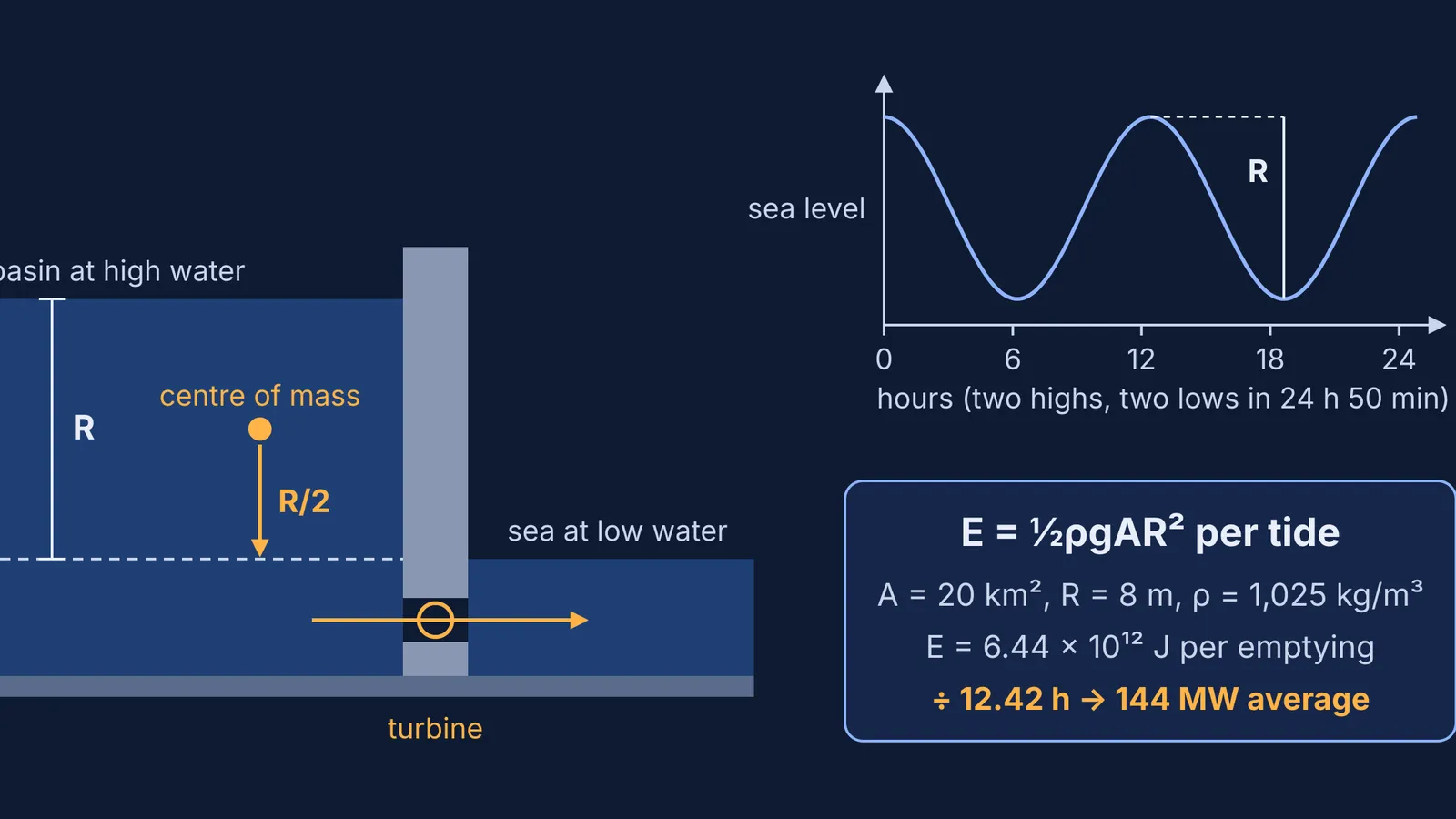
A barrage is a dam across a bay or estuary with sluice gates and turbines in it. In ebb generation it runs like this.
As the tide comes in, the sluices are open and the basin fills with the sea.
At high water, the gates close. The basin is now full to the high-tide level.
The sea outside falls. When the difference in level is large enough, water is let out through the turbines.
The basin drains until its level nears the sea's, and the cycle repeats on the next tide.
Why there are two tides a day in the first place is explained in why there are two high tides a day, drawn as arrows. Here we only need the result: high water comes round about every 12 h 25 min, or 12.42 hours, not every 12 hours.
Why is the energy per tide ½ρgAR² and not ρgAR²?
Call the tidal range R: the height between high and low water. Take a basin of surface area A with vertical sides. The water that can be released is the layer between the high-tide level and the low-tide level.
Its volume is A × R, so its mass is m = ρAR.
The top of that layer falls a height R. The bottom of it hardly falls at all.
On average, the layer falls by the drop of its centre of mass, which sits halfway up the layer: R/2.
So the energy released in one emptying is
E = mg(R/2) = ρAR × g × R/2 = ½ρgAR²
Compare this with pumped hydro storage, where the reservoir sits a fixed height above the turbines and every kilogram falls through roughly the same head, so E = mgh. In a tidal basin the head shrinks as the basin drains. The factor ½ is the price of that shrinking head.
The R² matters most: doubling the range doubles both the mass released and the average height it falls.
How much power does an 8 m tide in a 20 km² basin give?
Take an illustrative basin, not a real project: A = 20 km² = 2.0 × 10⁷ m², R = 8 m, sea water density ρ = 1,025 kg/m³, g = 9.81 m/s².
Mass released. m = ρAR = 1,025 × 2.0 × 10⁷ × 8 = 1.64 × 10¹¹ kg.
Drop of the centre of mass. R/2 = 4 m.
Energy per emptying. E = mg(R/2) = 1.64 × 10¹¹ × 9.81 × 4 = 6.44 × 10¹² J.
In MWh. 1 MWh = 3.6 × 10⁹ J, so E = 6.44 × 10¹² ÷ 3.6 × 10⁹ ≈ 1,790 MWh.
Average power. With one emptying per tidal cycle of 12.42 h = 44,700 s, P = 6.44 × 10¹² ÷ 44,700 ≈ 1.44 × 10⁸ W = 144 MW.
Check the units: kg/m³ × m/s² × m² × m² = kg m²/s² = J. Good.
Generating on the incoming tide as well could at most double this, to about 290 MW, for a perfect machine.
Why does tidal power need a very large tidal range?
Because E ∝ R², a small tide is far worse than it looks. Keep the same 20 km² basin and change only R.
R = 4 m gives (4/8)² = ¼ of the energy: about 36 MW average.
R = 5 m gives (5/8)² = 0.39 of it: about 56 MW.
R = 10 m gives (10/8)² = 1.56 times it: about 225 MW.
Most of India's coast has small tides, so the sum is hopeless there. The Gulf of Khambhat narrows like a funnel, and the tide grows as it travels up it. A coastal atlas from the National Centre for Coastal Research, under the Ministry of Earth Sciences, gives mean spring tides of about 4.7 m at Mahuva near the mouth, 6.5 m at Gopnath and 10.2 m at Bhavnagar, with a maximum spring tide of 12.5 m recorded at Bhavnagar. That is why the Gulf of Khambhat, along with the Gulf of Kachchh, is the region studied for tidal power in India.
These are spring tides. Neap tides a week later are much smaller, and R² makes the energy drop even more.
How close do real tidal plants get to the ideal?
The longest-running barrage is La Rance in Brittany, France, opened in 1966. The PNNL Tethys database, run by a US national laboratory, lists an average tidal range of 8.2 m, a 22 km² basin, 24 turbines of 10 MW each (240 MW installed) and an annual output of about 600 GWh.
Apply the same formula: ½ × 1,025 × 9.81 × 2.2 × 10⁷ × 8.2² ≈ 7.4 × 10¹² J per tide, or about 166 MW averaged over a 12.42 h cycle. The real average output is 600 GWh ÷ 8,766 h ≈ 68 MW. Other published figures for the annual output are lower, so treat 68 MW as approximate.
The real plant gets well under half the ideal figure.
Turbines need a useful head to start and stop before it reaches zero, so part of R is never used.
The basin cannot be emptied instantly; the sea starts rising again while it drains.
Turbines and generators are not 100% efficient.
Spring and neap tides change R through the month.
The installed 240 MW is a peak rating, reached only at large head, not an average.
Is tidal power used in India?
Not at scale. The Standing Committee on Energy's 2021 report, summarised by PRS Legislative Research, put India's theoretical tidal potential at about 12.5 GW, noted that this is not the same as practically exploitable potential, and recorded that two earlier tidal projects, 3.75 MW in West Bengal and 50 MW in Gujarat, were shut down because of high cost. It recommended a pilot plant. A barrage also changes an estuary's silting, salinity and mudflat habitat.
Tidal power is predictable years ahead but not steady: output stops near every high and low water. Where the energy goes when it is not captured, as friction in shallow seas, is part of the story in why the Moon is slowly drifting away from Earth.
To practise more potential-energy problems where the centre of mass does the work, try the Fermi Problem Library, a step-by-step solver that explains the reasoning.
Quick checklist
Released water: mass ρAR, centre of mass falls R/2.
Energy per tide: E = ½ρgAR². Not ρgAR².
Tidal cycle: about 12.42 h. Average power = E ÷ 44,700 s for one emptying per cycle.
E ∝ R²: halve the range and you get a quarter of the energy.
Gulf of Khambhat spring tides reach about 10 m at Bhavnagar, which is why it is India's studied site.


