

On this page
Solar panels make most of their power at noon, and demand in India peaks in the evening. One way to move energy from one to the other is to pump water uphill when power is cheap and let it flow back down through turbines when it is needed. That is pumped hydro storage, and the physics behind it is the mgh you already know. Here is how much water stores one gigawatt-hour, checked against real plants.
What is pumped hydro storage?
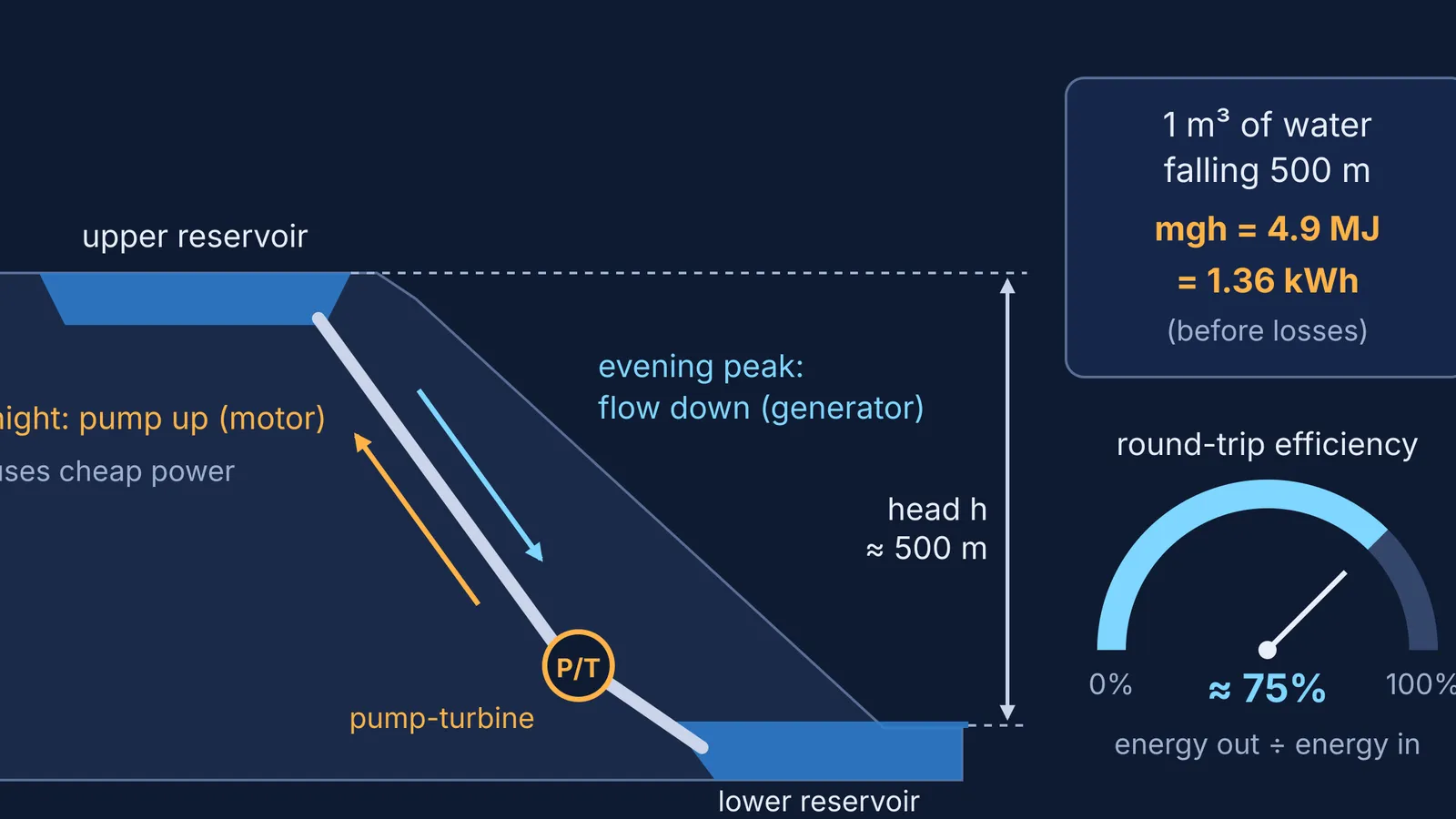
A pumped storage plant has two reservoirs at different heights, joined by a pipe called a penstock. In the middle sits a reversible machine called a pump-turbine.
Charging (pumping mode). Spare electricity from the grid runs the machine as a motor. It pumps water from the lower reservoir to the upper one. Electrical energy becomes gravitational potential energy.
Discharging (generating mode). At peak demand the water flows back down. It spins the same machine, now working as a turbine driving a generator. Potential energy becomes electrical energy again.
An ordinary hydroelectric dam only does the second half, with river water that arrives for free. That one-way process is covered in how dams make electricity from falling water and, with Indian numbers, in how a dam makes electricity: Bhakra and Tehri worked out. A pumped storage plant is different: it is a giant rechargeable battery made of water and height.
How much energy does 1 m³ of water store?
Start with one cubic metre. Its mass is m = ρV = 1000 kg/m³ × 1 m³ = 1000 kg. Lift it through a head h = 500 m and its potential energy rises by
mgh = 1000 × 9.81 × 500 = 4.905 × 10⁶ J ≈ 4.9 MJ.
One kilowatt-hour is 1000 W × 3600 s = 3.6 × 10⁶ J, so
4.905 × 10⁶ ÷ 3.6 × 10⁶ ≈ 1.36 kWh.
That is all the energy one tonne of water can give up after falling half a kilometre, before any losses. A 60 W fan running for 24 hours uses a little more (1.44 kWh), which is why pumped storage needs huge volumes and big heights.
How much water stores one gigawatt-hour?
Here is the full worked example.
Question. A pumped storage plant has an average head of 300 m. Its generating efficiency (potential energy to electrical energy out) is 90%. What volume of water must flow down to deliver 1 GWh to the grid? Take g = 9.81 m/s².
Convert the energy to joules. 1 GWh = 10⁹ W × 3600 s = 3.6 × 10¹² J.
Account for the efficiency. Electrical energy out = 0.90 × potential energy released. So the water must release 3.6 × 10¹² ÷ 0.90 = 4.0 × 10¹² J.
Write the potential energy in terms of volume. PE = ρVgh, so V = PE ÷ (ρgh).
Substitute. V = 4.0 × 10¹² ÷ (1000 × 9.81 × 300) = 4.0 × 10¹² ÷ 2.943 × 10⁶ ≈ 1.36 × 10⁶ m³.
Check the units. J ÷ (kg/m³ × m/s² × m) = (kg m²/s²) ÷ (kg/(m s²)) = m³. Correct.
Answer: about 1.36 million cubic metres. That is about 540 Olympic swimming pools of 2500 m³ each, for one gigawatt-hour.
How does a real plant compare?
Dinorwig in north Wales is a well-documented pumped storage plant. According to its Wikipedia article, it can supply a maximum of 1,728 MW and stores around 9.1 GWh. The upper lake, Marchlyn Mawr, holds water at about 636 m above sea level, and the lower lake, Llyn Peris, is at about 100 m. That gives a difference of about 536 m when the upper lake is full.
The head falls as the upper lake drains, so for a rough estimate use an average head of about 500 m. This is a round illustrative value, not an official figure. Then:
Water needed at 100% conversion: V = 9.1 × 10⁹ × 3600 ÷ (1000 × 9.81 × 500) ≈ 6.7 × 10⁶ m³.
At 90% generating efficiency: 6.7 × 10⁶ ÷ 0.90 ≈ 7.4 × 10⁶ m³.
So a full discharge at Dinorwig moves several million cubic metres of water down through the mountain. The same 9.1 GWh stored in lithium-ion cells at the cell-level 243 Wh/kg of a Panasonic NCR18650B datasheet would need about 37,000 tonnes of cells, before counting packs, wiring and cooling.
India now has its own example. THDC's Tehri pumped storage plant on the Bhagirathi uses the Tehri reservoir as its upper lake and the Koteshwar reservoir as its lower one (pv magazine). It has four 250 MW variable-speed units, 1,000 MW in all, and the fourth unit was commissioned in April 2026 (Powerline).
Is it energy (GWh) or power (MW)?
These are different quantities, and mixing them up is the most common mistake.
Power (MW) is how fast the plant can deliver energy. It is set by the turbines and the flow rate.
Energy (GWh) is how much it can deliver in total. It is set by the volume of water and the head.
Divide energy by power to get how long the plant can run at full output. For Dinorwig, 9.1 GWh ÷ 1.728 GW ≈ 5.3 hours, which matches the "up to six hours" in its description. The flow rate follows from P = η ρ Q g h: at 1,728 MW, 500 m and 90%, Q = 1.728 × 10⁹ ÷ (0.90 × 1000 × 9.81 × 500) ≈ 390 m³ of water every second.
Does pumped storage produce net energy?
No. It stores energy and loses some of it on every cycle. Pumping has losses (pump efficiency, friction in the penstock), and so does generating. The ratio of energy out to energy in is the round-trip efficiency, typically around 70–80%. Wikipedia gives Dinorwig an average efficiency of 74–76%.
At 75%, delivering 9.1 GWh means first taking about 9.1 ÷ 0.75 ≈ 12.1 GWh from the grid. The plant is a net consumer of electricity. It earns its keep by buying energy when there is too much and supplying it within minutes when there is too little. A flywheel does the same job on a smaller, faster scale by storing rotational kinetic energy instead; see how to calculate the energy stored in a rotating flywheel.
What mistakes cost marks here?
Using the dam height instead of the head, which is the vertical distance between the two water surfaces.
Forgetting that the head shrinks as the upper reservoir drains. Use an average head unless the question says otherwise.
Writing GWh where the question means MW, or the other way round.
Multiplying by the efficiency when you should divide.
Forgetting the factor of 3600 when converting kWh or GWh to joules.
For more energy and efficiency problems like these, the Fermi Problem Library has a step-by-step solver that explains the reasoning at each stage.
Quick checklist
Energy stored = ρVgh; 1 m³ through 500 m holds about 1.36 kWh.
1 GWh = 3.6 × 10¹² J.
Water needed = energy out ÷ (efficiency × ρgh).
Hours at full output = energy (GWh) ÷ power (GW).
Round-trip efficiency is about 70–80%, so the plant uses more energy than it returns.


