

On this page
This set follows our first set of Thermodynamics JEE Main practice questions and covers what set 1 skipped: free expansion, phase change, curve slopes, the second law, a refrigerator, a V–T cycle and a spring-loaded piston.
All of these sit in Unit 8 of the NTA syllabus for JEE (Main) 2027. Free expansion, the Kelvin-Planck and Clausius statements and the reversible refrigerator are in Chapter 11 of NCERT Class 11 Physics Part II (Reprint 2026-27). We use ΔQ = ΔU + ΔW with W done by the gas, and R = 8.3 J mol⁻¹ K⁻¹. New to the chapter? Start with our guide on how to prepare Thermodynamics for JEE Main.
How should you use this set?
Allow 25 minutes for all eight; Q6 and Q8 have numerical answers.
Write which of Q, W and ΔU is zero first.
Answer before reading the solution; read every trap.
Easy: free expansion, boiling water and curve slopes
Q1 (easy). An insulated rigid box is split in half: ideal gas on one side, vacuum on the other. The partition is punctured. Once it settles:
(A) T falls, as the gas does work (B) T is unchanged, P halves (C) T and P are unchanged (D) T rises, as the process is irreversible
Answer: (B). Nothing pushes back, so W = 0; insulation makes Q = 0. So ΔU = 0 and an ideal gas keeps its temperature. With V doubled, P halves. Trap: (A) treats it as a slow adiabatic expansion.
Q2 (easy). 5.0 g of water at 100 °C boils at a steady pressure of 1.0 × 10⁵ Pa. Liquid volume 5.0 cm³, steam 8.4 L, latent heat 2.26 kJ/g. What is the change in internal energy?
(A) 0.84 kJ (B) 10.5 kJ (C) 11.3 kJ (D) 12.1 kJ
Answer: (B). Heat in: 5.0 × 2.26 = 11.3 kJ. Work: PΔV = 1.0 × 10⁵ × (8.4 × 10⁻³ − 5 × 10⁻⁶) ≈ 0.84 kJ. ΔU = 11.3 − 0.84 ≈ 10.5 kJ. Trap: (C) forgets the steam's work.
Q3 (easy). Where an adiabatic and an isothermal curve of an ideal gas cross on a P–V diagram, the adiabatic is 1.5 times as steep. What is the gas's molar specific heat at constant volume?
(A) 1.5R (B) 2R (C) 3R (D) 0.67R
Answer: (B). The isothermal slope is −P/V and the adiabatic slope is −γP/V, so γ = 1.5. Then C_v = R/(γ − 1) = 2R. Trap: (C) is C_p = γR/(γ − 1).
Medium: adiabatic pressure, the second law and a refrigerator
Q4 (medium). A monatomic ideal gas at 300 K is compressed adiabatically until its pressure is 32 times the starting value. What is its final temperature?
(A) 600 K (B) 1200 K (C) 2400 K (D) 9600 K
Answer: (B). PV^γ = constant with PV = nRT gives T ∝ P^((γ − 1)/γ). With γ = 5/3 the exponent is 2/5, and 32^(2/5) = 4, so T = 1200 K. Trap: (D) scales T with P as at fixed volume; (C) uses the volume ratio, 8.
Q5 (medium). Engines work between reservoirs at 227 °C and 27 °C. Which per-cycle claim is possible?
(A) 1000 J in, 450 J work, 550 J out (B) 1000 J in, 500 J work, 550 J out (C) 1000 J in, 350 J work, 650 J out (D) 1000 J in, 1000 J work, 0 J out
Answer: (C). In kelvin, the reservoirs are 500 K and 300 K, so no engine can beat 1 − 300/500 = 40%. (A) claims 45%. (B) breaks the first law: 500 + 550 ≠ 1000. (D) is the perfect engine the Kelvin-Planck statement forbids. (C), at 35%, passes both laws. Trap: (A) looks fine if you put Celsius into the ratio, which gives an 88% limit.
Q6 (medium, numerical). A freezer at 255 K sits in a 300 K room, and 340 W of heat leaks in. For a reversible refrigerator, coefficient of performance = heat removed ÷ work input = T_cold/(T_hot − T_cold). Find the least power, in watts, that holds it at 255 K.
Answer: 60. Power = 340 × 45/255 = 60 W. Trap: 51, from 340 × 45/300, the engine efficiency formula used backwards.
Hard: a cycle on a V–T diagram and a gas against a spring
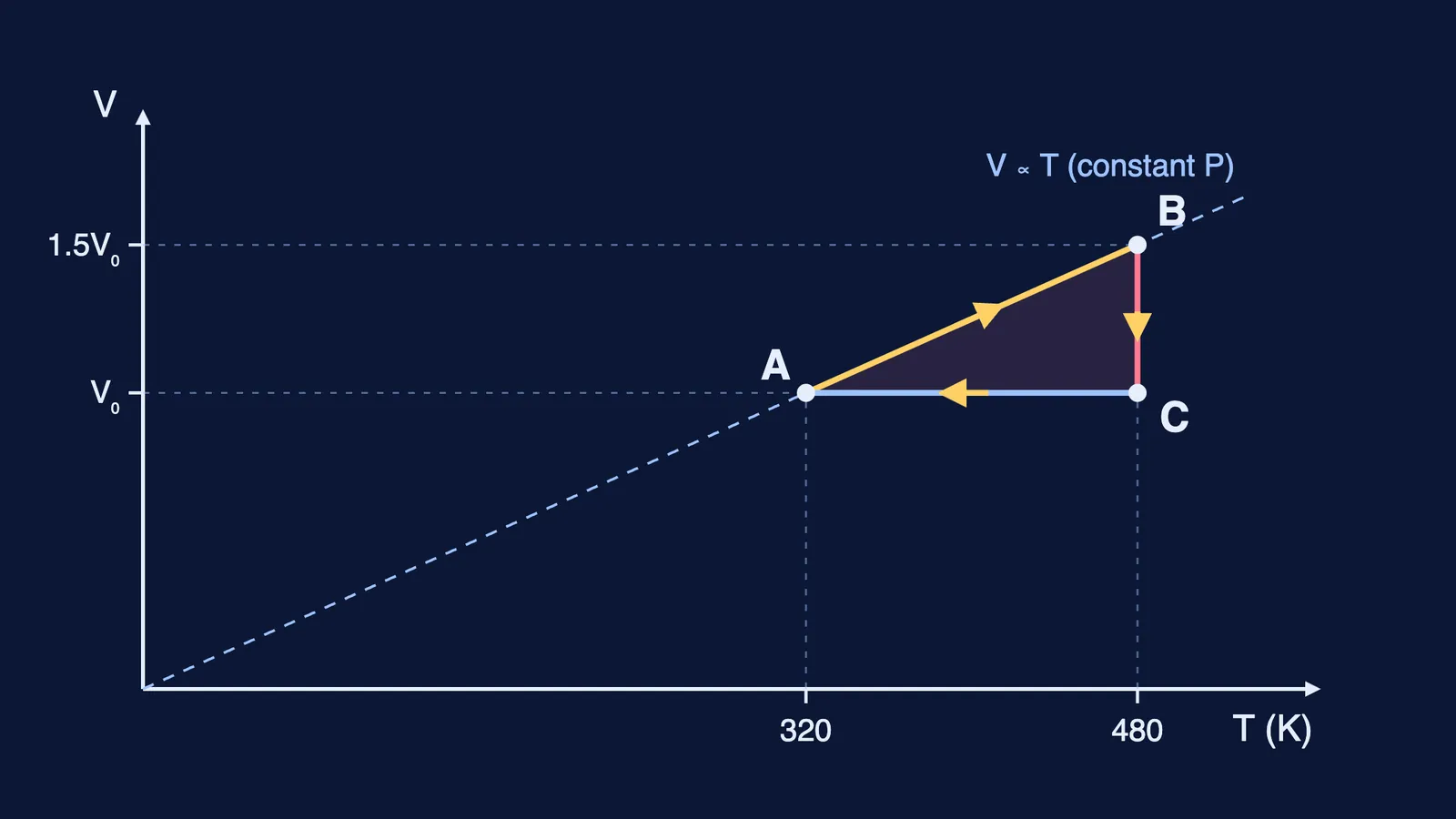
Q7 (hard). Two moles of a monatomic ideal gas run the V–T cycle in the diagram above: A (320 K, V₀) along a line through the origin to B (480 K, 1.5V₀), compressed at 480 K to C (480 K, V₀), then cooled at constant volume to A. What is the net work done by the gas per cycle?
(A) +575 J (B) −575 J (C) +2656 J (D) −3231 J
Answer: (B). A→B is isobaric: W = nRΔT = 2 × 8.3 × 160 = 2656 J. B→C is isothermal: W = nRT ln(V_C/V_B) = 2 × 8.3 × 480 × ln(2/3) ≈ −3231 J. C→A has W = 0. Net ≈ −575 J; on P–V the cycle runs anticlockwise. Trap: (A) assumes a clockwise loop means positive work on any diagram; that holds only on P–V.
Q8 (hard, numerical). A monatomic ideal gas fills 2.0 L under a light piston of area 0.010 m², with air at 1.0 × 10⁵ Pa outside and a spring (2000 N/m, initially relaxed) pressing on it. The gas is heated slowly until the piston rises 10 cm. How much heat, in joules, is supplied?
Answer: 350. Final pressure: 1.0 × 10⁵ + (2000 × 0.10)/0.010 = 1.2 × 10⁵ Pa; final volume 3.0 L. Work = against the air plus spring energy = 100 + ½ × 2000 × 0.10² = 110 J. ΔU = (3/2)(P₂V₂ − P₁V₁) = 1.5 × (360 − 200) = 240 J. ΔQ = 240 + 110 = 350 J. Trap: 340 leaves out the spring's 10 J.
What should you do after set 2?
Group your misses: process misread (Q1, Q7), missing work term (Q2, Q8), γ mixed up (Q3, Q4) or second-law limit misapplied (Q5, Q6). Redo each group after two days. For Q8-style set-ups, see our gas, piston and spring problems. For more practice, the Fermi Problem Library has worked problems with a step-by-step solver that explains the reasoning rather than printing an answer.


