

On this page
These eight original Thermodynamics questions are written for Section B of JEE Main Physics, where you type a number instead of choosing an option.
How are numerical-value questions marked in JEE Main?
The Information Bulletin for JEE (Main) 2027 gives Physics 20 multiple-choice questions in Section A and 5 numerical-value questions in Section B. You type an integer on an on-screen keypad; the answer "should be rounded off to the nearest integer". A correct answer earns +4, a wrong one −1 and a blank 0.
All eight questions stay inside Unit 8, Thermodynamics, of the Syllabus for JEE (Main) - 2027 and Chapter 11 of NCERT Class 11 Physics Part II (Reprint 2026-27). We use NCERT's ΔQ = ΔU + ΔW, ΔW done by the gas, and R = 8.3 J mol⁻¹ K⁻¹. Processes are slow unless stated; C_v is 3R/2 (monatomic) or 5R/2 (diatomic).
New to the chapter? Start with how to prepare Thermodynamics for JEE Main. For multiple-choice practice, try Thermodynamics JEE Main practice questions, set 1.
Easy: isobaric heat, a Carnot source and a heater
Q1 (easy). A diatomic ideal gas expands at a constant pressure of 1.5 × 10⁵ Pa from 4.0 L to 6.0 L. Find the heat it absorbs, in joules.
Answer: 1050. ΔW = PΔV = 1.5 × 10⁵ × 2.0 × 10⁻³ = 300 J. ΔU = (5/2)PΔV = 750 J, since PV = nRT. ΔQ = 750 + 300 = 1050 J.
Trap: 750, the rise in internal energy alone; the gas also does 300 J of work.
Q2 (easy). A Carnot engine rejects heat to a sink at 7 °C. Each cycle it takes in 1000 J and rejects 700 J. Find the source temperature in °C.
Answer: 127. Q₂/Q₁ = T₂/T₁, so T₁ = 280 × 1000/700 = 400 K = 127 °C.
Trap: 400, the kelvin value typed where the stem asks for °C.
Q3 (easy). A 50 W heater warms 2 mol of an ideal diatomic gas held at constant pressure. How many seconds does it take to raise the temperature by 30 K? Give the nearest integer.
Answer: 35. ΔQ = nC_pΔT = 2 × (7/2) × 8.3 × 30 = 1743 J. Time = 1743/50 = 34.9 s.
Trap: 25, from C_v = 5R/2.
Medium: adiabatic work, a triangular cycle and a heavy piston
Q4 (medium). A diatomic ideal gas (γ = 1.4) at 128 kPa and 1.0 L expands slowly and adiabatically to 32 L. Find the work done by the gas, in joules.
Answer: 240. P₂ = 128/32^1.4 = 1 kPa. W = (P₁V₁ − P₂V₂)/(γ − 1) = (128 − 32)/0.4 = 240 J, using kPa × L = J.
Trap: 444, the isothermal work 128 ln 32.
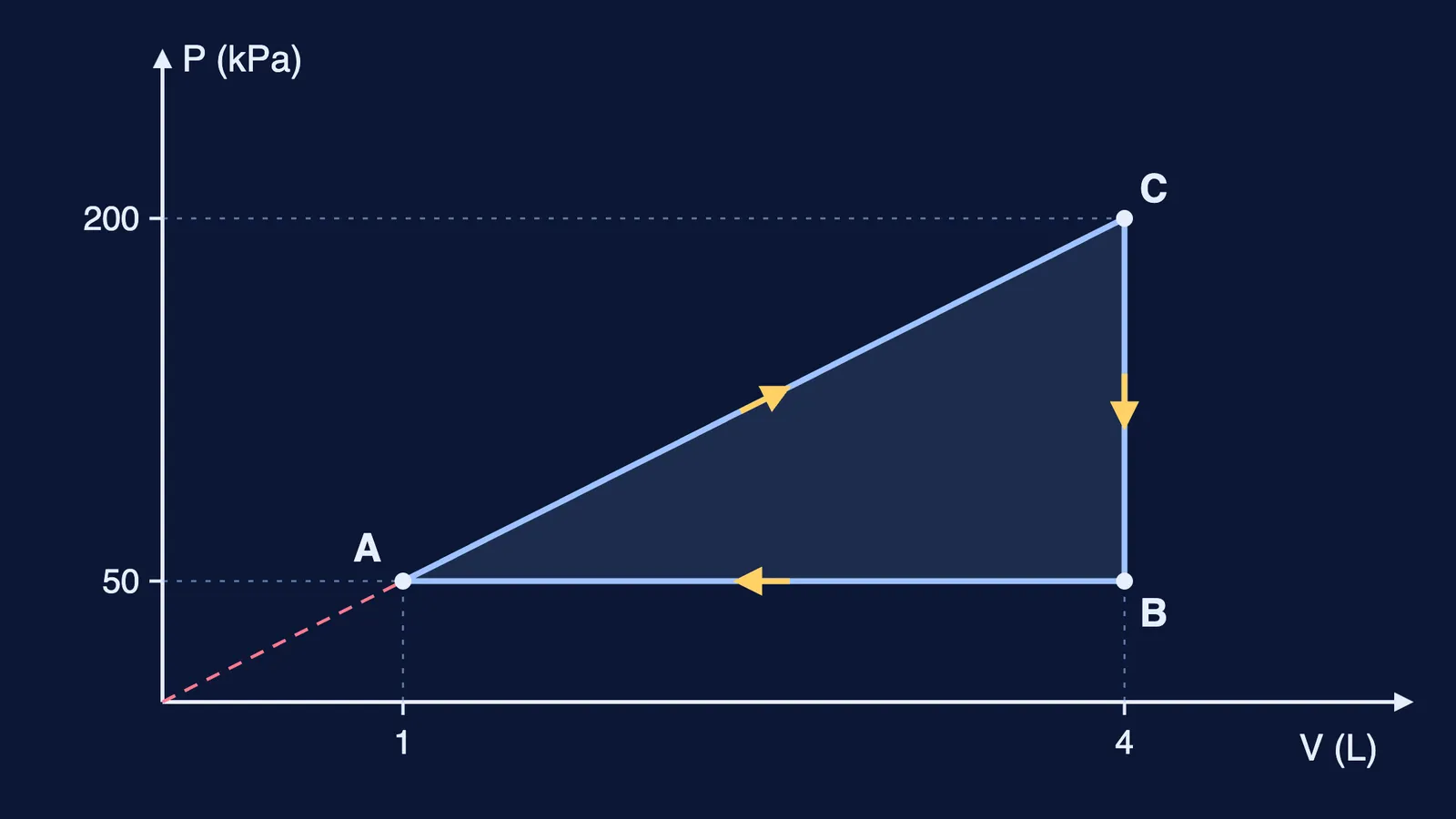
Q5 (medium). A diatomic ideal gas goes from A (50 kPa, 1 L) to C (200 kPa, 4 L) along a straight line that passes through the origin of the P–V graph, then at constant volume to B (50 kPa, 4 L), then at constant pressure back to A. Find the efficiency of the cycle, in percent.
Answer: 10. Net work = area = ½ × 3 L × 150 kPa = 225 J. Heat enters only on A→C (P ∝ V, so T keeps rising): ΔU = (5/2)(P_CV_C − P_AV_A) = 2.5 × 750 = 1875 J, and the work is the area under the line, ½ × (50 + 200) × 3 = 375 J, so ΔQ = 2250 J. Efficiency = 225/2250 = 10%.
Trap: 12, from dividing by ΔU alone and forgetting the work done along A→C.
Q6 (medium). A vertical cylinder holds a diatomic ideal gas under a 30 kg piston of area 50 cm², with air at 1.0 × 10⁵ Pa outside. The gas is heated slowly and the piston rises 10 cm. Taking g = 10 m/s², find the heat supplied, in joules.
Answer: 280. Gas pressure = 1.0 × 10⁵ + (30 × 10)/0.0050 = 1.6 × 10⁵ Pa, constant. ΔV = 0.0050 × 0.10 = 5.0 × 10⁻⁴ m³, so ΔW = 80 J. At constant pressure ΔQ = (7/2)PΔV = 280 J.
Trap: 175, which leaves out the piston's weight.
Hard: a Carnot cycle in numbers and a two-step expansion
Q7 (hard). One mole of an ideal gas runs a Carnot cycle between 450 K and 300 K. In the isothermal expansion its volume goes from 2.0 L to 4.0 L. Find the net work per cycle, in joules, to the nearest integer. Take ln 2 = 0.693.
Answer: 863. Q₁ = RT₁ ln(V₂/V₁) = 8.3 × 450 × 0.693 = 2588.4 J. Efficiency = 1 − 300/450 = 1/3, so W = 2588.4/3 = 862.8 J, which rounds to 863.
Trap: 2588, the heat taken in, not the work.
Q8 (hard). One mole of a diatomic ideal gas (γ = 1.4) at 1.0 L and 320 K expands isothermally to state B, then adiabatically until it reaches 64 L and 80 K. Find the total heat absorbed from start to finish, in joules, to the nearest integer. Take ln 2 = 0.693.
Answer: 1841. On the adiabat TV^(γ−1) is constant: 320 × V_B^0.4 = 80 × 64^0.4, so V_B^0.4 = 64^0.4/4 = 1.320 and V_B = 2.0 L. The adiabat takes in no heat, so the total is RT ln 2 = 8.3 × 320 × 0.693 = 1840.6 J, which rounds to 1841.
Trap: 11044, from putting 64 L into the isothermal log; that step ends at 2 L.
How do you get the number right in Thermodynamics?
Convert units first. kPa × L gives joules; change 50 cm² to 0.0050 m² before dividing a force by it.
Kelvin in every ratio. Carnot efficiency and TV^(γ−1) need absolute temperature; a temperature change is the same in °C and K.
Fix one sign convention. In NCERT physics ΔW is work done by the gas, so compression gives a negative ΔW. Our physics and chemistry sign conventions explainer shows both side by side.
Round once, at the end. In Q3, rounding ΔQ to 1700 J early gives 34, not 35.
Answer the quantity asked. Q2, Q7 and Q8 turn on °C versus K, work versus heat.
Is the method, not the arithmetic, the problem? The Fermi Problem Library has worked problems with a step-by-step solver that explains the reasoning rather than printing an answer.


