

On this page
Toss a book (with a rubber band round it, so it stays shut) into the air with three different spins. Spin it flat, like a pizza, and it stays flat. Spin it about its long spine and it stays clean. Flip it end over end and it almost always comes down with an extra half-twist, however carefully you throw it. A phone does the same, which is why you should practise with a book. This is the tennis-racket theorem, also called the intermediate-axis theorem or the Dzhanibekov effect. It comes straight out of moments of inertia and rotational kinetic energy.
What is the tennis-racket theorem?
Any rigid body has three principal axes, at right angles, with three moments of inertia. Call them I₁ < I₂ < I₃. The theorem says:
Spin about the axis of smallest I (I₁) is stable. A small wobble stays small.
Spin about the axis of largest I (I₃) is stable.
Spin about the intermediate axis (I₂) is unstable. A tiny wobble grows exponentially until the body flips over, and then the flip keeps repeating.
A peer-reviewed analysis by Van Damme, Mardešić and Sugny (Physica D, 2017) shows that the half-twist is a general geometric property of rigid bodies spinning about the intermediate axis, not a quirk of one racket shape. Air drag has nothing to do with it; it happens in space too.
The effect needs three different moments of inertia. A cube, a sphere or a cylinder spun about its symmetry axis does not show it, because two or more of its I values are equal.
How do you find the three moments of inertia of a phone?
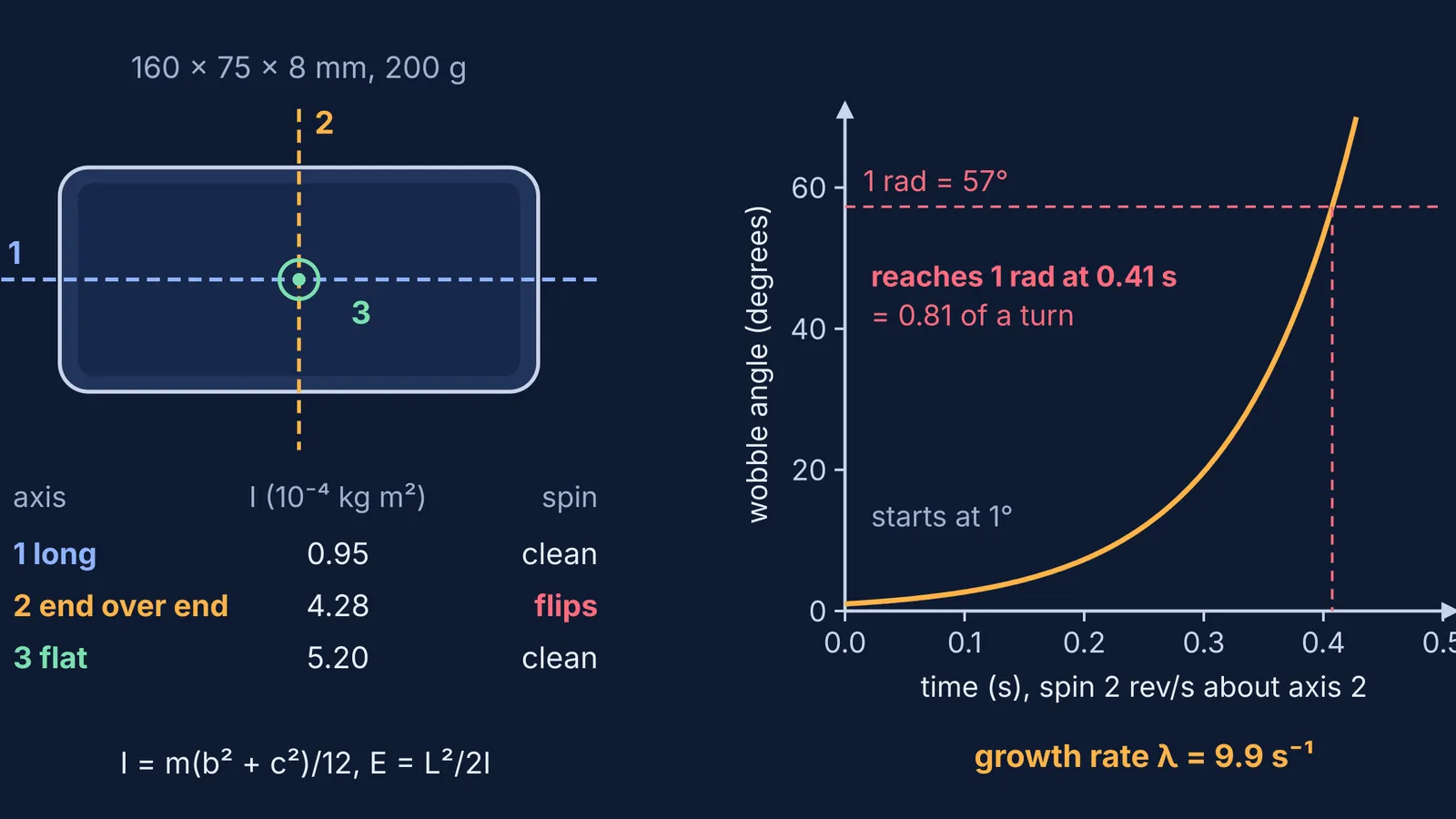
Treat a 200 g phone of 160 × 75 × 8 mm as a uniform box. For a box of sides a, b, c, the moment of inertia about the axis through the centre parallel to side a is I = m(b² + c²)/12. (Using axis theorems to get results like this is covered in parallel and perpendicular axis theorems.)
Long axis (along the 160 mm side). I₁ = 0.2 × (0.075² + 0.008²)/12 = 9.48 × 10⁻⁵ kg m².
Width axis (along the 75 mm side), the end-over-end flip. I₂ = 0.2 × (0.160² + 0.008²)/12 = 4.28 × 10⁻⁴ kg m².
Thickness axis (through the screen), the flat spin. I₃ = 0.2 × (0.160² + 0.075²)/12 = 5.20 × 10⁻⁴ kg m².
Check: for a thin flat object, the perpendicular axis theorem says I₃ ≈ I₁ + I₂ = 5.23 × 10⁻⁴, close to 5.20 × 10⁻⁴. The small gap is the 8 mm thickness. So the end-over-end flip is about the intermediate axis, and that is the throw that twists.
A real phone is not uniform (the battery is heavy), so its actual values differ a little. The order I₁ < I₂ < I₃ does not change.
Why does spin about the middle axis grow?
This part is beyond NCERT, but the idea is short. For a body spinning with no torque, Euler's equations link the angular velocity components ω₁, ω₂, ω₃ about the principal axes:
I₁ dω₁/dt = (I₂ − I₃)ω₂ω₃
I₃ dω₃/dt = (I₁ − I₂)ω₁ω₂
Spin mostly about axis 2 at rate ω, with small wobble components ω₁ and ω₃. Differentiate the first equation and substitute the second:
d²ω₁/dt² = [(I₂ − I₃)(I₁ − I₂)/(I₁I₃)] ω² ω₁.
Look at the signs. For the middle axis, I₂ − I₃ is negative and I₁ − I₂ is negative, so the bracket is positive. An equation of the form d²x/dt² = +λ²x has growing solutions, e^(λt). The growth rate is
λ = ω√[(I₂ − I₁)(I₃ − I₂)/(I₁I₃)].
Do the same for spin about axis 1 or axis 3, and one factor changes sign. You get d²x/dt² = −Ω²x, simple harmonic motion: the wobble just oscillates. That is the whole theorem in two lines of signs.
Worked example: how fast does the twist appear?
Flip the phone end over end at 2 rev/s, so ω = 2 × 2π = 12.57 rad/s.
Ratio inside the root. (I₂ − I₁)(I₃ − I₂)/(I₁I₃) = (3.33 × 10⁻⁴)(0.93 × 10⁻⁴)/(9.48 × 10⁻⁵ × 5.20 × 10⁻⁴) = 0.625.
Growth rate. λ = 12.57 × √0.625 = 9.9 s⁻¹. The wobble grows by a factor e every 0.10 s.
Start from a 1° wobble. It reaches 1 radian (57.3°) when e^(λt) = 57.3, so t = ln 57.3 ÷ 9.9 = 4.05 ÷ 9.9 = 0.41 s.
Turns completed by then. 2 rev/s × 0.41 s = 0.81 of a turn.
By then the wobble is no longer small and the phone's face flips over: the half-twist you see. Notice that λ is proportional to ω, so the number of turns before the twist does not depend on how fast you spin it. A faster flip twists sooner in seconds, but after the same fraction of a turn.
Compare the stable axes. At the same 2 rev/s, the wobble about the long axis oscillates at 1.6 per second and about the flat axis at 2.0 per second, using Ω = ω√[(I₂ − I₁)(I₃ − I₁)/(I₂I₃)] and Ω = ω√[(I₃ − I₁)(I₃ − I₂)/(I₁I₂)]. Neither grows.
Why did Explorer 1 end up tumbling?
Now let the body lose energy slowly while keeping its angular momentum L, because no outside torque acts. Rotational kinetic energy is E = ½Iω² = L²/2I. For a fixed L, E is lowest when I is largest. So a body that loses energy drifts towards spin about its axis of largest I: a flat spin.
For the phone, a spin about the long axis with the same L carries I₃/I₁ = 5.20 ÷ 0.948 = 5.5 times the energy of a flat spin. Any internal flexing that wastes energy pushes it towards the flat spin.
That is what happened to Explorer 1, the first US satellite, launched in 1958. NASA's history page says it was spun about its long axis at 750 revolutions per minute, which kept its four flexible whip antennas extended. The long axis of a pencil-shaped satellite is the axis of smallest I. The flexing whips slowly dissipated energy, and the satellite went into a tumble about an axis of largest I. Bracewell and Garriott explained the satellite's rotation in Nature in 1958, and since then spacecraft are spun about their axis of largest I or fitted with dampers. The science Explorer 1 did is covered in James Van Allen and the radiation belts. For another rotation result that looks wrong at first, see why a spinning wheel does not fall.
A 3D toss is easier to see than to read about, and the Simulation Lab has interactive simulations for ideas like this.
Quick checklist
Three principal moments I₁ < I₂ < I₃: spins about I₁ and I₃ are stable, about I₂ unstable.
Box: I = m(b² + c²)/12 about the axis parallel to the third side.
Wobble growth rate λ = ω√[(I₂ − I₁)(I₃ − I₂)/(I₁I₃)]; for the phone, 9.9 s⁻¹ at 2 rev/s.
The twist appears after a fixed fraction of a turn, whatever the spin rate.
At fixed L, E = L²/2I, so energy loss drives a body to its axis of largest I.
Bodies with two equal moments of inertia do not show the effect.


