

On this page
In 1950 the British physicist G. I. Taylor published an estimate of the energy released in the first atomic test, at Trinity, New Mexico, in July 1945. The figure was still secret. He worked it out from a series of declassified photographs of the fireball, each stamped with a time and a distance scale, and from one idea you already know from Class 11: the units on both sides of an equation must match.
What did Taylor measure from the Trinity photographs?
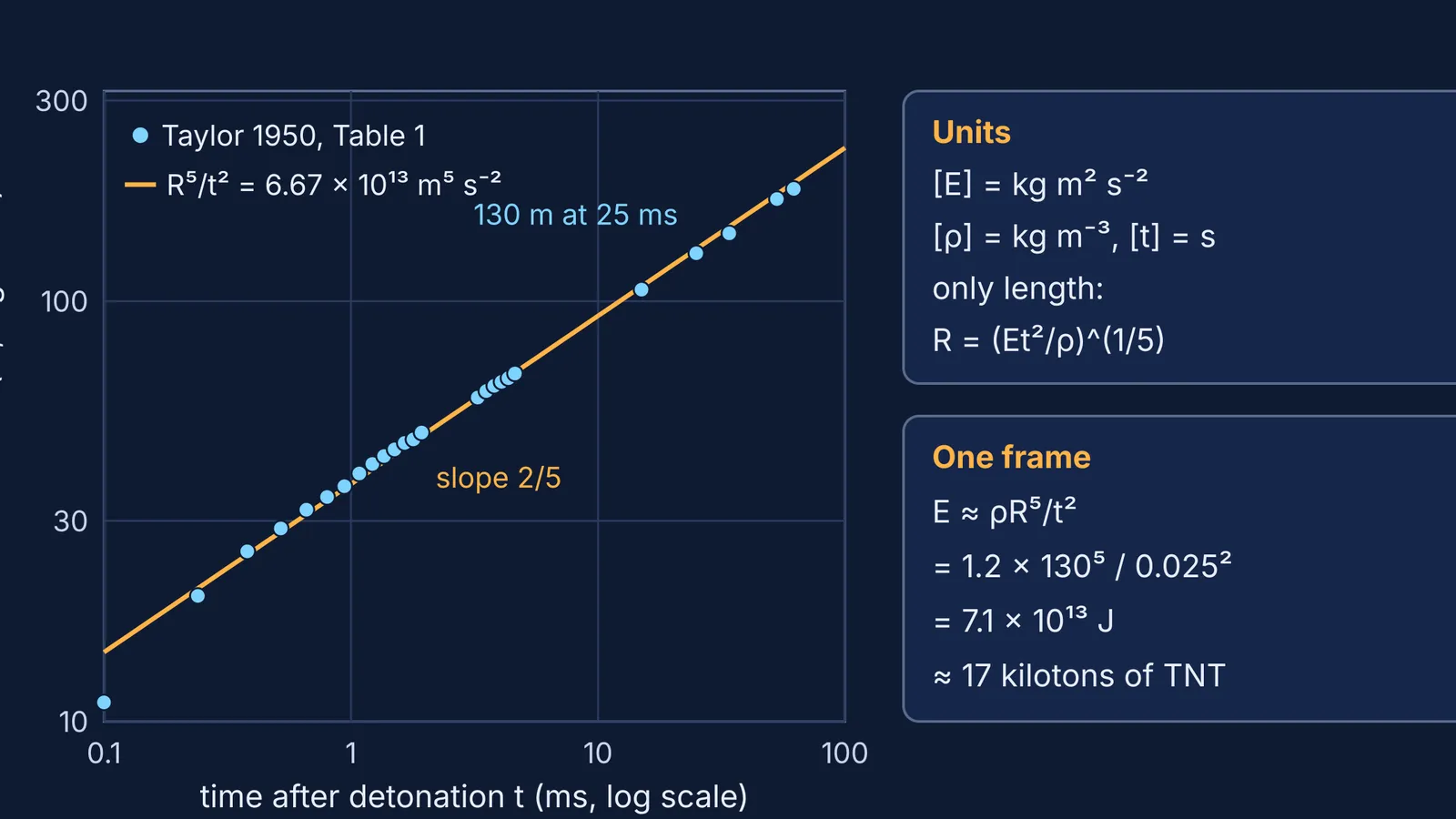
Motion-picture frames taken by J. E. Mack at the test were declassified in 1947. Each showed the fireball, the time and a distance scale. Taylor read the radius R of the fireball off 25 frames, from 0.10 ms (R = 11.1 m) to 62 ms (R = 185 m), and listed them in Table 1 of his paper. A few of his readings:
t = 1.08 ms, R = 38.9 m
t = 15.0 ms, R = 106.5 m
t = 25.0 ms, R = 130.0 m
t = 62.0 ms, R = 185.0 m
The data and the full analysis are in Taylor, Proc. Roy. Soc. A 201, 175–186 (1950). The theory behind it, written during the war, is in Part I of the same paper.
How does dimensional analysis give R = (Et²/ρ)^(1/5)?
Picture a very large energy E released almost at a point in still air. A spherical shock wave runs outwards. Early on, Taylor argued, its radius R can depend on only three things:
the energy released, E, with dimensions [M L² T⁻²]
the time since release, t, with dimensions [T]
the density of the undisturbed air, ρ, with dimensions [M L⁻³]
Normal air pressure is left out on purpose. While the blast is strong, the pressure inside the shock is far above atmospheric, so the 1 atm of the surrounding air hardly matters.
Now write R = C E^a t^b ρ^c, with C a pure number, and match the powers of M, L and T. If you want the general method first, see how to derive a formula using dimensional analysis.
Mass: a + c = 0.
Length: 2a − 3c = 1.
Time: −2a + b = 0.
From step 1, c = −a. Put that in step 2: 5a = 1, so a = 1/5 and c = −1/5.
From step 3, b = 2a = 2/5.
So R = C (Et²/ρ)^(1/5). Raise both sides to the fifth power and you get E = (1/C⁵) ρR⁵/t².
Dimensional analysis cannot tell you C. Taylor had to find it by solving the equations of gas flow behind the shock, and his value depends on γ, the ratio of the specific heats of air. For γ = 1.40 he found E = 0.856 ρR⁵/t², which means C ≈ 1.03. Why the method leaves this gap is covered in what dimensional analysis cannot find.
Worked example: how much energy does one frame give?
Take the frame at t = 25 ms with R = 130 m. Use ρ = 1.2 kg/m³ for air and set the constant to 1, which is what you would do in an exam with no other information.
Square the time. t = 0.025 s, so t² = 6.25 × 10⁻⁴ s².
Fifth power of R. 130⁵ = 3.71 × 10¹⁰ m⁵.
Divide. R⁵/t² = 3.71 × 10¹⁰ / 6.25 × 10⁻⁴ = 5.94 × 10¹³ m⁵ s⁻².
Multiply by ρ. E ≈ 1.2 × 5.94 × 10¹³ = 7.1 × 10¹³ J.
Check the units. (kg m⁻³)(m⁵)(s⁻²) = kg m² s⁻² = J. Good.
Convert to TNT. One kiloton of TNT is defined as 4.184 × 10¹² J, so E ≈ 7.1 × 10¹³ / 4.184 × 10¹² = 17 kilotons.
Taylor did it more carefully. Instead of one frame, he fitted a line through all the points and found R⁵/t² = 6.67 × 10²³ cm⁵ s⁻², which is 6.67 × 10¹³ m⁵ s⁻². With his constant 0.856 and ρ = 1.25 kg/m³ that gives E = 7.14 × 10¹³ J, which he quoted as 16,800 tons of TNT.
The same law predicts how fast the fireball grows. With E = 7.1 × 10¹³ J it gives R = 36 m at 1 ms, 90 m at 10 ms and 106 m at 15 ms, where Taylor measured 106.5 m. Since R ∝ t^(2/5), the radius grows only 3.6 times between 1 ms and 25 ms, and doubling the energy makes the fireball only 2^(1/5) = 1.15 times wider at the same moment.
Why does a small error in the radius matter so much?
E depends on R⁵. A 4% error in reading the radius becomes 1.04⁵ = 1.22, a 22% error in energy. Read the 25 ms frame as 140 m instead of 130 m, an 8% change, and the one-frame estimate jumps from 17.0 to 24.7 kilotons.
This is why Taylor fitted all 25 points. Plotting (5/2) log R against log t, he found a straight line of slope 1, which is the same as R⁵ ∝ t². That check made the scaling law believable.
How close was Taylor's answer to the official yield?
Los Alamos's own account says the yield announced in 1945 was 18.6 kilotons and that a 1963 review raised it to 21 kilotons. In 2021 a team led by Susan Hanson re-measured fused sand samples from the site and arrived at 24.8 ± 2 kilotons, as described by Los Alamos National Laboratory.
Taylor's 16,800 tons was low by about a third against the current figure, but it had the right size. He noted that his answer counted only the energy not radiated away from the fireball, and that a lower γ of 1.3 would raise it to 22,900 tons.
When does the formula stop working?
When the blast weakens. The law assumes the shock pressure is far above atmospheric. Spread 7.1 × 10¹³ J over a sphere of radius 130 m and the average energy density is about 7.7 × 10⁶ J/m³, roughly 76 times atmospheric pressure. By the time the shock has spread much further, air pressure can no longer be ignored and the R ∝ t^(2/5) line bends.
Very early. Taylor's first point, at 0.10 ms, sits off the line, because the fireball had not yet settled into a smooth sphere.
This is a different kind of estimate from the one Enrico Fermi made at the same test by watching scraps of paper drift in the blast, covered in how physicists make Fermi estimates. If you want to practise dimension-matching problems with each step explained, try the Fermi Problem Library, a step-by-step solver that explains the reasoning.
Quick checklist
The radius of a strong blast depends only on E, t and ρ.
Matching M, L and T gives R = C (Et²/ρ)^(1/5), so E ≈ ρR⁵/t².
Dimensional analysis cannot give C; Taylor computed it (about 1.03 for γ = 1.40).
One frame, R = 130 m at 25 ms, gives about 7.1 × 10¹³ J, or 17 kilotons.
A 4% error in R is a 22% error in E.
The law fails once the shock is weak enough for air pressure to matter.


