

On this page
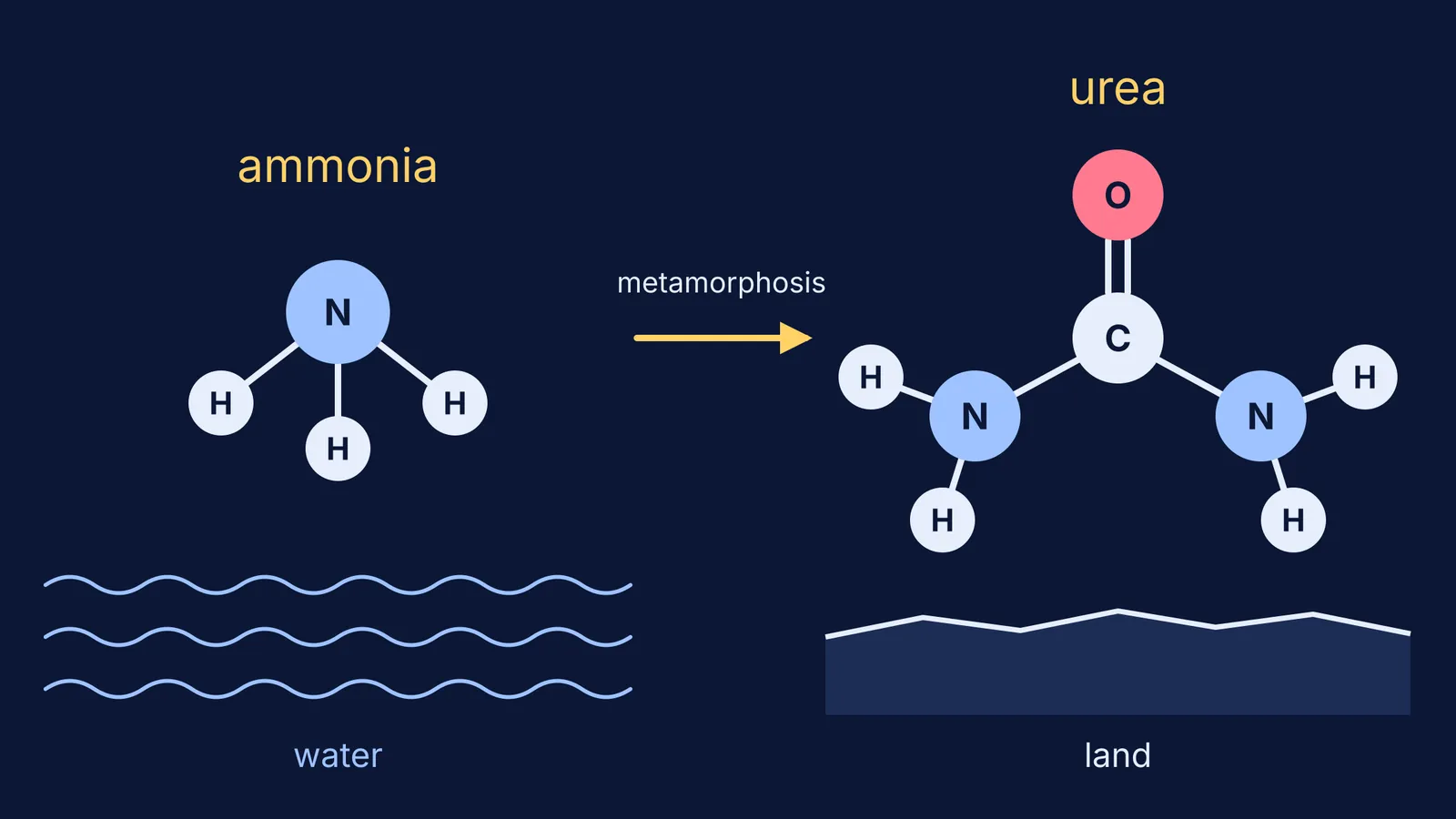
A tadpole and the frog it grows into are the same animal, but they get rid of nitrogen in different chemical forms. The tadpole releases ammonia; the adult land frog makes urea. The reason is water: how much the animal has around it, and how much it can afford to lose.
Why does a tadpole excrete ammonia?
When an animal breaks down proteins, the leftover nitrogen first appears as ammonia. The NCERT Class 11 Biology chapter on excretion puts the problem plainly: "Ammonia is the most toxic form and requires large amount of water for its elimination" (NCERT Chapter 16, Excretory Products and their Elimination).
Ammonotelism is the process of excreting ammonia; NCERT lists many bony fishes, aquatic amphibians and aquatic insects as ammonotelic. Because ammonia is readily soluble, it is generally excreted by diffusion across body surfaces (or gills, in fish) as ammonium ions, and NCERT notes that the kidneys play no significant role.
That suits a tadpole: surrounded by pond water, it loses nothing by washing ammonia away. A 2022 study in Ecology and Evolution describes this as the normal pattern: "Most aquatic vertebrates excrete nitrogen in the form of cheap, water-soluble ammonia" (Méndez-Narváez and Warkentin, 2022).
Why does an adult frog excrete urea instead?
On land, the same approach becomes dangerous. Méndez-Narváez and Warkentin explain that living on land raises the risk of dehydration, and the need to save water creates a waste-disposal problem that increases the risk of ammonia toxicity.
Urea solves this. NCERT notes that "terrestrial adaptation necessitated the production of lesser toxic nitrogenous wastes like urea and uric acid for conservation of water", and that in ureotelic animals ammonia is converted into urea in the liver, released into the blood, then filtered and excreted by the kidneys (NCERT Class 11 Biology, Chapter 16). NCERT lists mammals, many terrestrial amphibians and marine fishes as animals that mainly excrete urea.
The general rule comes from a 1995 review by P. A. Wright: "A major factor in determining the mode of nitrogen excretion is the availability of water in the environment" (Wright, Journal of Experimental Biology, 1995). For frogs, the 2022 study adds that in most frogs a high capacity for urea synthesis "seems to be acquired at metamorphosis, congruent with the developmental and physiological transition from water to land" (Méndez-Narváez and Warkentin, 2022).
What switches the tadpole over to making urea?
The switch is part of metamorphosis, which is driven by thyroid hormone (see our explainer on how thyroxine and iodine trigger frog metamorphosis). In 1960, Woon Ki Paik and Philip Cohen reported that thyroxine speeds up the synthesis of carbamyl phosphate synthetase in the liver of bullfrog tadpoles, Rana catesbeiana (Paik and Cohen, Journal of General Physiology, 1960). This enzyme is one of the liver enzymes that build urea.
A 1965 study saw the same thing in the Mexican axolotl: inducing metamorphosis with a thyroid hormone shifted it from a mix of ammonia and urea to complete ureotelism, with a rise mainly in carbamoyl phosphate synthetase (Mora and colleagues, Biochemical Journal, 1965). For the cycle itself, see Hans Krebs and the urea cycle.
Habitat, water and waste: the pattern in one list
Read each line as habitat, then water availability, then main waste.
Tadpole: pond water; plenty of water; ammonia (NCERT: aquatic amphibians are ammonotelic).
Adult frog that lives mostly on land: land and damp places; water must be saved; urea (NCERT: many terrestrial amphibians are ureotelic).
Adult African clawed frog, Xenopus laevis, in fresh water: fully aquatic; plenty of water; ammonia (Peña-Villalobos and colleagues, Biology Open, 2016).
Xenopus in salty water or during aestivation: hard to hold on to water; urea (same 2016 study).
Nest-dwelling larvae of the frog Leptodactylus fragilis: on land, in a nest that can dry out; urea, which rose under dry conditions (Méndez-Narváez and Warkentin, 2022).
How should you write this answer in an exam?
Use three steps, in this order:
Name the waste: tadpoles are ammonotelic (ammonia), adult frogs are ureotelic (urea).
Give the property: ammonia is the most toxic and needs a lot of water to remove; urea is less toxic and saves water.
Link it to habitat and timing: water for the tadpole, land for the frog, and the switch at metamorphosis.
A model three-mark answer: "A tadpole lives in water and excretes ammonia, which is highly toxic but very soluble, so it diffuses out into the surrounding water. At metamorphosis, thyroid hormone increases urea-making enzymes in the liver. The adult frog spends much of its time on land, where water must be conserved, so it converts ammonia into less toxic urea, which the kidneys excrete with less water loss."
For the full comparison with uric acid in birds and reptiles, read our guide to ammonotelic, ureotelic and uricotelic animals.
If these terms still blur together, the Fermi Concept Library gives every biology concept its own lesson and its place in the map. If you are unsure where to start on the whole excretion chapter, Fermi's AI tutor can work out what you already know and build a plan for the session.


