

On this page
The textbook route to a new species is a split: a mountain range or a sea divides a population, and the halves drift apart over many generations. Plants have a shortcut: a change in chromosome number can produce a plant that cannot breed with its parents, though it grows in the same field. The wheat in your roti is one of the clearest examples.
What is sympatric speciation by polyploidy?
Sympatric speciation is "the process through which new species evolve from a single ancestral species while inhabiting the same geographic region", in the words of this open biology textbook chapter on sympatric speciation/18%3A_Evolution_and_the_Origin_of_Species/18.02%3A_Formation_of_New_Species/18.2E%3A_Sympatric_Speciation). Polyploidy means having more than two complete sets of chromosomes. The same chapter separates two kinds:
Autopolyploidy: the extra sets come from the same species, for example when chromosomes double but the cell does not divide.
Allopolyploidy: the sets come from two different species, usually a hybrid whose chromosome number then doubles.
Why is the result a new species? A polyploid's gametes carry a different chromosome number from its parents' gametes, so they are incompatible. The new plant can still self-pollinate or breed with polyploids that share its number. Reproductive isolation appears without any barrier on the map. Our explainer on aneuploidy vs polyploidy shows how a cell gains whole extra sets.
This is not rare. A 2009 study in PNAS by Troy Wood, Loren Rieseberg and colleagues estimated that 15% of flowering-plant and 31% of fern speciation events are accompanied by an increase in ploidy.
How did bread wheat become a new species?
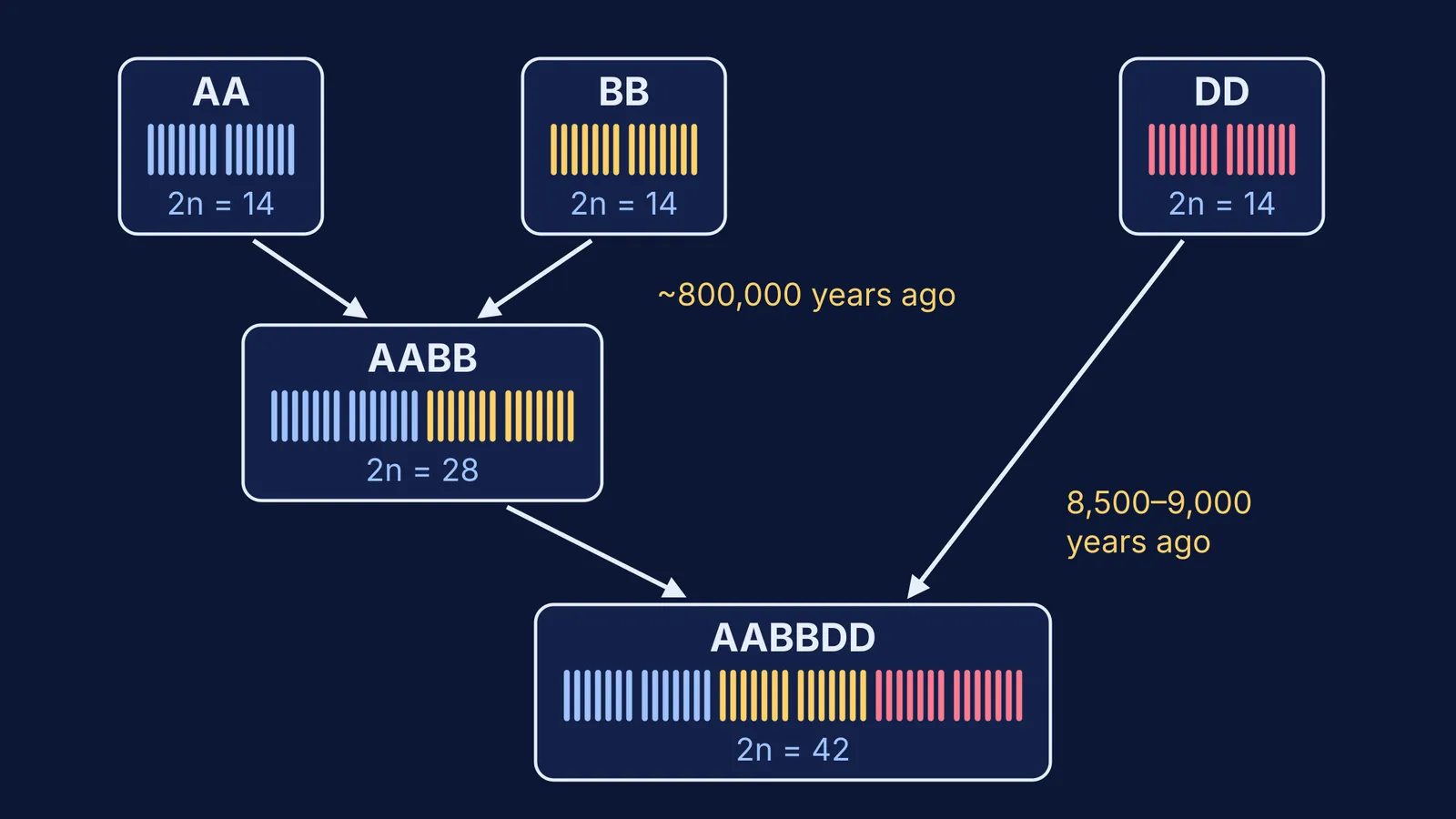
Bread wheat (*Triticum aestivum*) carries three genomes, A, B and D, and has 2n = 6x = 42 chromosomes, according to a 2022 review in The Plant Cell by Avraham Levy and Moshe Feldman. The review describes two rounds of hybridisation and doubling:
About 800,000 years ago, two wild diploid grasses (2n = 14 each) hybridised to form tetraploid wild emmer wheat, AABB, with 2n = 28.
After people domesticated tetraploid wheat, it hybridised with the wild grass *Aegilops tauschii* (DD, 2n = 14). The result, AABBDD, is bread wheat, formed only 8,500–9,000 years ago.
No mountain or sea separated the new plant from its parents. A 2014 Science paper adds that the D genome itself arose from an ancient hybrid between the A and B lineages, so bread wheat is the product of several rounds of hybrid speciation.
Is polyploid speciation still happening?
Yes, and botanists have watched it. A 2022 paper in Taxon by Douglas Soltis, Pamela Soltis and colleagues recounts how, in 1950, the botanist Ownbey described two new species of goatsbeard, *Tragopogon mirus* and *T. miscellus*, from the Palouse region of eastern Washington and adjacent Idaho in the USA. Both are allotetraploids whose diploid parents were introduced from Europe.
The same paper says they could not have formed before about 1930, roughly 90 years or 45 generations before it was written. It reports that there may be as many as 21 separate origins of *T. miscellus* and 11 of *T. mirus* in the Palouse alone, and that some populations only 1–2 kilometres apart in the same small city formed independently. That is speciation within a human lifetime, with both parents growing nearby.
How is it different from allopatric speciation?
In allopatric speciation, populations become geographically separated, which stops the flow of alleles between them, as this textbook chapter on allopatric speciation explains. Its example is the northern and Mexican spotted owls. To watch the separation build up, read what a geographic isolation speciation simulation reveals.
Set the two side by side:
What starts it: allopatric needs a barrier dividing a population (vicariance) or a few members moving away (dispersal); polyploidy needs only a change in chromosome sets.
What isolates it: allopatric relies on differences piling up over time; polyploidy on mismatched chromosome numbers from the start.
Speed: allopatric is usually slow; the goatsbeard species formed within a human lifetime.
Examples: spotted owls for allopatric; bread wheat and goatsbeard for polyploidy.
How do you explain it in an exam answer?
Count chromosomes. Here is the wheat case as a worked example:
Tetraploid wheat, AABB (2n = 28), makes gametes AB with 14 chromosomes.
*Aegilops tauschii*, DD (2n = 14), makes gametes D with 7.
Their hybrid is ABD with 21 chromosomes: one copy of each set, so its chromosomes have no partners to pair with at meiosis.
Doubling gives AABBDD with 42 chromosomes. Every chromosome now has a partner, and the plant can breed with others like it.
Test the barrier: a bread wheat gamete (ABD, 21) plus a tetraploid gamete (AB, 14) gives 35 chromosomes, with the D set unpaired. That mismatch makes such hybrids poorly fertile, which helps keep the species apart.
A full answer then has four parts:
A one-sentence definition of sympatric speciation.
The mechanism: hybridisation plus doubling (allopolyploidy) or doubling within one species (autopolyploidy).
Why it isolates (incompatible gametes), with numbers such as 14, 28 and 42 in wheat.
One line contrasting it with allopatric speciation.
If meiosis feels shaky, the Fermi Concept Library gives each biology concept its own lesson and its place in the map. Or bring the topic to Fermi's AI tutor, which works out what you already know and builds a plan for the session.


