

On this page
Mark eight dots on paper, not all in a row. However you place them, some straight line passes through exactly two dots and no third. That guarantee is the Sylvester–Gallai theorem.
What is the Sylvester–Gallai theorem?
The Sylvester–Gallai theorem states that every finite set of points in the plane, not all on one line, has a line passing through exactly two of the points. Such a line is called an ordinary line.
J. J. Sylvester posed it as a problem in 1893. Eberhard Melchior proved an equivalent version in 1941, but Paul Erdős, unaware of that proof, raised the problem again in 1943, and Tibor Gallai published a proof in 1944 (history in the same article).
Both conditions matter. "Finite" rules out the whole plane, where every line holds infinitely many points. "Not all on one line" rules out the case where the only line contains every point.
How does Kelly's shortest-distance proof work?
The best-known proof, by Leroy Milton Kelly, argues from the smallest distance in the picture. Aigner and Ziegler's Proofs from THE BOOK singles it out as the best of the many known proofs (source). Call a line through at least two of the points a connecting line.
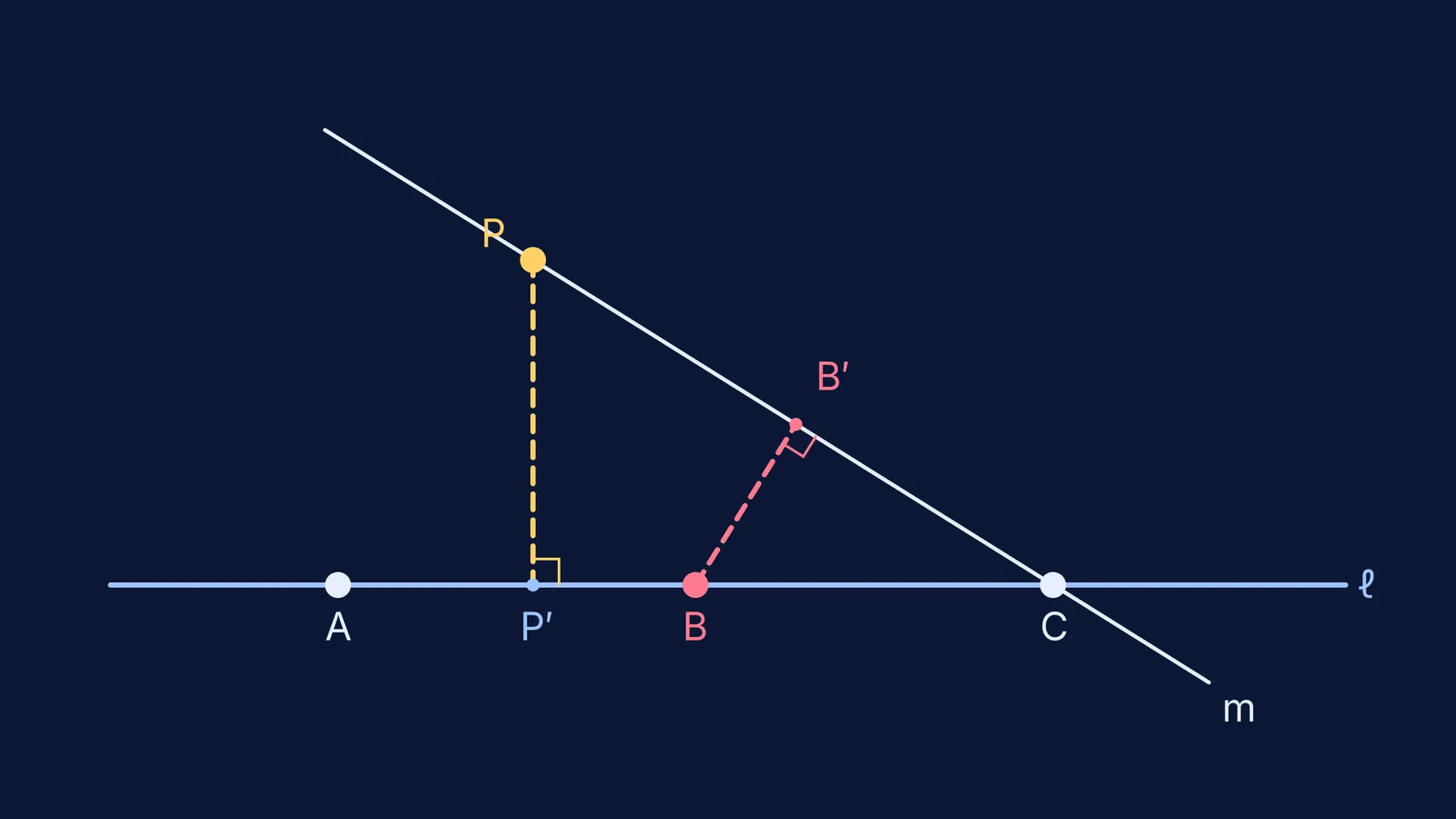
Look at every pair of a point P and a connecting line not through P. There are finitely many, and at least one. Pick the pair (P, ℓ) with the smallest distance.
Suppose ℓ holds three or more points. Drop a perpendicular from P to ℓ, meeting it at P′. Three points, two sides of P′: two of them, B and C, are on the same side, with B nearer to P′ (B may sit at P′).
Draw the connecting line m through P and C. Drop a perpendicular from B to m, meeting it at B′.
Triangles PP′C and BB′C are both right-angled and share the angle at C, so they are similar, and BB′/PP′ = BC/PC. Since BC is at most P′C, and P′C is shorter than the hypotenuse PC, BB′ is shorter than PP′.
So B and m are closer than P and ℓ, contradicting step 1. The line ℓ must hold exactly two points.
The key is the extremal move: pick the smallest thing, then show a counterexample would give something smaller. For other results that guarantee structure in any arrangement, see why six people always contain three friends or three strangers and the Erdős–Szekeres theorem on monotone subsequences.
Why does the theorem fail over complex numbers?
The Hesse configuration is a set of 9 points and 12 lines with three points on every line and four lines through every point. Every two of its points lie on one of the 12 lines, so every line through two points also passes through a third, and there is no ordinary line at all.
It cannot be drawn with real coordinates, but it exists in the complex projective plane as the 9 inflection points of a cubic curve and the 12 lines through triples of them (source).
You can check its pattern on a noughts-and-crosses board: the 9 squares are the points, and the 12 lines are the rows, columns and diagonals, counting "broken" diagonals that wrap around the edges. There are 36 pairs of squares, and 12 lines with 3 pairs each also make 36, so every pair is covered exactly once.
Kelly's proof breaks at step 2. "The same side of P′" needs order, and a complex line behaves like a real plane, so a point does not split it into two sides. The complex version still holds one dimension up: in 1986 Kelly proved that any such configuration in complex space must lie in a single complex plane, so in three complex dimensions, points not all in one plane always have an ordinary line (Kelly, Discrete & Computational Geometry).
How many ordinary lines must there be?
Melchior's proof already gives at least three ordinary lines (source). For n points, Csima and Sawyer proved at least 6n/13 in 1993, except when n is 7.
Ben Green and Terence Tao showed that for large n there are at least n/2 ordinary lines, confirming a conjecture of Dirac and Motzkin (Green and Tao, On sets defining few ordinary lines).
Try it yourself
Draw that seven-point triangle. The 3 sides and 3 medians each hold three points, so find the 3 ordinary lines that are left. (They join the midpoints in pairs.)
Scatter 5 points, find the closest point-and-connecting-line pair, and confirm that line holds only two points.
Revise how complex numbers test whether points are collinear.
If a step like the similar triangles feels shaky, the Fermi Concept Library gives every mathematics concept its own lesson. For practice, the Fermi Problem Library has worked problems with a step-by-step solver that explains the reasoning rather than printing an answer.


