

On this page
A JEE-style question rarely stops at solving sin 2x = cos x. It asks how many solutions lie in [0, 2π], or what they add up to. The method never changes: list the solutions from the general solution, count them inside the interval, then add them, pairing mirror images where you can.
How do you list solutions from the general solution?
NCERT's Class 11 chapter on trigonometric functions states that sin x = 0 implies x = nπ, and cos x = 0 implies x = (2n + 1)π/2, where n is any integer. The same chapter notes that sine and cosine repeat after an interval of 2π, and tangent after an interval of π.
To list solutions in an interval, turn the interval into an inequality on n.
Take sin 3x = 0. Then 3x = nπ, so x = nπ/3. For x in [0, 2π] you need 0 ≤ nπ/3 ≤ 2π, so 0 ≤ n ≤ 6. That is 7 integers and 7 solutions: 0, π/3, 2π/3, π, 4π/3, 5π/3 and 2π.
How do you count solutions in [0, 2π] or [−π, π]?
Count integers, not sketches. With the general solutions from the NCERT chapter, three things change the count:
Brackets. In the open interval (0, 2π), sin 3x = 0 allows only n = 1 to 5: 5 solutions, not 7.
The interval. In [−π, π], the bounds become −3 ≤ n ≤ 3: again 7 solutions, but different ones.
Undefined points. If the equation contains tan x or a fraction, drop values where it is undefined, such as x = π/2 for tan x.
How do you find the sum of all solutions quickly?
When the solutions are equally spaced, use the arithmetic-progression sum: count × (first + last)/2. For sin 3x = 0 in [0, 2π], that is 7 × (0 + 2π)/2 = 7π.
Otherwise, pair them by symmetry on the unit circle from the NCERT chapter. For a nonzero k strictly between −1 and 1, with α the principal value:
cos x = k: α and 2π − α in [0, 2π], summing to 2π; α and −α in [−π, π], summing to 0.
sin x = k with k > 0: α and π − α, summing to π in either interval.
sin x = k with k < 0: the sum is 3π in [0, 2π] and −π in [−π, π].
tan x = k: two solutions exactly π apart, with no free pairing, so add them directly.
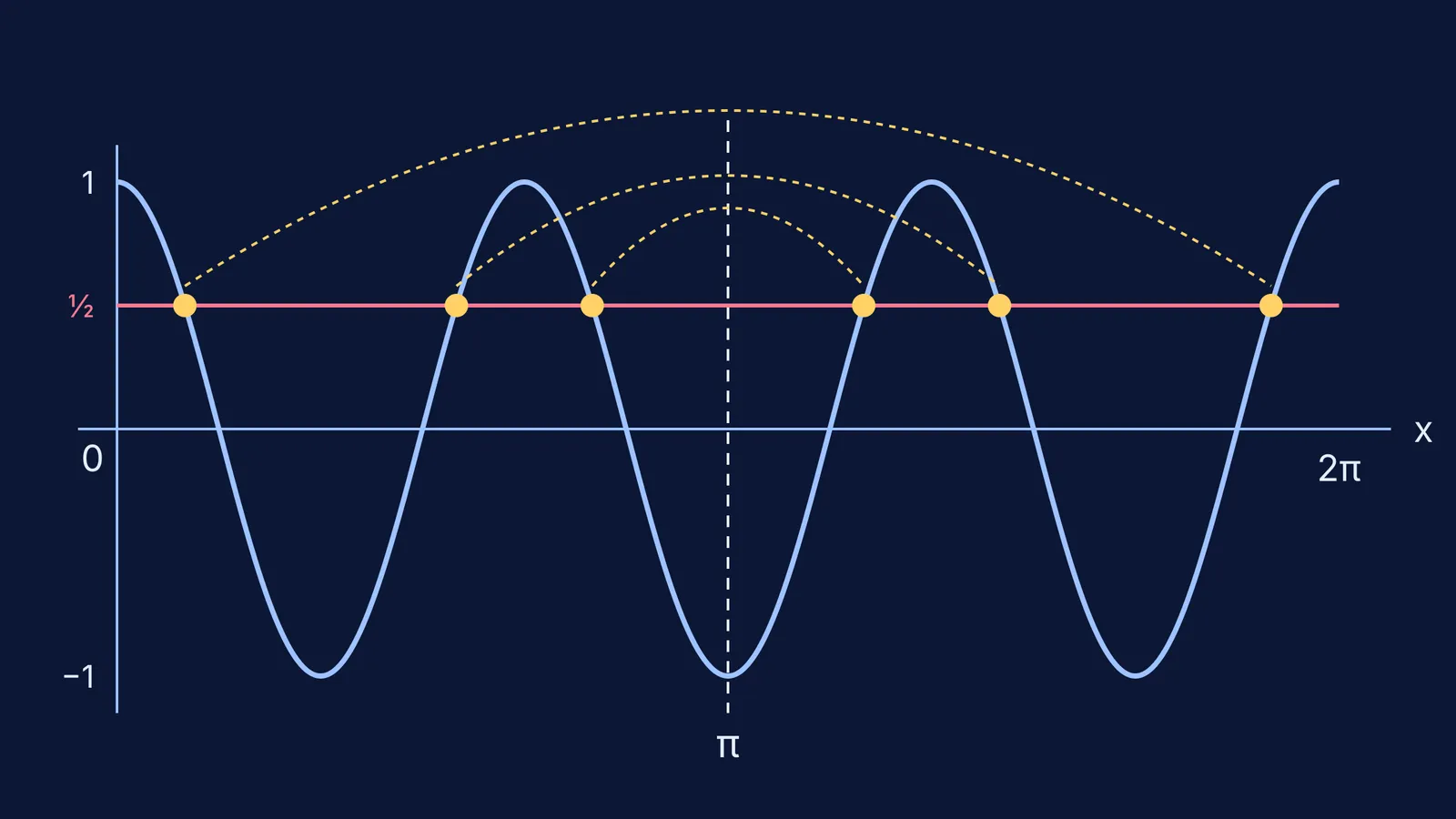
For example, cos 3x = 1/2 in [0, 2π] puts 3x in [0, 6π], so 3x is π/3, 5π/3, 7π/3, 11π/3, 13π/3 or 17π/3. That is 6 solutions, so the sum is 6π. Adding them one by one gives 54π/9 = 6π, the same answer.
A JEE-style worked example
Find the number of solutions of sin 2x = cos x in [0, 2π], and their sum. Then repeat for [−π, π].
Use sin 2x = 2 sin x cos x, so cos x (2 sin x − 1) = 0.
cos x = 0 gives x = (2n + 1)π/2: π/2 and 3π/2, a mirror pair about π with sum 2π.
sin x = 1/2 gives π/6 and 5π/6, with sum π.
Check for overlaps: where cos x = 0, sin x is ±1, never 1/2.
Answer: 4 solutions with sum 3π. Check one: at x = π/6, sin(π/3) and cos(π/6) both equal √3/2.
In [−π, π], cos x = 0 gives ±π/2 (sum 0), and sin x = 1/2 still gives π/6 and 5π/6. There are still 4 solutions, but the sum is π. Same equation, same count, different sum: read the interval twice.
What checklist works for any interval question?
Factor the equation into basic equations: sin x = k, cos x = k, tan x = k.
Write the general solution of each.
Turn the interval into bounds on n, count the integers and check the brackets.
Remove points where the equation is undefined, and duplicates shared by two factors.
Add with the progression formula or mirror pairs, then substitute one solution back to check.
If your count keeps coming out wrong and you cannot see why, the Fermi Problem Library has worked problems with a step-by-step solver that explains the reasoning rather than printing an answer, so you can find the step where a solution went missing. If the unit circle itself feels shaky, the Fermi Concept Library gives each concept its own lesson.
For the rest of the chapter, see our guide to preparing trigonometry for JEE Advanced, the Class 11 trigonometric functions guide and the 2 sin A trick for cos A cos 2A cos 4A.
Next time you see an interval, write the inequality on n before you draw anything.


