

On this page
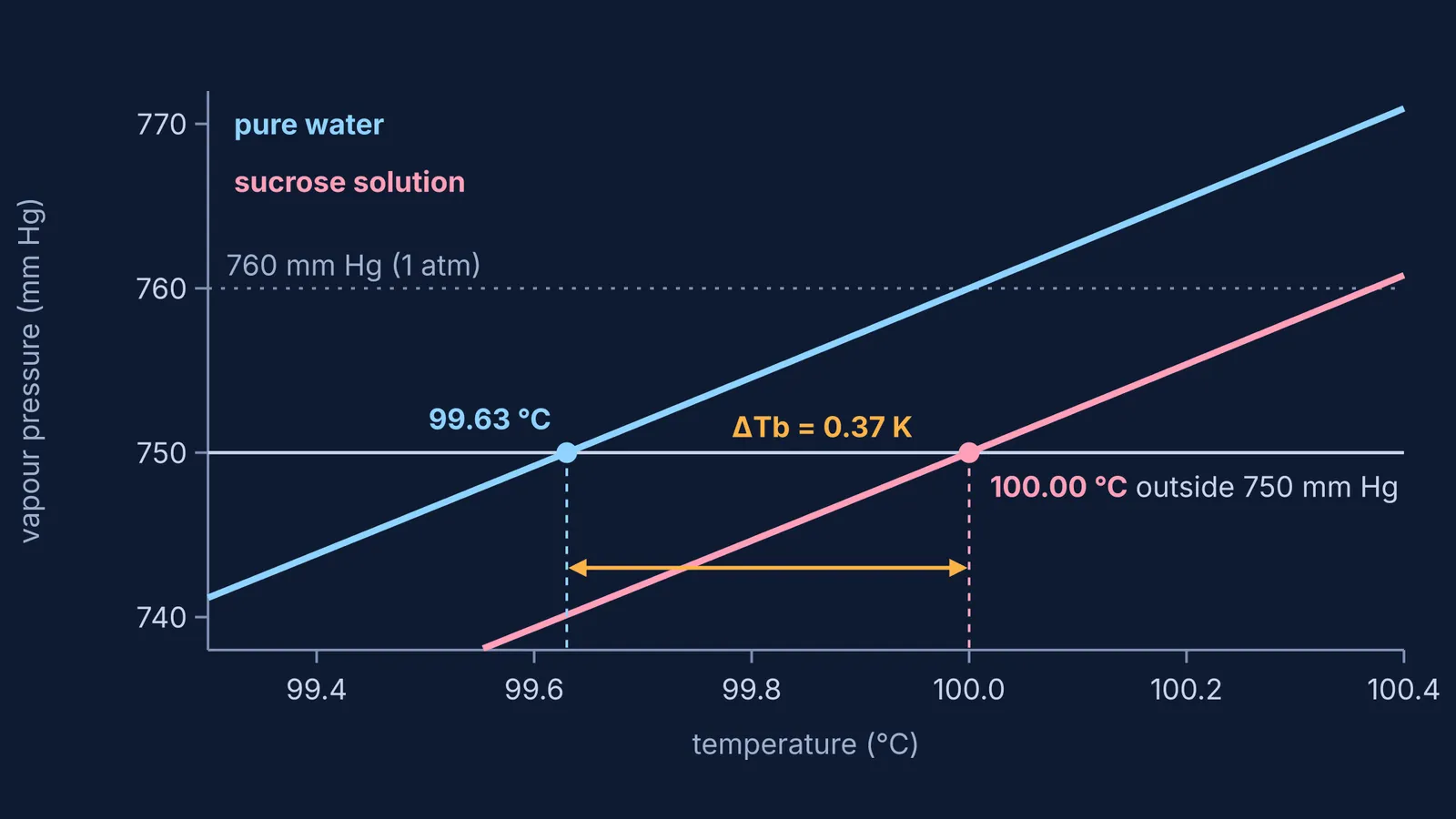
At 750 mm Hg, a little below normal air pressure, pure water boils at 99.63 °C instead of 100 °C. NCERT's Class 12 Solutions chapter asks how much sucrose you must dissolve in 500 g of this water to make it boil at exactly 100 °C again. The question is short, but it joins two ideas from different chapters that push in opposite directions. Lower pressure lowers the boiling point. A dissolved solute raises it. You need just enough solute to cancel the pressure effect.
Why does water boil below 100 °C at 750 mm Hg?
A liquid boils when its vapour pressure equals the pressure above it. Pure water's vapour pressure reaches 760 mm Hg (1 atm) at 100 °C. If the air pushes down with only 750 mm Hg, the water reaches that lower vapour pressure a little sooner, at 99.63 °C. The question gives this number, so you do not need to calculate it.
The same idea, on a much bigger scale, explains why water boils near 88 °C in Leh. Our post on why water boils at a lower temperature in the mountains works through those numbers.
How does sucrose raise the boiling point back to 100 °C?
Sucrose is non-volatile, so it adds nothing to the vapour. It dilutes the water, which lowers the vapour pressure of the solution at every temperature (Raoult's law). The solution therefore has to be heated further before its vapour pressure matches the 750 mm Hg pressing down on it. That extra heating is the elevation in boiling point:
ΔTb = i × Kb × m
Here Kb for water is 0.52 K kg mol⁻¹, m is the molality (moles of solute per kg of solvent) and i is the van 't Hoff factor. Sucrose does not dissociate in water, so i = 1.
The goal is to move the boiling point from 99.63 °C to 100.00 °C. That is ΔTb = 0.37 °C. A change of 0.37 °C is the same interval as 0.37 K, so you can use it directly with Kb.
How much sucrose is needed? A worked example
Question. Water boils at 99.63 °C under 750 mm Hg. How much sucrose (C₁₂H₂₂O₁₁) must be added to 500 g of water so that it boils at 100 °C? Kb = 0.52 K kg mol⁻¹.
Find the required rise. ΔTb = 100.00 − 99.63 = 0.37 K.
Find the molality. With i = 1, m = ΔTb/Kb = 0.37/0.52 = 0.712 mol kg⁻¹.
Use the mass of solvent in kg. 500 g of water is 0.500 kg.
Find the moles of sucrose. n = 0.712 × 0.500 = 0.356 mol.
Find the molar mass. C₁₂H₂₂O₁₁: 12 × 12 + 22 × 1 + 11 × 16 = 342 g mol⁻¹.
Convert to grams. Mass = 0.356 × 342 ≈ 121.7 g.
NCERT's answer is 121.67 g, which is what you get if you keep all the digits until the last step. Rounding m to 0.71 too early gives about 121.4 g. That is still close, but it is a reason to carry extra digits.
That is a lot of sugar: about a quarter of the mass of the water. A rise of only 0.37 K needs a fairly concentrated solution because Kb for water is small.
Can you check the answer with Raoult's law?
Yes, and it is a good habit for JEE. At 100 °C, pure water has a vapour pressure of 760 mm Hg. For the solution to boil at 100 °C under 750 mm Hg, its vapour pressure at 100 °C must fall to 750 mm Hg.
Moles of water in 1 kg. 1000/18.015 = 55.51 mol.
Mole fraction of sucrose. x = 0.712/(0.712 + 55.51) = 0.0127.
Vapour pressure of the solution at 100 °C. P = (1 − 0.0127) × 760 = 750.4 mm Hg.
That is almost exactly 750 mm Hg, so the two routes agree. They have to, because Kb itself comes from the same vapour-pressure argument. Our post on deriving Kb from the enthalpy of vaporisation shows where the 0.52 comes from.
One honest note. Kb = 0.52 K kg mol⁻¹ is the value for water boiling at 1 atm. At 750 mm Hg the boiling point is 0.37 K lower, and Kb changes by a tiny amount, far less than the precision of the data. Using 0.52 here is a standard and very small approximation.
What changes if you use salt instead of sugar?
Colligative properties depend on the number of dissolved particles, not on what they are. NaCl splits into Na⁺ and Cl⁻, so if you assume complete dissociation, i = 2.
Required molality of NaCl. m = ΔTb/(i × Kb) = 0.37/(2 × 0.52) = 0.356 mol kg⁻¹.
Moles in 0.500 kg of water. 0.356 × 0.500 = 0.178 mol.
Mass. 0.178 × 58.5 ≈ 10.4 g.
So about 10.4 g of salt does the job of 121.7 g of sugar. The ratio is about 11.7. A factor of 2 comes from i = 2, which halves the moles needed. The larger factor, about 5.8, comes from the molar mass: 58.5 g mol⁻¹ against 342 g mol⁻¹. In a real solution of this strength, NaCl behaves as if i is a little below 2 because the ions attract each other, so slightly more salt would be needed. For board and JEE answers, use i = 2 unless the question says otherwise.
For more practice with i and molality, see our boiling point elevation numericals using Kb and molality.
Which mistakes cost marks on this question?
Taking ΔTb as 100 − 99.63 but then adding it to 100 °C, as if the target were 100.37 °C.
Dividing by the mass of the solution, or by 500 instead of 0.500 kg.
Using molarity in mol L⁻¹ instead of molality in mol kg⁻¹.
Giving sucrose an i greater than 1. It is a non-electrolyte.
Writing 0.37 °C and 0.37 K as different numbers. They are the same interval.
Rounding the molality early and getting an answer a few tenths of a gram off.
If you want to work through more questions that mix two chapters like this, the Fermi Problem Library has a step-by-step solver that explains the reasoning at each stage. To see how a solute shifts the vapour-pressure curve, the Simulation Lab has interactive simulations for ideas that are easier to see than read.
Quick checklist
Lower outside pressure lowers the boiling point; a non-volatile solute raises it.
ΔTb is measured from the actual boiling point of the pure solvent at that pressure: here 99.63 °C.
ΔTb = 0.37 K, m = 0.37/0.52 = 0.712 mol kg⁻¹, n = 0.356 mol in 0.500 kg.
Sucrose (i = 1, 342 g mol⁻¹): about 121.7 g.
NaCl (i ≈ 2, 58.5 g mol⁻¹): about 10.4 g.
Raoult's law check: 760 × (1 − 0.0127) ≈ 750 mm Hg at 100 °C.


