

On this page
Walk along a lit main road at night and count your steps between poles. The gap is usually a few times the height of the pole, and that is not a coincidence. The Indian code for road lighting suggests 9 to 10 m poles for main roads and caps the spacing at about three to four times the height. You can see why with two ideas from school optics: the inverse-square law and the cosine factor for light that arrives at a slant.
What does the Indian standard say about street light spacing?
The Indian Standard for lighting public roads is IS 1944 (Parts I and II), 1970. You can read the full text in the Public.Resource.Org copy of IS 1944 Parts I and II. Three parts of it matter here.
Mounting height. Clause 8.2 says heights of 9 to 10 m generally suit the main roads it calls Group A, and 7.5 to 9 m suit Group B roads.
Spacing. Clause 8.3 says that, to keep the light even along the road, the spacing should generally not be more than 3 times the mounting height for cut-off lamps, 3.5 times for semi-cut-off lamps and 4 times for non-cut-off lamps.
Light level. Table 1 gives average levels of 30 lux for important fast traffic routes (Group A1), 15 lux for other main roads (A2) and 8 lux for busy secondary roads (B1). For A2 it asks that the minimum be at least 0.4 of the average, and for B1 at least 0.3.
A cut-off lamp hides its bulb from drivers' eyes by sending little light at low angles, so it lights a shorter patch of road and needs closer spacing. That is where the "about three times" comes from.
How much light reaches the road from one lamp?
Treat the lamp as a point source of luminous intensity I (in candela) at height h. Two things reduce the light at a point on the road a horizontal distance x away.
Distance. The slant distance is r = h/cos θ, where θ is the angle from the vertical. By the inverse-square law for light, the illuminance on a surface facing the lamp is I/r².
Slant. The road is flat, so the light hits it at angle θ to the normal. The same beam is spread over a larger area, which brings in a factor of cos θ. It is the same reason a solar panel collects most when it faces the Sun.
Put together: E = I cos θ / r² = I cos θ × cos²θ / h², so
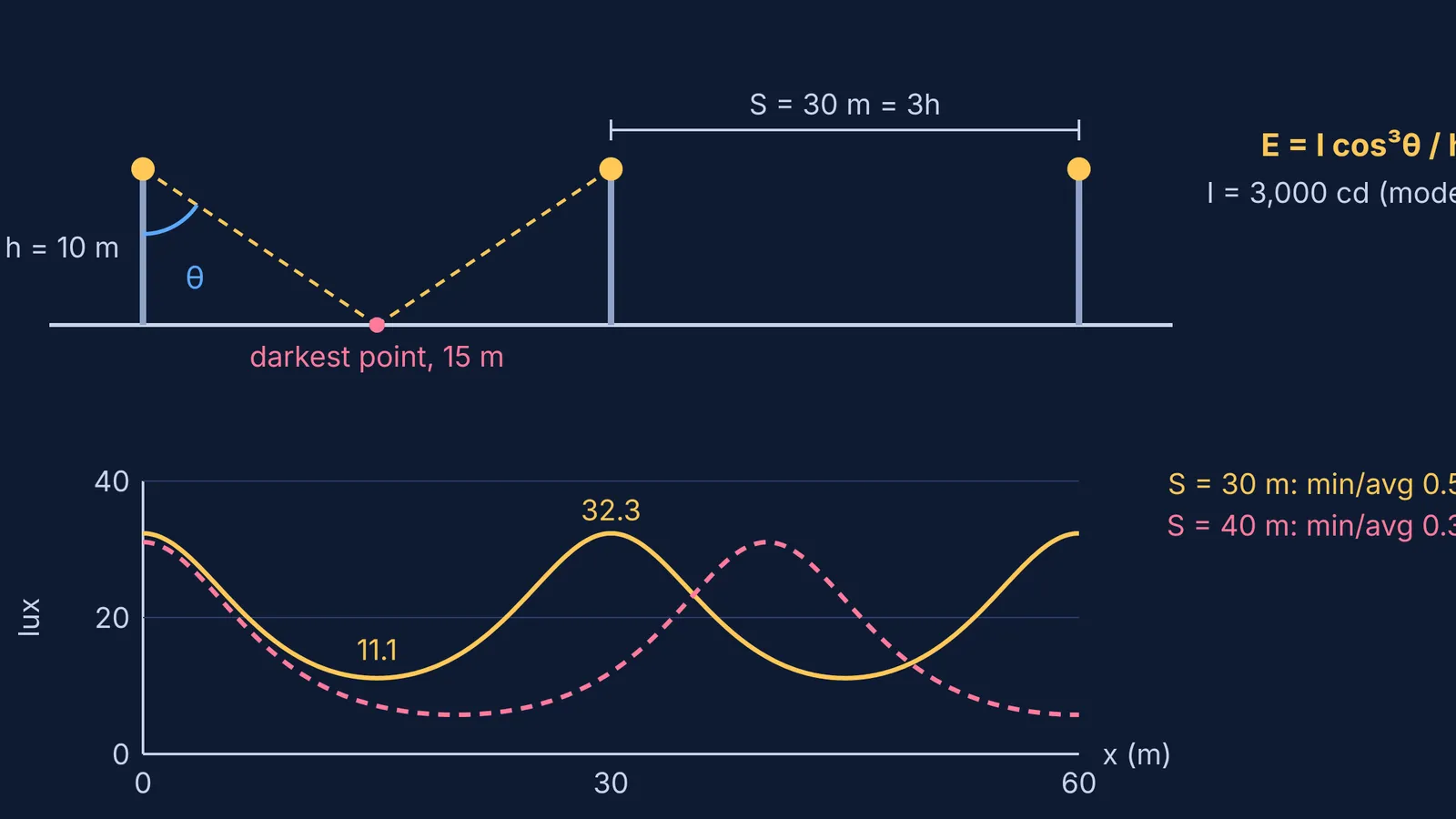
E = I cos³θ / h²
Illuminance E is in lux (lumen per square metre). Intensity I is in candela and describes light leaving the lamp in one direction. Keep the two apart: lux is about the surface, candela about the source.
Worked example: one lamp, then a row of lamps
Take an illustrative lamp that sends 3,000 cd in every downward direction, mounted 10 m high. Real street lamps have shaped beams, so this simple equal-in-all-directions lamp is a model, not a product.
Directly below. θ = 0, cos θ = 1. E = 3,000/10² = 30 lux.
15 m along the road. tan θ = 15/10, so θ ≈ 56.3° and cos θ = 10/√325 ≈ 0.555. Then cos³θ ≈ 0.171 and E ≈ 30 × 0.171 = 5.1 lux.
Check units. A candela is a lumen per steradian, and a steradian is a ratio of areas with no unit, so cd/m² here is lumen per m², which is lux. The answer drops by a factor of almost 6 for a point only 15 m away, which is why one lamp alone cannot light a road.
Add a row of lamps 30 m apart. The darkest point is midway, 15 m from the two nearest lamps. Those give 2 × 5.1 = 10.2 lux. The next two lamps, 45 m away, add about 0.6 lux. Adding all the lamps along the row gives E_min ≈ 11.1 lux.
The brightest point is right under a lamp: 30 lux from it plus a little from the neighbours, E_max ≈ 32.3 lux.
Average. The light from one lamp, added along the whole road, comes to 2I/h per metre of spacing, so E_avg = 2I/(hS) = 2 × 3,000/(10 × 30) = 20 lux.
Uniformity. E_min/E_avg = 11.1/20 ≈ 0.56.
Now change the spacing and keep everything else the same. These numbers are along the line under the lamps:
S = 20 m (2h): E_min ≈ 24.0 lux, E_avg = 30 lux, ratio 0.80.
S = 30 m (3h): E_min ≈ 11.1 lux, E_avg = 20 lux, ratio 0.56.
S = 35 m (3.5h): E_min ≈ 7.9 lux, E_avg ≈ 17.1 lux, ratio 0.46.
S = 40 m (4h): E_min ≈ 5.7 lux, E_avg = 15 lux, ratio 0.38.
S = 50 m (5h): E_min ≈ 3.3 lux, E_avg = 12 lux, ratio 0.27.
The ratio stays above 0.4 up to about 3.5h and falls below it near 4h. That matches the range the standard allows. Pushing the poles further apart saves poles but leaves dark gaps.
Why does the ratio to height matter, not the spacing alone?
Look at the formula again. The angle θ depends only on x/h. If you double both the height and the spacing, every angle in the problem stays the same, and every illuminance drops by the same factor, 4. So the shape of the bright-and-dark pattern, and the uniformity ratio, depend only on S/h. That is why a code can state one ratio for all heights.
Taller poles have a cost: for the same lamp, the light level falls as 1/h². So engineers raise the pole to spread the light more evenly and choose a brighter lamp to keep the level up.
Why are real street lamps not simple point sources?
A real luminaire has reflectors or lenses that throw more light sideways along the road than straight down. That fills in the dark midpoints, so real designs can reach good uniformity at spacings that this simple model would not allow. The cut-off design also limits light near the horizontal to reduce glare for drivers. The colour of the light is a separate story, covered in why old street lights glow yellow and make colours disappear.
Real roads add two more effects. What a driver sees is road luminance, the light reflected toward the eye, which depends on the road surface and grows patchy when the road is wet. And glare from the lamps themselves can hide an obstacle even on a well-lit road.
If you want to see how a beam spreads over a tilted surface, try it in the Simulation Lab, which has interactive simulations for ideas easier to see than read.
Quick checklist
Light on a flat road from a lamp at height h: E = I cos³θ/h².
One cos θ is for slant arrival; two come from r = h/cos θ in the inverse-square law.
Lux measures light on a surface; candela measures light leaving a source.
Average along a long row: E_avg = 2I/(hS).
Uniformity depends only on S/h, so codes state a spacing-to-height ratio.
IS 1944 caps it at 3 for cut-off, 3.5 for semi-cut-off and 4 for non-cut-off lamps.


