

On this page
If you have worked through our first set of straight lines JEE Main practice questions with solutions, here are eight new ones, medium to hard, several joining two ideas.
What does JEE Main 2027 test in straight lines?
Straight lines sit in Unit 10, Co-ordinate Geometry, of NTA's JEE (Main) 2027 syllabus, which lists forms of a line, angles between two lines, concurrency, the distance of a point from a line, and the centroid, orthocentre and circumcentre of a triangle.
The JEE (Main) 2027 Information Bulletin gives Mathematics 20 MCQs and 5 numerical-value questions in Paper 1, with +4 marks for a correct MCQ and −1 for a wrong one. Picking the trap instead of the answer costs you five marks.
Medium: can you use two line facts at once?
Q1. The lines through (1, 2) making 45° with 2x − y + 3 = 0 are: (A) 3x + y − 5 = 0 and x − 3y + 5 = 0 (B) 3x − y − 1 = 0 and x + 3y − 7 = 0 (C) x − y + 1 = 0 and x + y − 3 = 0 (D) y = 2 and x = 1
Answer: (A). With slope 2, |(m − 2)/(1 + 2m)| = 1 gives m = −3 or m = 1/3, so y − 2 = −3(x − 1) and y − 2 = (x − 1)/3. Trap: (B) uses −2 as the given slope. Check: (−3)(1/3) = −1, as the two 45° lines must be perpendicular.
Q2. Two sides of a square lie on 3x − 4y + 5 = 0 and 6x − 8y − 25 = 0. Its area is: (A) 49/4 (B) 36 (C) 49 (D) 7/2
Answer: (A). Halve the second line to 3x − 4y − 12.5 = 0, so the side is |5 + 12.5|/5 = 7/2 and the area is 49/4. Trap: (B) skips the halving, giving a side of 6. Check: (−5/3, 0) on the first line is 35/10 = 3.5 from the second.
Q3. The area of the parallelogram formed by y = 2x + 1, y = 2x + 5, y = −x + 1 and y = −x + 4 is: (A) 4 (B) 12 (C) 4/3 (D) 8
Answer: (A). For y = mx + c₁, c₂ and y = nx + d₁, d₂ the area is |(c₁ − c₂)(d₁ − d₂)/(m − n)| = |4 × 3/3| = 4. Trap: (B) forgets to divide by |m − n|. Check: the vertices (0, 1), (1, 3), (−1/3, 13/3) and (−4/3, 7/3) give 4 by the shoelace formula.
Q4. The lines x = 0, y = 0 and 3x + 4y = 24 form a triangle. The distance between its circumcentre and incentre is: (A) √5 (B) 5 (C) √2 (D) 2√5
Answer: (A). The vertices are (0, 0), (8, 0) and (0, 6). The circumcentre is the hypotenuse midpoint (4, 3); the inradius is (8 + 6 − 10)/2 = 2, so the incentre is (2, 2). Trap: (B) is the circumradius. Check: Euler's relation R(R − 2r) = 5(5 − 4) = 5.
Hard: can you mix families, locus, reflection and regions?
Q5. Among the lines (x + y − 3) + k(2x − y) = 0, k real, the one farthest from the origin is: (A) x + 2y − 5 = 0 (B) 2x + y − 4 = 0 (C) x + y − 3 = 0 (D) x − 2y + 3 = 0
Answer: (A). Every member passes through P(1, 2), where both brackets vanish. The farthest member is perpendicular to OP, at distance OP = √5. Trap: (C), the k = 0 line, is only 3/√2 ≈ 2.12 away. Check: the foot of the perpendicular from O to x + 2y = 5 is P.
Q6. A line through (2, 3) meets the axes at A and B. The locus of the midpoint of AB is: (A) 3x + 2y = 2xy (B) 2x + 3y = 2xy (C) 2x + 3y = xy (D) 3x + 2y = xy
Answer: (A). Write x/a + y/b = 1 with 2/a + 3/b = 1. The midpoint is (h, k) = (a/2, b/2), so 1/h + 3/(2k) = 1, which is 3h + 2k = 2hk. Trap: (D) uses (a, b) for the midpoint. Check: x + y = 5 has midpoint (2.5, 2.5), and 7.5 + 5 = 12.5 = 2 × 6.25.
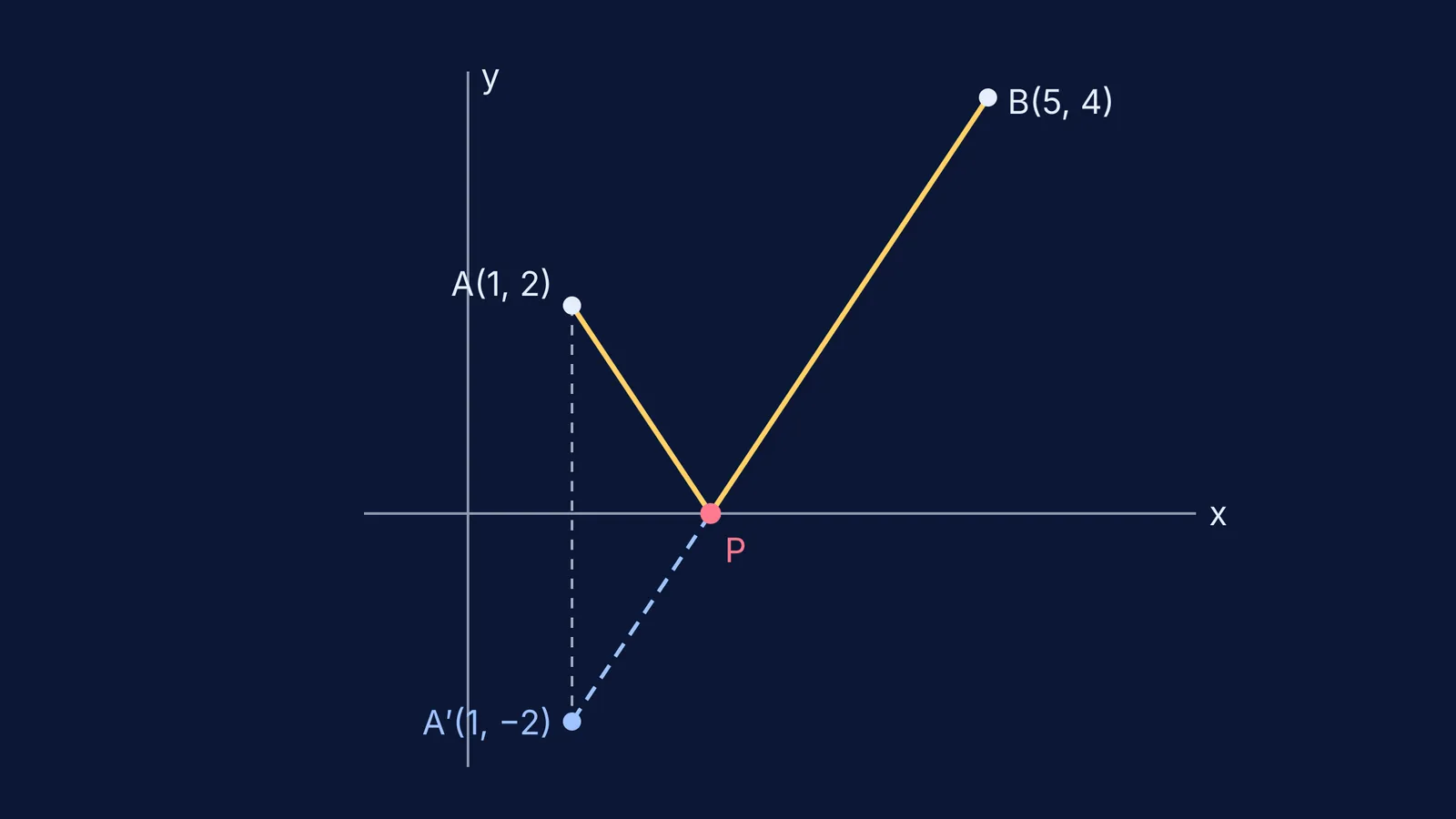
Q7. For A(1, 2), B(5, 4) and P on the x-axis, the least value of PA + PB is: (A) 2√5 (B) 2√13 (C) 6 (D) 2√10
Answer: (B). Reflect A to A′(1, −2). Then PA + PB = PA′ + PB ≥ A′B = √(16 + 36) = 2√13, with equality at P(7/3, 0). Trap: (A) is AB, which needs P on segment AB, but AB never meets the x-axis. Check: PA = √52/3 and PB = 2√52/3 add to √52.
Q8. The point (a, a²) lies strictly inside the triangle formed by y = 0, y = x and x + y = 6 exactly when: (A) 0 < a < 1 (B) −3 < a < 2 (C) 1 < a < 2 (D) 0 < a < 2
Answer: (A). With vertices (0, 0), (6, 0) and (3, 3), the inside is y > 0, y < x and x + y < 6. So a ≠ 0, a² < a (0 < a < 1) and a² + a < 6 (−3 < a < 2). Trap: (D) keeps a > 0 and a² + a < 6 but forgets the point must stay below y = x. Check: a = 1/2 gives (0.5, 0.25), inside; a = 1.5 gives (1.5, 2.25), above y = x.
How should you use this second set?
Do all eight in one sitting, without notes, and time yourself.
Label each miss: sign slip, unnormalised equation, wrong formula, or a dropped condition.
Redo the check line for each miss.
Later, try the straight lines numerical value questions and revise with our guide on how to prepare straight lines for JEE Main.
If you can follow a solution but could not have started it yourself, the Fermi Problem Library has worked problems with a step-by-step solver that explains the reasoning. For the rest of the syllabus, Fermi Test Prep is our hub for JEE Main and Advanced preparation.


