

On this page
One line in the NCERT Class 11 Biology chapter on the animal kingdom packs two rays into a single sentence: among the cartilaginous fishes, "some of them have electric organs (e.g., Torpedo) and some possess poison sting (e.g., Trygon)", according to the NCERT Animal Kingdom chapter. Here is what that sting is, why a stingray is a cartilaginous fish, and how to keep Trygon and Torpedo apart.
How does a stingray sting?
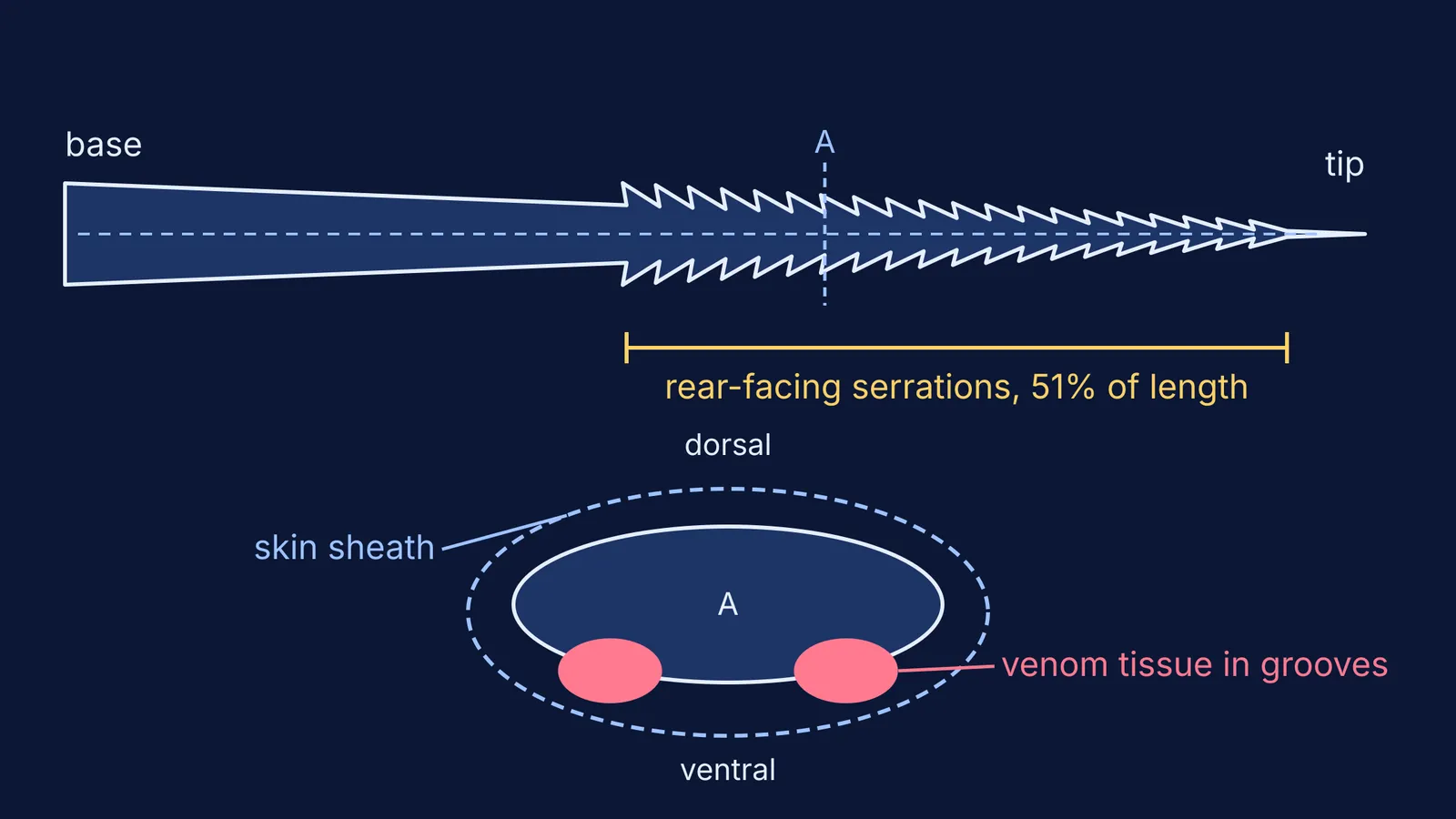
Stingrays are named for a spine on the tail, also called a caudal barb or stinger, as a 2021 study in Integrative and Comparative Biology by Shea-Vantine and colleagues, led from Florida Atlantic University, explains. The spine sits on the upper (dorsal) surface of the tail. It is flattened from top to bottom, with a sharp tip and rear-facing serrations on both sides.
The sting is a defence. When provoked, a stingray raises its tail and drives the spine into the target, or lashes the tail from side to side and cuts a slash-like wound, the same paper reports. So the spine does two jobs: it tears tissue, and it delivers venom.
The serrations are thought to make the spine hard to pull out. In the same study, spines were serrated along an average of 50.8% of their length in the Atlantic stingray and 62.3% in the bluntnose stingray. If the spine sinks in deeply, it often breaks off or comes away from the tail.
Where is the venom in a stingray's spine?
The venom tissue lies along the spine itself. Vascular venomous tissue sits in grooves along the lower sides of the spine, covered by a protective skin sheath that ruptures during a puncture and lets the venom into the wound, according to the Integrative and Comparative Biology paper. Animal Diversity Web, from the University of Michigan, describes the same layout: each spine has grooves on its underside that contain venom-producing soft tissue.
Three more facts help the NCERT line make sense:
The spines are modified placoid scales tipped with barbs, says Animal Diversity Web. Placoid scales are the same skin scales NCERT lists for all cartilaginous fishes.
The spines are constantly shed and replaced, and can reach 40 cm in length (Animal Diversity Web).
Spines are made of mineralised collagen, and a new spine grows beneath the old one and causes it to be shed (Shea-Vantine and colleagues, 2021).
Why is a stingray a cartilaginous fish?
NCERT places Trygon (sting ray) in class Chondrichthyes, alongside Scoliodon (dog fish), Pristis (saw fish) and Carcharodon (great white shark). The class features, all from the NCERT Animal Kingdom chapter, are:
a cartilaginous endoskeleton, and a notochord that persists throughout life
a ventral mouth
separate gill slits with no operculum (gill cover)
tough skin with minute placoid scales
no air bladder, so they have to swim constantly to avoid sinking
a two-chambered heart, and a body temperature that follows their surroundings (poikilothermous)
claspers on the pelvic fins of males, internal fertilisation, and many species viviparous
For the opposite trap, see why jellyfish, cuttlefish and crayfish are not fish. If the class-level features blur together, the Fermi Concept Library gives every concept in biology its own lesson and its place in the map.
How do you tell Trygon from Torpedo in NEET?
Both are rays, both are cartilaginous, and NCERT names them in the same sentence. What separates them is the weapon and where it sits.
Trygon (sting ray): a poison sting on the tail. It works by puncture plus venom, and the spine is a modified placoid scale (Animal Diversity Web).
Torpedo (electric ray): a pair of kidney-shaped electric organs at the base of the pectoral fins, on either side of the head, built from modified gill-arch muscle (Wikipedia: Electric ray).
The cells inside those organs are electrocytes, modified muscle cells stacked in columns like batteries placed end to end, explains the Australian Museum. A torpedo ray's organs hold about 45 columns of around 700 electrocytes and can produce 20 to 50 volts, the museum says.
How do you answer a Trygon and Torpedo match-the-list question?
Match List I with List II.
List I: A. Torpedo, B. Trygon, C. Pristis, D. Scoliodon
List II: 1. Dog fish, 2. Poison sting, 3. Electric organs, 4. Saw fish
Answer: A-3, B-2, C-4, D-1, all straight from the NCERT text.
Run this three-step check whenever a ray turns up:
Place the class first: rays are Chondrichthyes, so no operculum, no air bladder, placoid scales.
Name the weapon: Trygon stings, Torpedo shocks.
Locate it: the sting is on the tail, the electric organs are near the head.
That check catches the usual statement traps, such as "Trygon has an air bladder" (false) or "Torpedo is a bony fish with an operculum" (false). For more practice in this format, try our set of Animal Kingdom NEET statement and match-the-list questions, and the animal kingdom mnemonics checked against NCERT. When you get a matching question wrong and cannot see why, the Fermi Problem Library has worked problems with a step-by-step solver that explains the reasoning rather than printing an answer.


