

On this page
Flick a marble across a smooth floor and it rolls a long way. Flick it across a carpet with the same speed and it stops quickly. Golf course staff face the same question about their putting greens every morning: how much does this grass slow a rolling ball? Their answer is a grooved aluminium bar called the Stimpmeter, and reading it needs nothing more than the equation of motion you learnt in Class 11, v² = u² − 2as.
What is a Stimpmeter and how does it work?
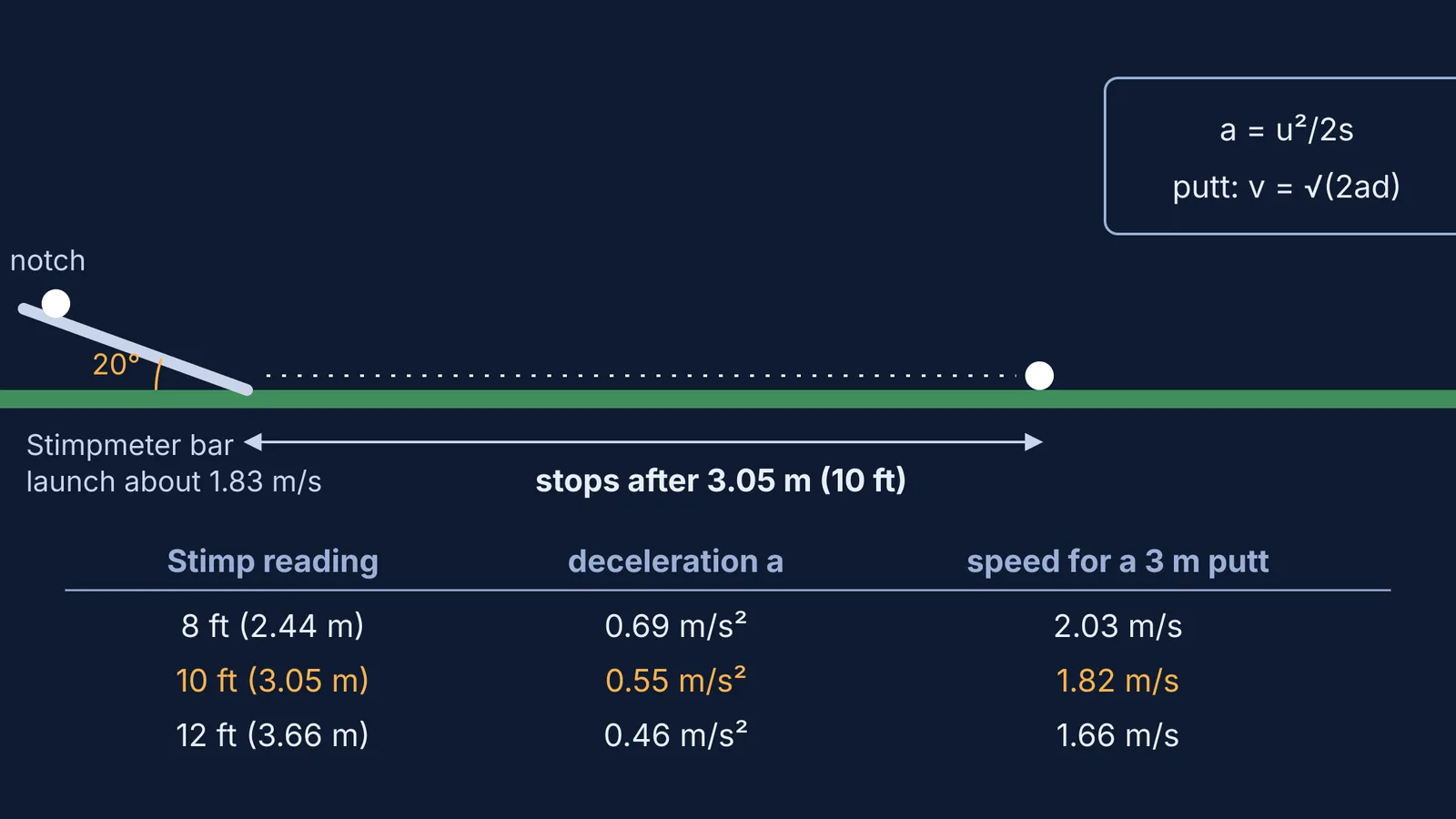
A 1982 article in the USGA Green Section Record by Donald Hoos, then a director in the USGA Green Section, describes it as an extruded aluminium bar 36 inches long with a V-shaped groove along its whole length and a precisely milled ball-release notch 30 inches from the tapered end, the end that rests on the ground. The user slowly lifts the notched end. At an angle of about 20°, the ball rolls out of the notch, down the groove and onto the green (Hoos, In Defense of the Stimpmeter, USGA Green Section Record, 1982). Some later descriptions quote about 22°, so treat the angle as approximate.
The trick is that the ball always starts from the same height, so it always leaves the bar at nearly the same speed. A physics analysis of the device in The Physics Teacher gives that speed as about 6 ft/s, or 1.83 m/s (Holmes, Dialogue concerning the Stimpmeter, 1986). Everything that happens next depends only on the grass.
The distance the ball rolls before stopping, in feet, is the Stimp reading. A USGA Green Section guide says staff roll several balls on a flat area, measure how far they travel, and then repeat in the opposite direction to calculate an average (Waters, How Data Delivers Better Greens, USGA, 2019). Rolling both ways cancels a slight slope: the ball goes further downhill and less far uphill.
Why does the ball leave the bar at 1.83 m/s?
Start with energy. The notch is 30 inches (0.762 m) along a bar tilted at 20°, so the ball drops h = 0.762 × sin 20° = 0.261 m.
A solid sphere rolling without slipping on a smooth incline has v = √(10gh/7), because 2/7 of its kinetic energy goes into spin. That gives √(10 × 9.81 × 0.261 / 7) = 1.91 m/s, a little above 1.83 m/s.
Why lower in practice? In a V-groove the ball touches the two sides of the groove, not the bottom, so it rolls on a radius r smaller than its own radius R. For each metre per second of forward speed it must spin faster, so more of the energy goes into rotation and less into forward motion. Energy conservation becomes mgh = ½mv²(1 + 2R²/5r²). Setting v = 1.83 m/s gives r ≈ 0.87R. There is also a small bump where the ball leaves the bar for the grass. The exact split between these two effects is not given in the sources above; the point is that the launch speed is fixed by the device, not by the person using it.
How do you turn a Stimp reading into a deceleration?
On a level green, grass resistance slows the ball. Treat it as a steady deceleration a; this is a model, because grass friction changes a little with speed. The ball starts at u = 1.83 m/s and stops (v = 0) after the Stimp distance s:
0 = u² − 2as, so a = u²/2s
The rolling resistance comes from the grass blades bending and the ball sinking slightly into the surface, the same kind of resistance compared with static and sliding friction in static, sliding or rolling friction: which is least? A carrom board is the indoor version: the powder there cuts friction so the striker and coins run further, as in why players sprinkle powder on a carrom board. A faster green is one with a smaller a.
Worked example: how hard do you hit a 3 m putt?
Given: launch speed u = 1.83 m/s; a green that reads 10 ft (3.048 m). Find the deceleration and the starting speed for a level 3 m putt that just reaches the hole.
Deceleration. a = u²/2s = 1.83² / (2 × 3.048) = 3.349 / 6.096 ≈ 0.55 m/s².
As a fraction of g. a/g = 0.55 / 9.81 ≈ 0.056. The grass acts like a rolling-resistance coefficient of about 0.06.
Putt speed. The ball must stop after d = 3 m: v = √(2ad) = √(2 × 0.549 × 3) ≈ 1.82 m/s.
Units check. √(m s⁻² × m) = m/s.
Time to roll. t = v/a = 1.82 / 0.549 ≈ 3.3 s.
Now repeat on a slower green that reads 8 ft (2.438 m):
a = 3.349 / (2 × 2.438) ≈ 0.69 m/s².
v = √(2 × 0.687 × 3) ≈ 2.03 m/s.
The same 3 m putt needs about 12% more speed on the slower green, and a putt struck at 1.82 m/s there would stop about 0.6 m short.
There is a shortcut. Since a = u²/2S for a Stimp distance S, the putt speed is v = √(2ad) = u√(d/S). For d = 3 m on a 3.048 m green, v = 1.83 × √(0.984) = 1.82 m/s, with no need to find a at all.
What Stimp readings count as fast?
Hoos's 1982 article gives a table of speeds: for regular membership play, 8 ft 6 in counts as fast and 4 ft 6 in as slow; for tournament play, 10 ft 6 in counts as fast. The same article notes that speeds at televised championships are generally above 10 ft. Using the model above:
4 ft 6 in (1.37 m): a ≈ 1.22 m/s²
8 ft 6 in (2.59 m): a ≈ 0.65 m/s²
10 ft 6 in (3.20 m): a ≈ 0.52 m/s²
A fast tournament green slows the ball less than half as hard as a slow club green. Golf balls are better known for their dimples, which matter in the air, not on the grass; that story is in why golf balls have dimples.
If you want to see how deceleration changes stopping distance, try the Simulation Lab, which has interactive simulations for ideas easier to see than read. For JEE practice, Fermi Test Prep offers personalised preparation for JEE Main & Advanced with an AI tutor, live classes, adaptive mocks, mentorship and a study plan that updates based on mastery.
Quick checklist
Stimpmeter: fixed release height, so a fixed launch speed of about 1.83 m/s.
Stimp reading = rolling distance in feet, averaged over both directions.
a = u²/2s; a 10 ft reading gives about 0.55 m/s².
Putt speed v = √(2ad), or v = u√(d/S) straight from the reading.
Smooth-ramp rolling gives 1.91 m/s; the V-groove's smaller rolling radius lowers it.
Constant deceleration is a model; real grass is not perfectly uniform.


