On this page
You try to push a heavy suitcase across the floor at the railway station. At first it refuses to move. Then it jerks forward and becomes a little easier to drag. Tip it onto its wheels and it glides. Those three moments are the three kinds of friction, in order from largest to smallest.
Which friction is least: static, sliding or rolling?
Rolling friction is the least, sliding (kinetic) friction is in the middle, and limiting static friction is the largest. For the same surfaces and the same load, the order is rolling < sliding < static.
Static friction acts between two surfaces that are not moving relative to each other, and kinetic friction acts once they slide, as defined in OpenStax University Physics, section 6.2. Static friction obeys f_s ≤ μ_s N, where N is the normal force and μ_s is the coefficient of static friction.
OpenStax states that "the coefficients of kinetic friction are less than their static counterparts" (OpenStax). Its table gives wood on wood as 0.5 static and 0.3 kinetic, and dry steel on steel as 0.6 static and 0.3 kinetic. Oiled steel on steel drops to 0.05 and 0.03.
Rolling resistance is also written as a coefficient times the normal force, and that coefficient "is generally much smaller than the coefficient of sliding friction" (Wikipedia: Rolling resistance). The same page lists 0.010 to 0.015 for ordinary car tyres on concrete and 0.0003 to 0.0004 for a steel railway wheel on a steel rail.
Why is static friction larger than sliding friction?
OpenStax explains that once an object is moving, "there are fewer points of contact (fewer molecules adhering), so less force is required to keep the object moving" (OpenStax). That is the jerk you feel when the suitcase finally gives way.
Static friction is also not a fixed number. OpenStax calls it "a responsive force that increases to be equal and opposite to whatever force is exerted, up to its maximum limit." Only the maximum, μ_s N, is larger than kinetic friction.
Why is rolling friction so small?
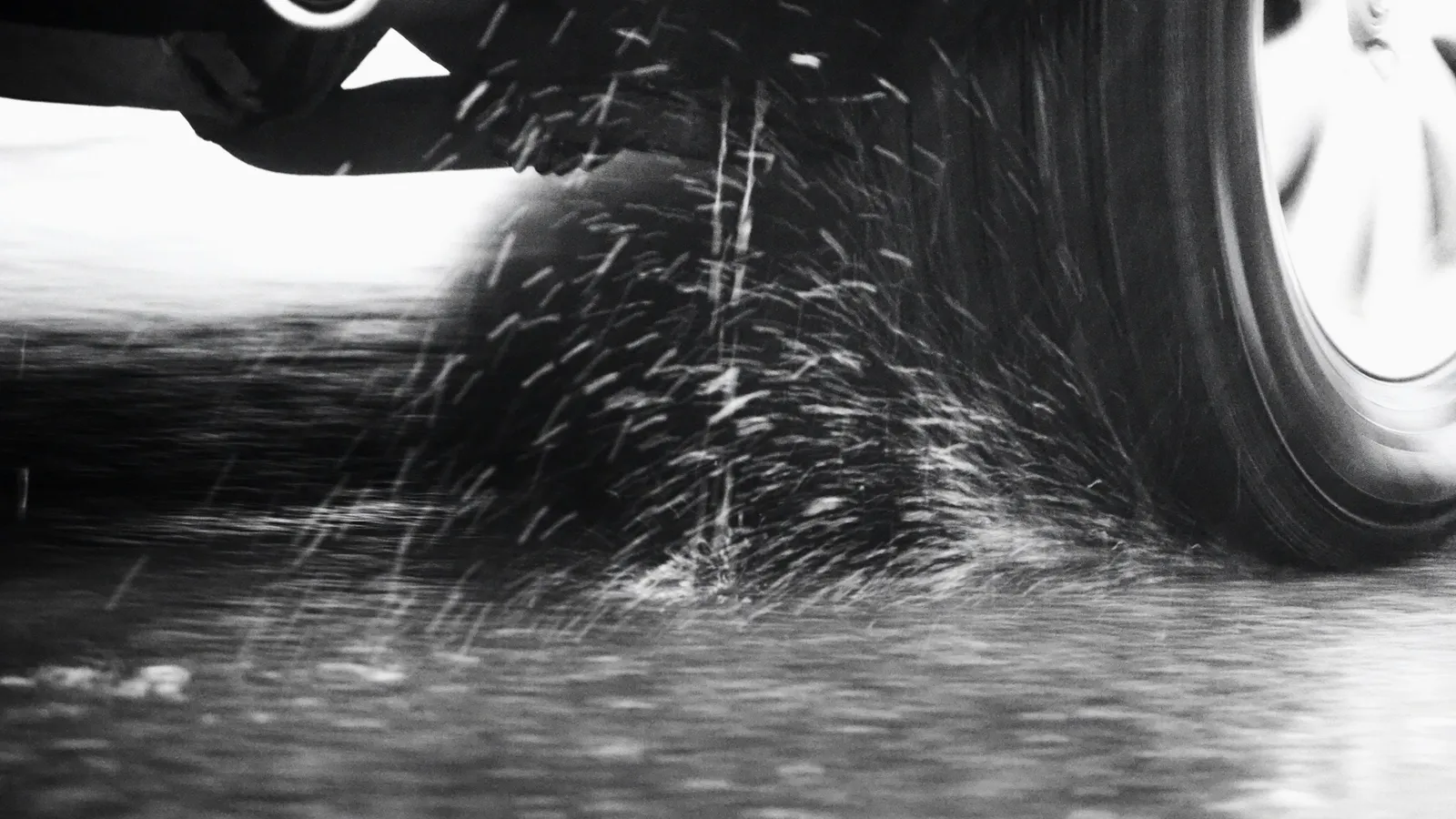
A wheel rolling without slipping does not rub along the ground. The point in contact is momentarily at rest, so there is no scraping of one surface over the other. The small resistance that remains comes from squashing the wheel and the ground. A tribology note from the Indian Institute of Science, Bengaluru says "deformation is a must for the rolling friction to occur" and that the energy loss in rolling is "about 2-3 orders of magnitude lesser" than in sliding for reasonably rigid bodies.
This also explains when wheels stop helping. Soft ground deforms a lot: Wikipedia's table lists 0.3 for ordinary car tyres on sand, close to sliding values. Pulling a trolley bag across a beach feels like dragging it for a reason.
Worked example: how much easier is a wheeled suitcase?
Take a 20 kg suitcase on a level floor, with g = 9.8 m/s². The normal force is N = 20 × 9.8 = 196 N. For illustration, use the OpenStax wood-on-wood values for the suitcase body (μ_s = 0.5, μ_k = 0.3) and a rolling coefficient of 0.01, the low end of the car-tyre-on-concrete range in Wikipedia's table.
Force needed to start it sliding: μ_s N = 0.5 × 196 = 98 N.
Force to keep it sliding at steady speed: μ_k N = 0.3 × 196 = 58.8 N.
Force to keep it rolling at steady speed: 0.01 × 196 ≈ 2 N.
On wheels you need about one-thirtieth of the sliding force. If you push with only 30 N before it moves, friction is 30 N, not 98 N, because static friction matches your push up to its limit.
How do you keep the order straight in an exam?
Use this checklist when a friction question appears in a board paper or JEE Main.
Write the order first: μ_rolling < μ_k < μ_s.
Ask: is anything sliding yet? If not, friction equals the applied force, up to μ_s N.
Once it slides, switch to μ_k N, which stays the same however hard you push.
For a wheel rolling without slipping, the contact point is not sliding, so the friction there is static. Do not use μ_k.
Friction does not depend on contact area, OpenStax notes, so tipping a box onto a narrow side does not change μ.
If the difference between static and kinetic friction still feels slippery, the Fermi Concept Library has a lesson on each concept in physics, each with its place in the map. To practise the checklist, the Fermi Problem Library has worked problems with a step-by-step solver that explains the reasoning rather than printing an answer.
Next time you tip a suitcase onto its wheels, you are switching from about 59 N of sliding friction to about 2 N of rolling resistance.