

On this page
It seems counterintuitive that a rough, dimpled surface flies better than a perfectly smooth one. But in fluid dynamics, a smooth surface is often a disadvantage for blunt objects moving at high speeds.
A perfectly smooth golf ball performs poorly and travels a significantly shorter distance than a standard dimpled ball. The reason comes down to how the thin layer of air surrounding the ball—the boundary layer—behaves during flight, and how dimples trigger a phenomenon known as the drag crisis.
What is the boundary layer?
When a ball moves through the air, it pushes molecules out of the way. The air immediately touching the surface sticks to it, while the air slightly further away slides past. This creates a thin envelope of air called the boundary layer.
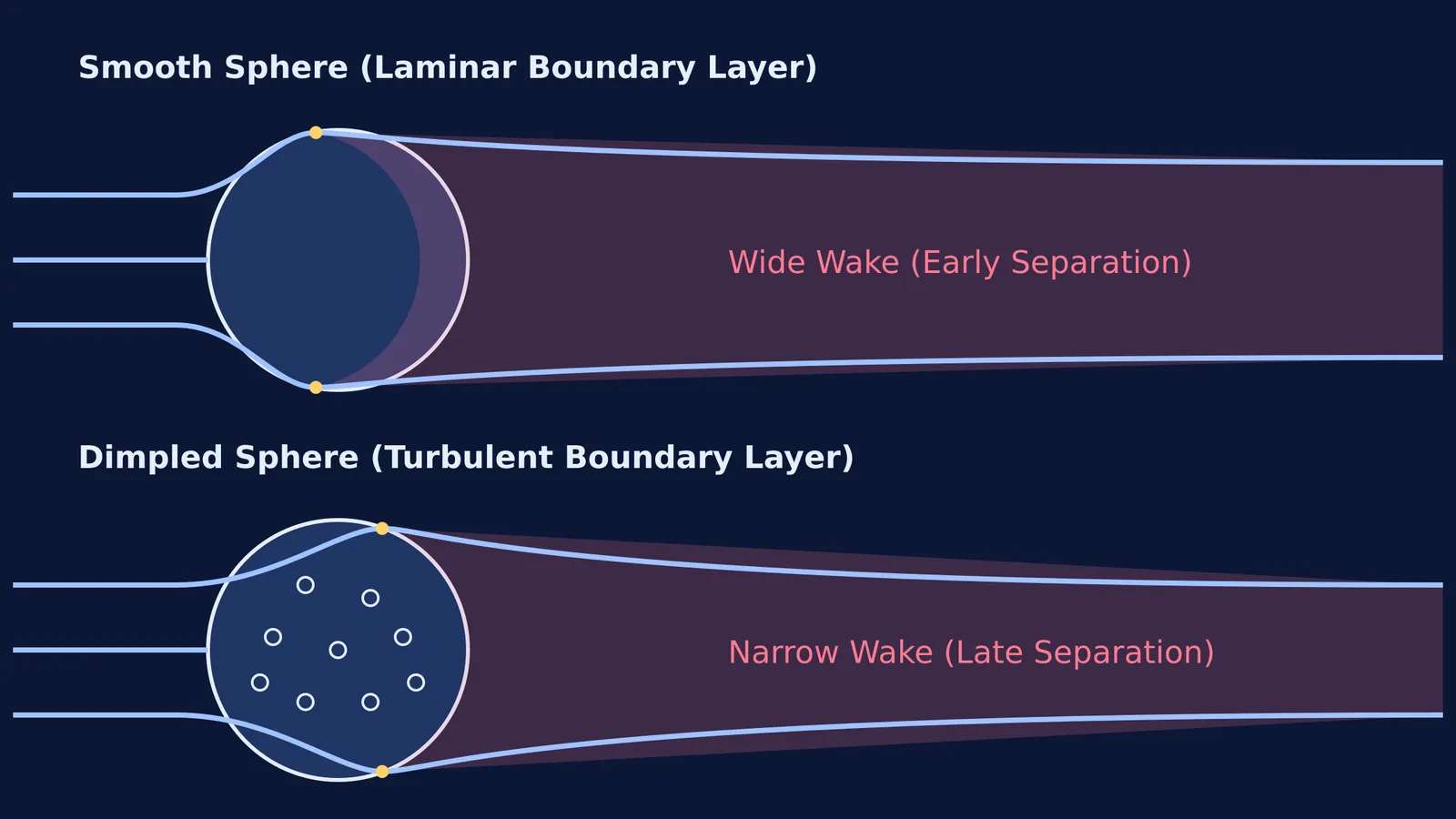
If the ball is perfectly smooth, the air within this boundary layer flows in neat, parallel sheets. This is called a laminar boundary layer. While laminar flow sounds ideal, it lacks the kinetic energy needed to stay attached to the back of a curving sphere.
Why do smooth balls create a wide wake?
Because a laminar boundary layer is relatively weak, it cannot follow the steep curve around the back of the golf ball. It "separates" from the surface early, near the ball's equator.
When the airflow detaches, it leaves a large, swirling pocket of low-pressure air behind the ball. This wide wake acts like a vacuum, pulling the ball backwards. In aerodynamics, this suction force is known as form drag or pressure drag, and it is the primary force slowing the ball down.
How do dimples trigger the drag crisis?
Dimples are designed to disrupt the laminar flow. They act as tiny turbulators, mixing the airflow and forcing the boundary layer into a turbulent state.
While "turbulence" usually implies resistance, a turbulent boundary layer is highly energetic. This extra kinetic energy allows the air to fight against the adverse pressure gradient and cling to the ball's curved surface much further towards the rear before finally separating.
By delaying flow separation, dimples drastically shrink the size of the low-pressure wake. This sudden, massive drop in pressure drag is known as the drag crisis. A 2007 study in the American Journal of Physics measured this effect directly, confirming that at typical golf drive speeds (54 to 180 km/h), dimpled balls experience significantly lower drag forces than smooth spheres of the exact same weight and diameter.
Do dimples increase lift?
Beyond reducing drag, dimples also interact with the ball's backspin to create upward lift via the Magnus effect.
As the dimpled surface spins, it grabs the energetic, turbulent air and deflects it downwards at the back of the ball. Newton's third law dictates that this downward push results in an equal and opposite upward lift. A classic 1949 study in the Journal of Applied Physics showed that a smooth ball generates *negative* lift at spin rates below 5000 r.p.m., whereas a dimpled ball generates significantly more lift at higher speeds.
Because aerodynamic drag changes continuously with the ball's velocity, predicting the exact trajectory requires you to integrate acceleration given as a function of v rather than using simple constant-acceleration formulas. Understanding these initial conditions is the first step in plotting the curve of a horizontal projectile from a cliff.
If it is hard to picture an invisible boundary layer or the sudden drop in drag, the Fermi Simulation Lab has interactive simulations for the ideas that are easier to see than to read. You can change the flow speed or the surface roughness and watch the wake shrink in real time.


