

On this page
A mussel clamped shut looks like a sealed box. A starfish has no teeth, no jaws and a mouth on its underside. Yet starfish eat mussels and clams all the time. The trick is that the starfish does not bring the clam to its stomach. It takes its stomach to the clam.
How does a starfish open a clam?
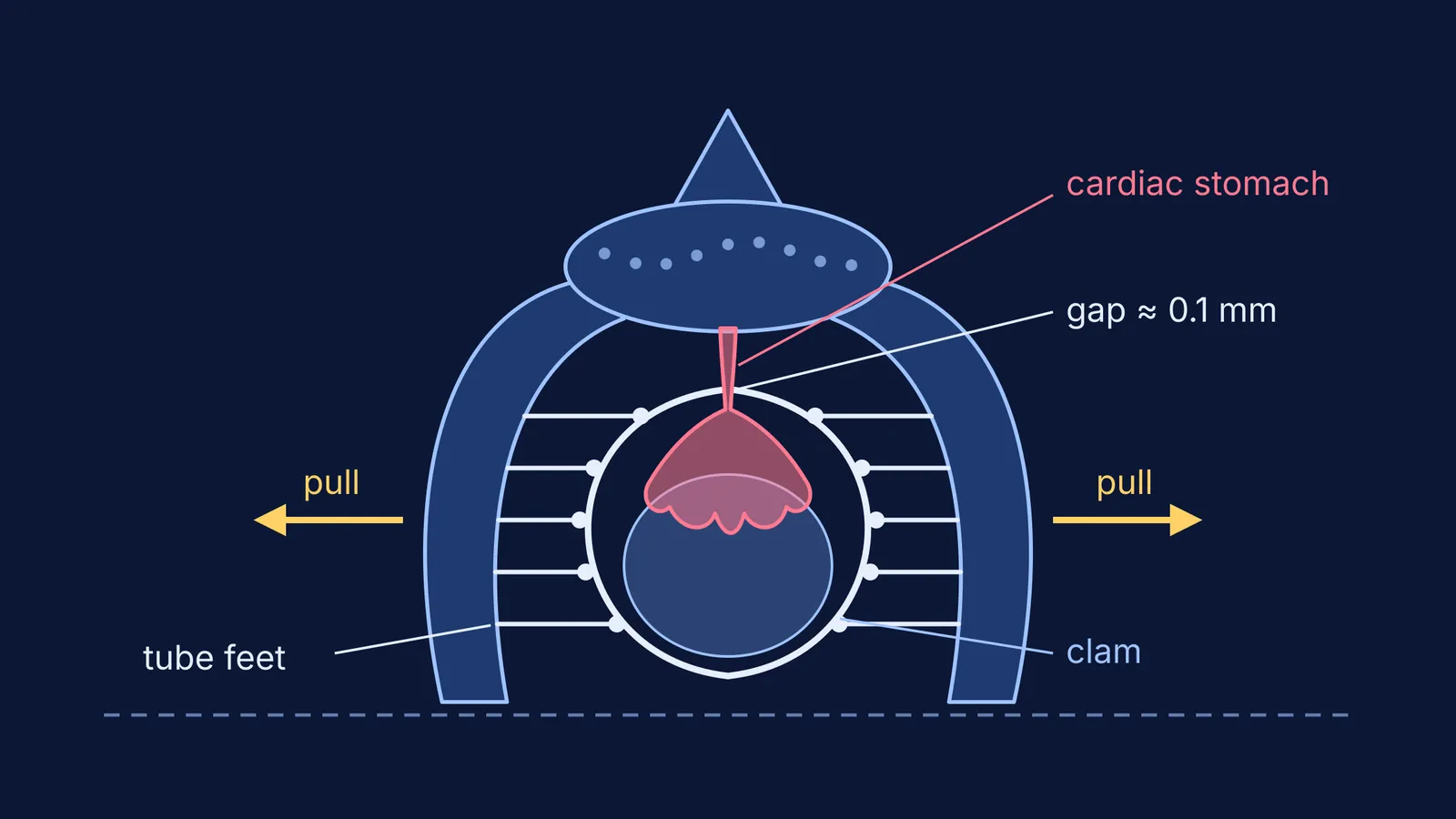
The starfish humps over the clam, grips both halves of the shell with the suckers on its tube feet and pulls them apart. Tube feet are run by the water vascular system: seawater enters through the madreporite, flows through a ring canal and radial canals, and each tube foot is controlled by a bulb-like ampulla (OpenStax Biology 2e). For the full plumbing, read our explainer on how the water vascular system powers tube feet.
For decades, scientists argued about whether starfish pulled the shell open or poisoned the clam into relaxing. Marcel Lavoie of Syracuse University tested both ideas in a 1956 paper, How sea stars open bivalves, using the sea star Asterias forbesi and the blue mussel Mytilus edulis.
Poison idea: extracts of the starfish's digestive organs, tested on over 1,000 mussels, made them gape at about the same rate as mussels injected with plain seawater or distilled water.
Pull idea: he cut each mussel's closing muscle and replaced it with a spring linked to a water-filled tube, so any pull on the shell showed up as a change in water level. Sea stars pulled with forces of over 3,000 grams.
The pull came in bursts. In one record from the same paper, the force swung between zero and 800 grams over nearly three hours, with the starfish relaxing and pulling again.
How does the stomach fit through such a tiny gap?
A starfish has two stomachs, and one of them, the cardiac stomach, can be everted: pushed out through the mouth to release digestive juices onto prey (OpenStax Biology 2e).
Lavoie found that an opening of 0.1 mm between the two halves of the shell was enough for the stomach to slip in (Lavoie, 1956). An earlier estimate he cites had put the minimum at 7 mm, 70 times wider.
One sea star settled over a mussel for 5 minutes, then pulled hard for 3 more; when it was lifted off, most of its stomach was already inside the shell. In another test, mussels tied so their shells could open only 0.1 mm were still invaded.
What happens to the food after the stomach goes in?
Digestion starts outside the starfish's body. The everted stomach releases enzymes into the clam, so the prey is digested inside its own shell (OpenStax Biology 2e). In Lavoie's tanks, the stomachs reached the soft parts of most of the mussels and partly or wholly digested them.
The food can then be pulled into the body, with digestion completed in the second stomach, the pyloric stomach, according to Brigham Young University-Idaho's Invertebrate Life textbook. This lets a starfish eat prey larger than its mouth.
Worked example: how many tube feet does that pull need?
Lavoie (1956) used an earlier measurement that each tube foot sticks with about 29 grams.
Force: 3,100 grams, the load that later bent open the valves of one tightly bolted, invaded mussel by 0.1 mm.
In newtons: 3.1 kg x 9.8 m/s2 = about 30 N, roughly the weight of a 3 kg bag of rice.
Tube feet needed: 3,100 / 29 = at least 107 tube feet pulling at once.
So no single foot is strong. The force comes from many small tube feet working together; Lavoie thought the pull came from the muscles of the tube feet themselves. He estimated that a starfish would need fewer than a quarter of its tube feet pulling at once to exceed 5,000 grams.
How do you write this as an exam answer?
A five-step short answer:
The starfish arches over the bivalve and attaches tube feet to both valves.
The tube feet, worked by the water vascular system, grip and pull the valves apart.
A gap as small as 0.1 mm opens, which is enough (Lavoie, 1956).
The cardiac stomach is everted through the mouth and into the shell, where it releases enzymes.
The partly digested food passes to the pyloric stomach, where digestion finishes.
Mistakes that cost marks:
Mixing up the stomachs: the cardiac stomach goes out; the pyloric stomach stays in.
Saying the starfish poisons the clam: the 1956 experiments found no relaxing toxin in starfish extracts, and pulling alone was enough.
Saying the clam is swallowed whole: digestion begins outside the body.
If the hydraulics is the part that will not stick, the Fermi Concept Library gives every concept in biology its own lesson and its place in the map, so you can see how tube feet connect to the rest of the echinoderm body plan.
Next, test yourself on why a starfish is not a fish, then look at the prey's side in why bivalves like clams have no head.


