

On this page
Look through a surveyor's level or theodolite and you see more than one cross-hair. Above and below the main horizontal hair sit two shorter ones, the stadia hairs. Point the telescope at a graduated staff, read where the two hairs cut it, multiply the gap by 100 and you have the distance to the staff in metres, with no tape. The rule comes straight from the thin-lens formula and similar triangles, the ray optics of Class 12.
What are stadia hairs and how are they used?
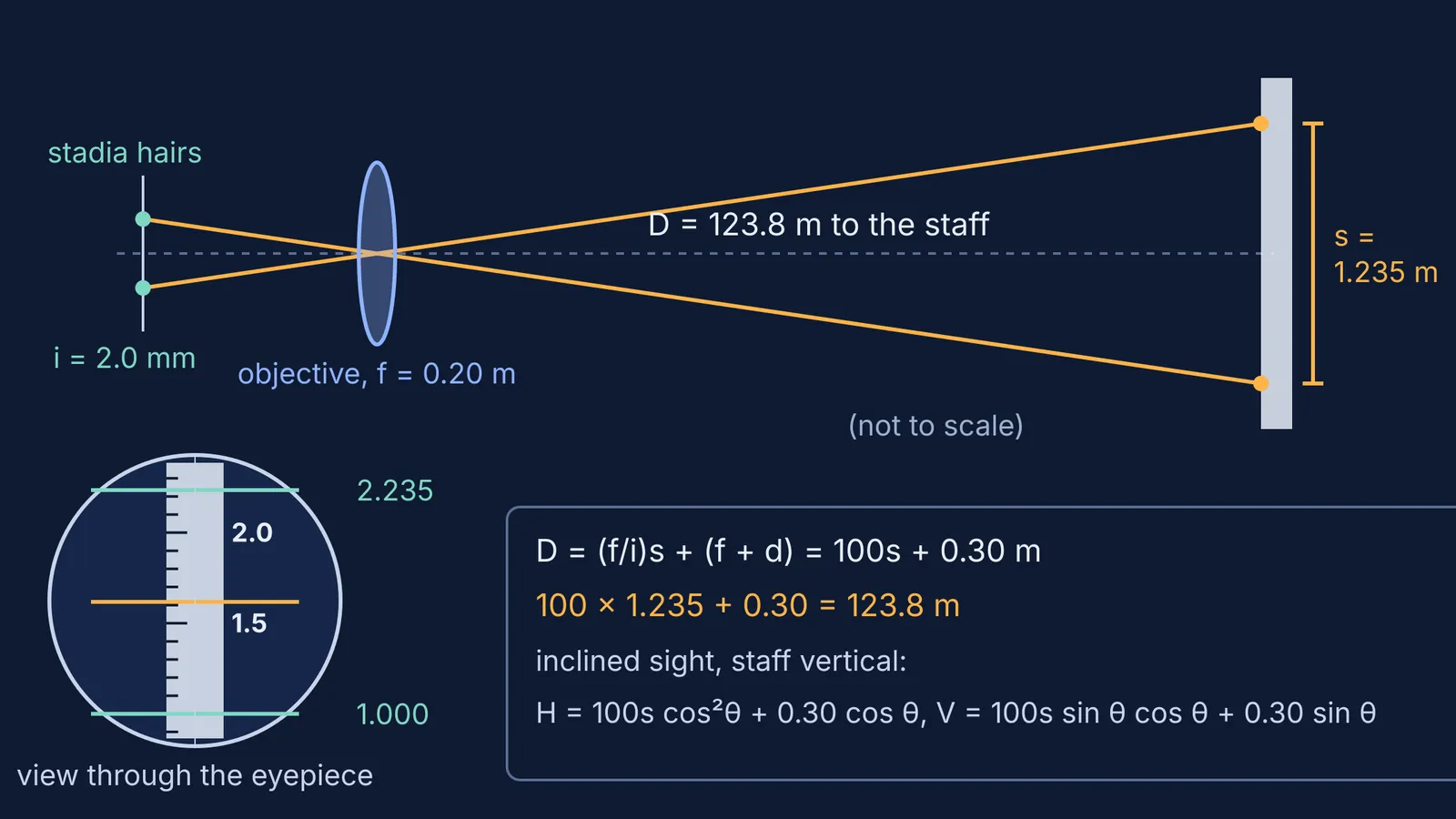
The stadia hairs are two extra horizontal lines fixed on the same glass plate (the diaphragm) as the main cross-hairs, a small distance i apart. When the telescope is focused on a staff, the image of the staff falls on that plate, so the hairs appear to lie across the staff. The surveyor reads the staff at the upper and lower hairs. The difference is the staff intercept, s.
A far staff looks small, so a long stretch of it fits between the hairs. A near staff looks large, so only a short stretch fits. The intercept therefore grows in proportion to the distance. A classic surveying text, Breed and Hosmer's The Principles and Practice of Surveying (1908), Appendix A, describes the method as rapid and accurate enough for mapping topographic detail.
Why is the distance 100 times the staff intercept?
Let the objective lens have focal length f, and the staff be at distance u in front of it. Its image forms at distance v behind the lens, where the hairs are.
Similar triangles. Rays through the centre of the lens go straight on, so the staff intercept and the hair gap are in the ratio of their distances: s/i = u/v.
Lens formula. 1/v + 1/u = 1/f in magnitudes, so u/v = u/f − 1 = (u − f)/f.
Combine. s/i = (u − f)/f, so u − f = (f/i)s.
The quantity u − f is the distance of the staff from the lens's front focal point, the x₁ of Newton's form of the lens formula. Measured from that point, distance is exactly proportional to the intercept. To get the distance from the centre of the instrument, add f (focal point to lens) and d (lens to the instrument's vertical axis):
D = (f/i)s + (f + d).
Makers space the hairs so that f/i = 100, the multiplying constant. The term f + d is the additive constant. Breed and Hosmer give it as about 1 foot (0.75 to 1.25 ft) for the transits of their day. Other telescope designs change it, so use the constants stated for your instrument.
Worked example: a 1.235 m intercept
Illustrative instrument: f = 0.20 m, hair gap i = 2.0 mm, lens 0.10 m in front of the axis. The staff is held vertical and the sight is level.
Multiplying constant. f/i = 0.20 ÷ 0.0020 = 100.
Additive constant. f + d = 0.20 + 0.10 = 0.30 m.
Read the staff. Lower hair 1.000 m, upper hair 2.235 m, so s = 1.235 m.
Distance from the focal point. 100 × 1.235 = 123.5 m.
Distance from the lens. u = 123.5 + 0.20 = 123.7 m.
Distance from the instrument axis. D = 123.5 + 0.30 = 123.8 m.
Check with the lens formula. v = uf/(u − f) = 123.7 × 0.20 ÷ 123.5 = 0.2003 m, and s/i = u/v = 123.7 ÷ 0.2003 = 617.5 = 1.235 ÷ 0.0020. The numbers agree.
Units: f/i is a pure number, so 100 × metres gives metres. Notice how little the image moves: focusing from infinity to 123.7 m moves the image only 0.3 mm. That is why the hair gap can be fixed.
What changes when the sight is inclined?
On sloping ground the telescope tilts up or down by an angle θ, but the staff is still held vertical. Breed and Hosmer derive the correction in their article on inclined sights.
Effective intercept. The vertical staff is tilted by θ relative to a staff square to the line of sight, so the useful intercept is s cos θ (very nearly).
Distance along the line of sight. 100s cos θ + (f + d).
Horizontal distance. H = 100s cos²θ + (f + d) cos θ.
Height difference. V = 100s sin θ cos θ + (f + d) sin θ.
Take the same 1.235 m intercept at θ = 8°. H = 123.5 × cos²8° + 0.30 × cos 8° = 121.1 + 0.30 = 121.4 m. V = 123.5 × sin 8° cos 8° + 0.30 × sin 8° = 17.02 + 0.04 = 17.06 m. The middle hair's staff reading and the instrument height are then added or subtracted to get the level of the ground.
A common slip is to take D = 123.8 m and multiply by cos 8° once. That gives 122.6 m, about 1.2 m too long, because it forgets that the vertical staff shows a longer intercept than a square-on staff would.
How accurate is a stadia distance?
Every millimetre misread on the staff is 100 mm on the ground. At 124 m the staff's millimetre marks are hard to read exactly, so an error of a millimetre or two is normal: 0.1 to 0.2 m, about 1 part in 600 to 1200 here. That is fine for placing trees, walls and contour points on a map, but not for setting out a building corner. Breed and Hosmer note that stadia cannot match the precision of very careful chaining.
The hairs themselves subtend an angle of i/f = 0.002 ÷ 0.20 = 0.010 rad, about 34 minutes of arc. The idea of putting a measuring mark in a telescope's focal plane goes back to William Gascoigne and his micrometer. The constants are checked in the field, as the same text describes: hold the staff at two distances measured with a tape, read both intercepts, and solve D = Ks + C twice for K and C. How the objective and eyepiece set the magnifying power is a separate question, covered in microscopes and telescopes, worked step by step.
To see how moving an object changes where its image forms, try the lens simulations in the Simulation Lab.
What mistakes cost marks on stadia questions?
Measuring the proportional distance from the lens instead of from the front focal point.
Reading the middle hair and one stadia hair and treating that as the full intercept. It is half of it.
Using cos θ instead of cos²θ for the horizontal distance with a vertical staff.
Forgetting the additive constant, or adding it without the cos θ factor on an inclined sight.
Quick checklist
Staff intercept s = upper hair reading − lower hair reading.
D = (f/i)s + (f + d); f/i is usually 100.
From the lens formula: s/i = (u − f)/f.
Inclined, vertical staff: H = 100s cos²θ + (f + d) cos θ, V = 100s sin θ cos θ + (f + d) sin θ.
1 mm on the staff is 0.1 m on the ground.


