On this page
The usual lens formula measures from the lens and makes you add reciprocals. Newton measured from the two focal points instead, which turns the formula into one product, x₁x₂ = f², and often gets you to the focal length, image position or magnification in one line.
What is Newton's lens formula?
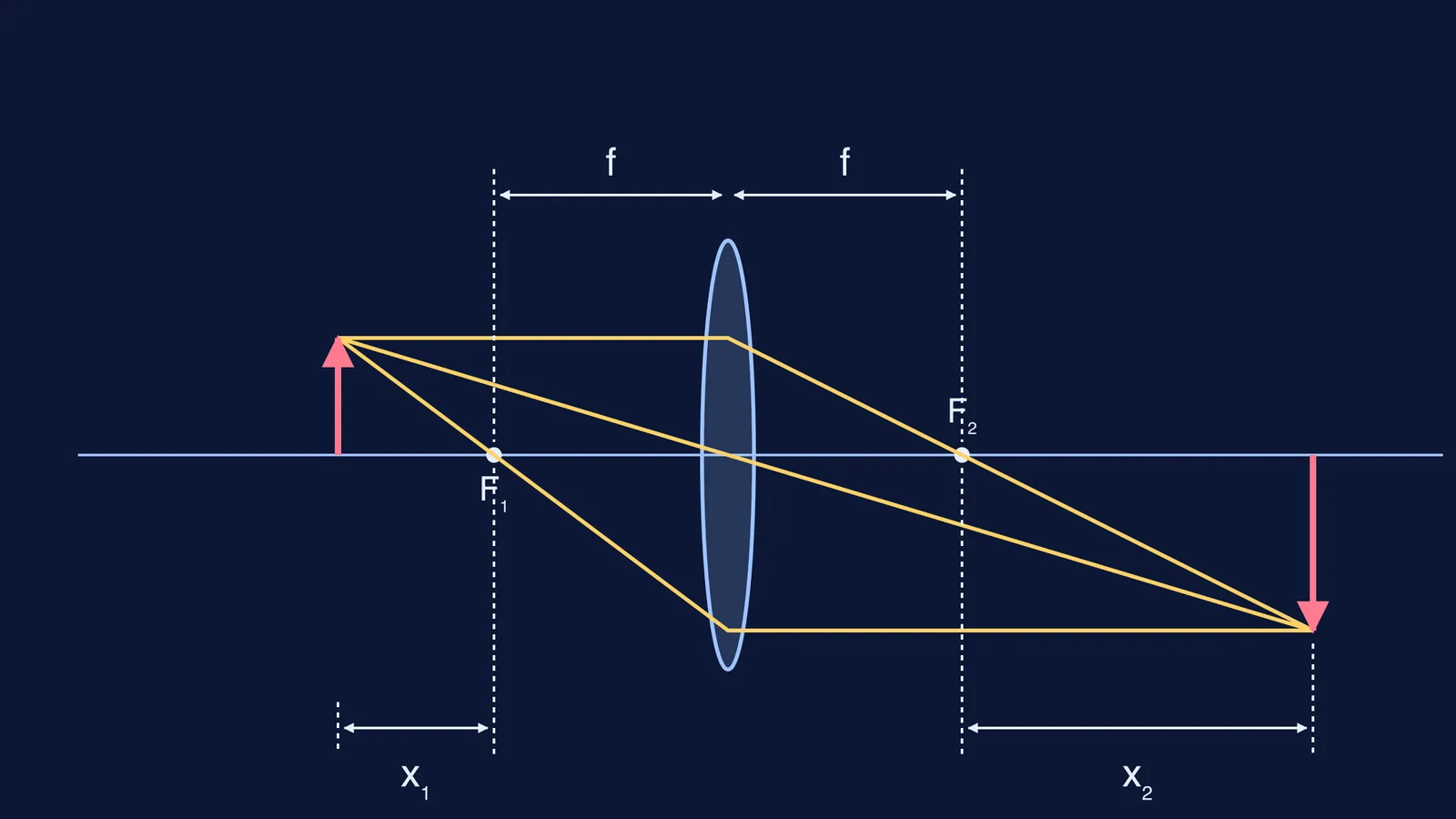
For a thin lens, the Newtonian form of the lens equation is x₁x₂ = f², where x₁ is the object's distance from the front focal point and x₂ is the image's distance from the rear focal point (Lens, Wikipedia).
HyperPhysics at Georgia State University calls x₁ and x₂ the "extrafocal distances" and describes Newton's form as an equivalent treatment to the usual Gaussian form, which measures from the lens.
With light travelling left to right, the Wikipedia article counts x₁ as positive when the object is to the left of the front focus F₁, and x₂ as positive when the image is to the right of the back focus F₂ (Lens, Wikipedia). For the everyday case (a real object outside the focal length of a convex lens, giving a real image), both are positive and you can work with plain lengths.
Why does x1 x2 equal f squared?
Take an object of height h and its inverted image of height h′. Two rays and their similar triangles do all the work, as in the derivation in the Wikipedia article on lenses.
The ray through F₁ leaves the lens parallel to the axis. Its triangles give h/x₁ = h′/f.
The ray that arrives parallel to the axis passes through F₂. Its triangles give h/f = h′/x₂.
Both say the same ratio h′/h, so f/x₁ = x₂/f, which rearranges to x₁x₂ = f².
You also get the size of the magnification for free: h′/h = f/x₁ = x₂/f.
You can check it against the familiar formula. Write the object distance as u = f + x₁ and the image distance as v = f + x₂ (all lengths). The Gaussian form for this case is 1/u + 1/v = 1/f, which is the same as uv = f(u + v). Expand both sides: f² + fx₁ + fx₂ + x₁x₂ = 2f² + fx₁ + fx₂. Everything cancels except x₁x₂ = f².
How do you find f quickly with x1 x2 = f²?
The whole method is: find each distance from its own focus, multiply, take the square root. Here are three examples, and each one also satisfies 1/u + 1/v = 1/f from the Gaussian form.
Example 1, focal length from extrafocal distances. An object is 4 cm outside the front focus of a convex lens, and a sharp image forms 9 cm beyond the back focus. Then f² = 4 × 9 = 36, so f = 6 cm. Check: u = 10 cm and v = 15 cm, and 1/10 + 1/15 = 1/6. The image is f/x₁ = 6/4 = 1.5 times the object's height, and x₂/f = 9/6 gives the same 1.5.
Example 2, image position without reciprocals. A lens has f = 10 cm and the object is 30 cm away, so x₁ = 20 cm. Then x₂ = 100/20 = 5 cm, and the image is 10 + 5 = 15 cm behind the lens, half the object's height (f/x₁ = 10/20).
Example 3, what happens as the object moves. Because x₁x₂ stays fixed at f², halving x₁ doubles x₂. With f = 6 cm, move the object from 4 cm to 2 cm outside F₁ and the image jumps from 9 cm to 18 cm beyond F₂, while the magnification rises from 1.5 to 3. That is why images race away as an object nears the focus.
When should you use Newton's form in an exam?
The question gives distances from the foci, or asks for them.
You need the magnification fast: m = f/x₁ in size, with no image distance needed.
You are asked how close object and screen can be. Since u + v = 2f + x₁ + x₂ and x₁ + x₂ ≥ 2√(x₁x₂) = 2f, the separation is at least 4f, the result in our post on why a lens's object and real image are at least 4f apart.
You are checking lab readings. Once you have a value of f from the u-v method for a convex lens, each reading pair should give (u − f)(v − f) close to f².
If you keep losing marks at the substitution step, the Fermi Problem Library has worked problems with a step-by-step solver that explains the reasoning rather than printing an answer. To see where Newton's form sits next to the lens formula and magnification, each idea in the Fermi Concept Library has its own lesson and its place in the map.
Next time a ray-optics question mentions a focus, try measuring from it first.