

On this page
A squid fleeing a predator does not paddle. It fires water out in one hard squirt and shoots off the opposite way, using a law from Class 11 physics: conservation of momentum. Here is how it works, and how to estimate its escape speed on paper.
How does a squid swim by jet propulsion?
A squid's body is a muscular tube called the mantle, with a cavity inside and a short funnel, often called the siphon, near the head. A 2020 study of squid in Biology Open describes the escape jet as "produced by the rapid expulsion of water from the mantle cavity through a funnel" (York, Bartol, Krueger and Thompson, 2020). Each jet has two strokes:
Refill: the mantle expands and water is drawn into the cavity around the sides of the head.
Squeeze: the mantle muscles contract and force the water out through the narrow funnel as a fast jet.
Estimates of peak jet speed cited in the study range from 6.7 to 11 m/s for squid, compared with 2.9 to 6.9 m/s for octopus and cuttlefish (York et al., full text). In the study's escape jets, fin thrust was very low next to the jet's.
During escapes, adult brief squid (Lolliguncula brevis), with mantles 5.1 to 7.0 cm long, averaged about 4.2 mantle lengths per second, which works out to roughly 0.2 to 0.3 m/s (York et al., full text). The authors link these lower-than-usual speeds to their confined tanks.
What does conservation of momentum say?
The NCERT Class 11 Physics textbook (Laws of Motion, section 4.7) states it in one line: "The total momentum of an isolated system of interacting particles is conserved" (NCERT Physics Part 1, Chapter 4). NCERT's own example is a gun and bullet: both start at rest, so after firing, the bullet's forward momentum and the gun's recoil momentum add up to zero.
OpenStax's physics textbook says rockets, deflating balloons "and even squids and octopuses" are explained by the same principle, Newton's third law (OpenStax College Physics 2e, section 8.7); NCERT derives momentum conservation from that law. A squid is the gun-and-bullet problem with water as the bullet; compare gun recoil and momentum conservation and how a balloon rocket moves.
Take the squid plus the water in its mantle as your system; its total momentum starts at zero. Drag is external, but during one short squirt it is small next to the internal push, so treat the system as isolated.
How fast can one squirt move a squid? A worked example
The masses are practice numbers, not measurements; only the jet speed comes from the estimated range.
Mass of the squid without the water: M = 0.5 kg
Mass of water squirted in one pulse: m = 0.1 kg
Jet speed relative to the squid: u = 8 m/s (inside the 6.7 to 11 m/s range)
Choose directions: forward (the squid's way) is positive.
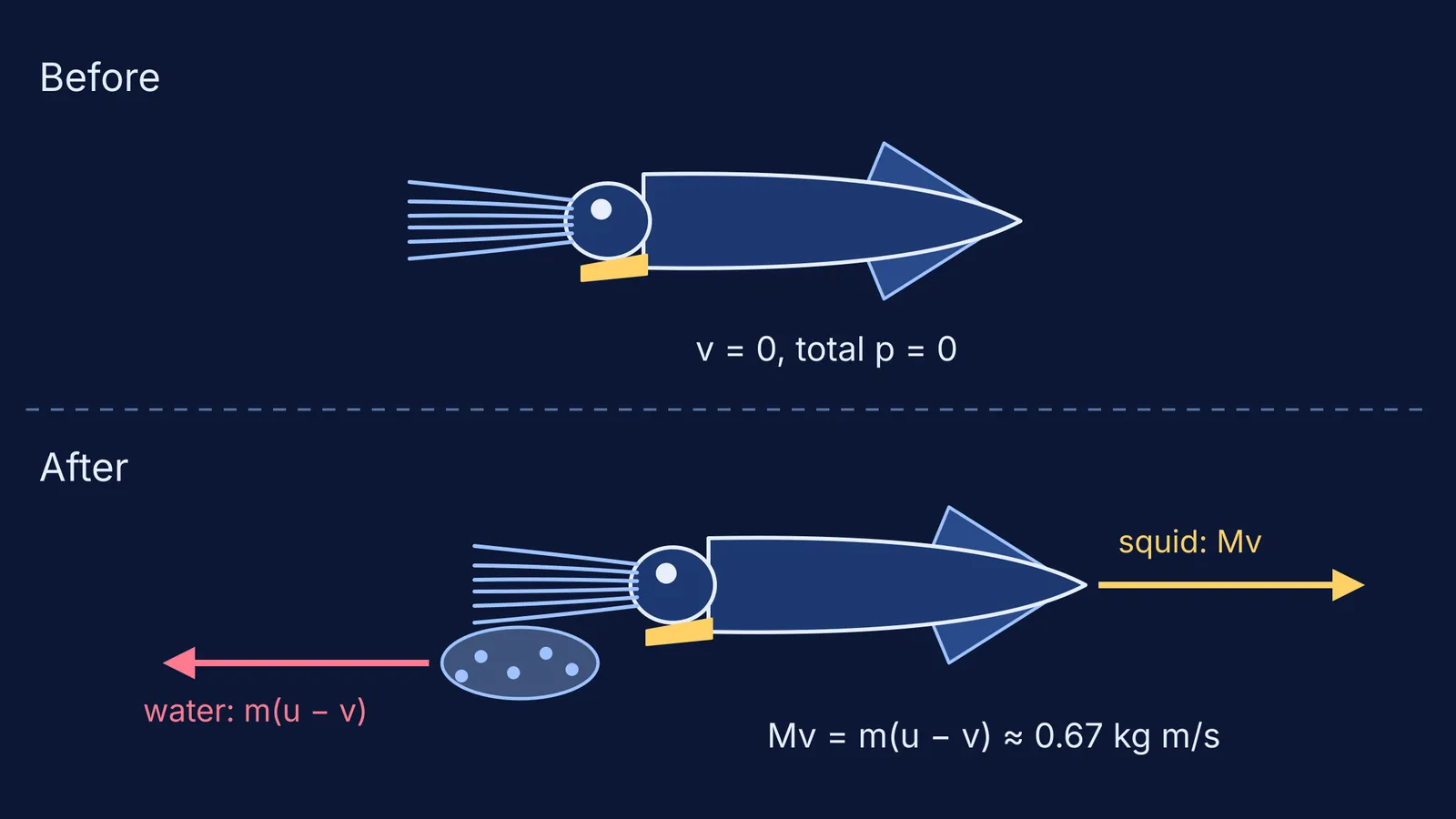
Watch the frame: 8 m/s is measured relative to the squid. If the squid ends up moving forward at v, the water moves backward at (u − v) relative to the ground.
Conserve momentum: 0 = Mv − m(u − v).
Solve: v = mu / (M + m) = (0.1 × 8) / 0.6 ≈ 1.33 m/s.
Check: the squid carries 0.5 × 1.33 ≈ 0.67 kg m/s forward; the water carries 0.1 × 6.67 ≈ 0.67 kg m/s backward. They cancel, as they must.
Treating 8 m/s as the water's ground speed gives v = mu / M = 1.6 m/s, 20% too high. Mixing up frames is the classic trap in recoil questions.
Add impulse: if the squeeze lasts an assumed 0.1 s, the average force on the squid is 0.67 / 0.1 ≈ 6.7 N.
Why does the size of the siphon matter?
One squirt gives momentum mu, but the jet carries kinetic energy of ½mu². For the same momentum, a small, fast jet costs more energy than a large, slow one. The York paper notes, citing earlier work, that squid hatchlings (paralarvae) have relatively larger funnel openings and hold proportionally more water, which allow "the expulsion of large volumes of water at relatively low speeds" and can improve propulsive efficiency (York et al., full text).
How do you solve any jet or recoil question?
The squid method works for guns, rockets and hoses:
Pick a system that makes the big forces internal.
Write the total momentum before (often zero).
Label every speed: relative to the body, or relative to the ground.
Write one momentum equation and solve it.
Check that the final momenta cancel, and note what you ignored (drag, gravity, extra pulses).
If your answers keep coming out wrong, the Fermi Problem Library has worked problems with a step-by-step solver that explains the reasoning rather than printing an answer, so you can see where your method went off track.
Next, rerun the worked example with 11 m/s, the top of the estimated range.


