

On this page
A spirit level looks simple, but the bubble does not sit in a straight tube. The inside of the vial is curved, and the radius of that curve decides how far the bubble moves for a given tilt. That one number is why a carpenter's level and a machinist's level can look alike and differ in sensitivity by a factor of 250. The working is one line of geometry, s = Rθ.
Why does the bubble move towards the higher end?
The vial is almost full of liquid, usually an alcohol, with a small bubble. Gravity pulls the liquid down as far as it can go, and the liquid pushes the bubble out of the way. So the bubble always ends up at the highest point inside the vial.
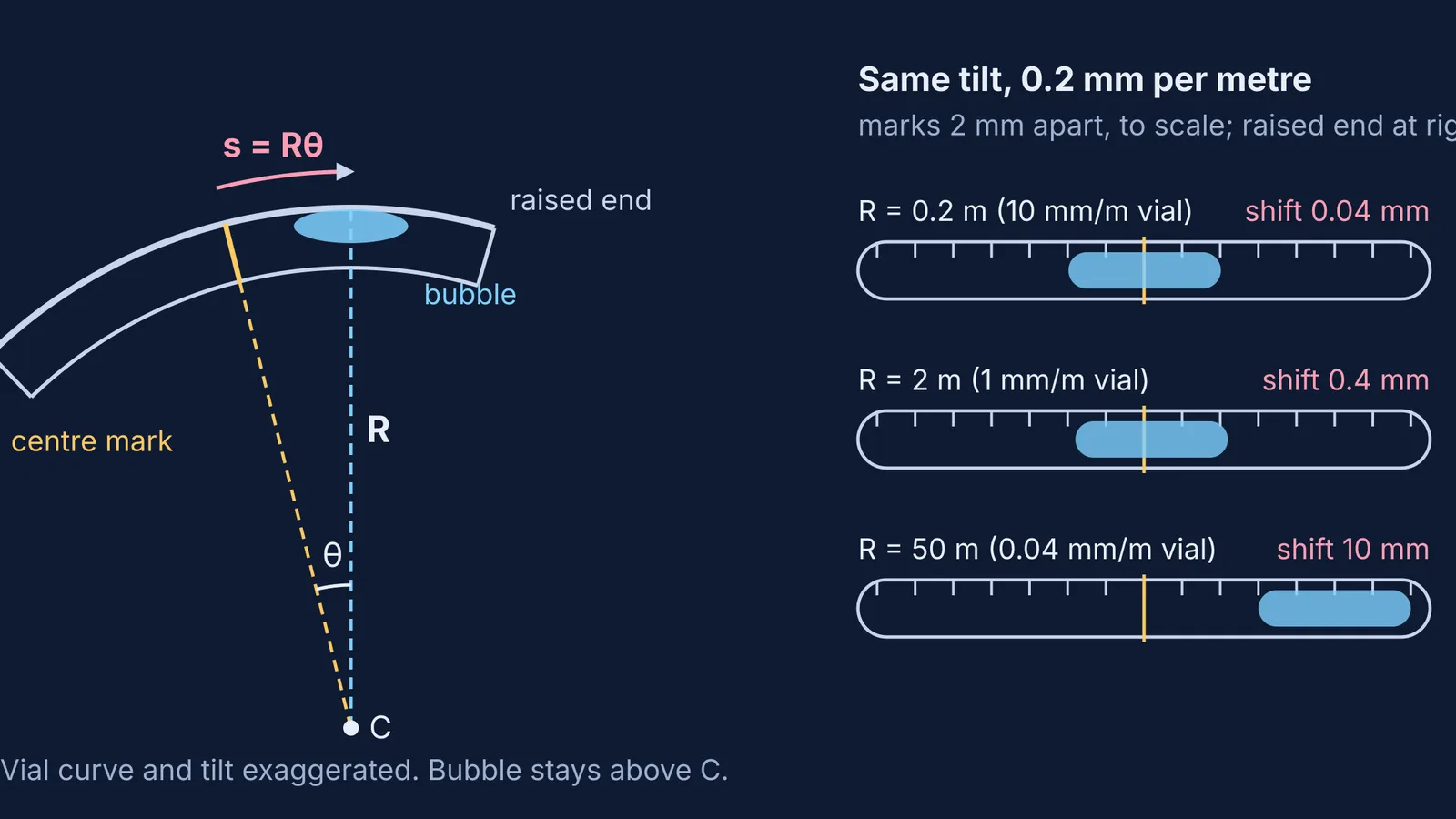
The top inner surface of the vial is not flat. It is a very gentle arch, part of a circle of radius R whose centre C lies far below the vial. When the vial is level, the highest point of that arch is in the middle, between the two marks.
Raise the right end. The arch rotates, and its highest point is now a little to the right of the middle. The bubble follows it. The bubble goes to the raised end because it is the liquid that falls, not the bubble.
How far does the bubble move for a given tilt?
The highest point of the arch is always the point directly above C. Tilt the vial by a small angle θ and the vial's own centre mark swings through angle θ about C. The bubble stays above C, so it ends up an arc length
s = Rθ
away from the centre mark, with θ in radians. For small angles θ is also the slope, so a slope of 1 mm per metre is θ = 10⁻³ rad.
Makers describe a vial by its sensitivity: the slope that moves the bubble by one division, 2 mm. Hultafors defines it this way and states that most spirit levels have a sensitivity of 10 mm per metre, the same as a 200 mm vial radius. Check it: R = s/θ = 2 mm ÷ 0.010 = 200 mm. So on an ordinary level, lifting one end of a 1 m level by 10 mm moves the bubble by just one division.
The same maker sells vials five and ten times as sensitive. Those are 2 mm/m and 1 mm/m, which need R = 1 m and R = 2 m.
What makes a precision level so much more sensitive?
Only the radius. The liquid, the bubble size and the level's length do not appear in s = Rθ.
Starrett's catalogue page for its Master Precision Level says metric vial graduations are 2 mm apart and that one division on its main vial equals 0.04 mm per metre. So the radius of that arch is
R = 2 mm ÷ (0.04 × 10⁻³) = 50 m.
That is 250 times the radius of an ordinary 200 mm vial, and 250 times the bubble movement for the same tilt.
The hero image puts three vials side by side at the same small tilt of 0.2 mm per metre. On the 200 mm vial the bubble moves 0.04 mm, too little to see. On a 2 m vial it moves 0.4 mm. On the 50 m vial it moves 10 mm, five whole divisions.
Worked example: how far does the bubble move on a sloping floor?
A tiler checks a floor that drops 10 mm over 3 m. How far does the bubble move on each level?
Slope. θ = 10 mm ÷ 3,000 mm = 3.33 × 10⁻³ rad, or 3.33 mm/m.
Ordinary level, R = 0.2 m. s = 0.2 m × 3.33 × 10⁻³ = 0.67 mm, a third of a division.
Sensitive vial, R = 2 m. s = 2 m × 3.33 × 10⁻³ = 6.7 mm, more than three divisions.
Precision level, R = 50 m. s = 50 m × 3.33 × 10⁻³ = 167 mm. The bubble runs to the end of the vial and gives no reading at all.
Direction. In every case the bubble moves towards the higher end of the floor.
A more sensitive level is not always more useful. The precision level is for machine beds, not floors.
Why does a spirit level read wrongly in an accelerating car?
In a car accelerating forwards at a, the liquid feels an effective gravity tilted backwards. As worked out in the angle of a hanging bob in an accelerating train, the effective "down" tilts by tan⁻¹(a/g). The bubble does not know the difference between a real slope and this false one.
Take a = 0.5 m/s². The tilt is tan⁻¹(0.5/9.81) = 2.92°, which is θ = 0.0509 rad, a false slope of 51 mm/m. On an ordinary 200 mm vial the bubble moves 0.2 m × 0.0509 = 10.2 mm, about five divisions, towards the front of the car. The front is the "higher" end in the effective gravity, just as a helium balloon in a car leans forwards.
How do you cancel the error of the level itself?
No vial is set perfectly parallel to the base of the level. The reversal test removes that error without any other instrument.
Place the level on the surface and note the bubble's position, say 3 divisions towards the east end.
Turn the level end for end on the same spot. Say the bubble is now 1 division towards the west end.
Call the true slope T and the level's own error e, both in divisions. The first reading is T + e = +3. The reversed reading is T − e = −1.
So T = (3 − 1) ÷ 2 = 1 division towards east, and e = (3 + 1) ÷ 2 = 2 divisions.
On the Starrett vial, 1 division is 0.04 mm/m. Over a 2 m machine bed, the east end is 0.08 mm higher.
Two more habits help. The bubble's length changes with temperature, so read both ends of the bubble and take the middle. And keep the base clean: a speck of dust 0.01 mm thick under one end of a 250 mm long precision level tilts it by 0.04 mm/m, a whole division on the Starrett vial.
In the lab you meet the spirit level as a null detector in Searle's apparatus for Young's modulus, where the bubble tells you when the frame is back to level, and in the inclined-plane practical, where it levels the base. If you want to see how effective gravity tilts in an accelerating frame, the Simulation Lab has interactive simulations for ideas that are easier to see than read.
Quick checklist
The vial's inside is an arch of radius R with its centre below; the bubble sits at the highest point.
Bubble shift s = Rθ, with θ in radians; slope in mm/m × 10⁻³ gives θ.
Ordinary vial: 10 mm/m per 2 mm division, R = 200 mm.
Precision vial: 0.04 mm/m per 2 mm division, R = 50 m.
The bubble moves to the higher end, and forwards in an accelerating car.
Reversal test: true slope is half the sum of the two readings; the level's error is half the difference.


