

On this page
The objective of this CBSE Class 11 physics experiment is to find the downward force acting on a roller due to gravity on an inclined plane. By measuring this force at different angles and plotting a graph between the force and sin θ, you verify that the force pulling the roller down the slope is directly proportional to sin θ.
How do you find the downward force along an inclined plane?
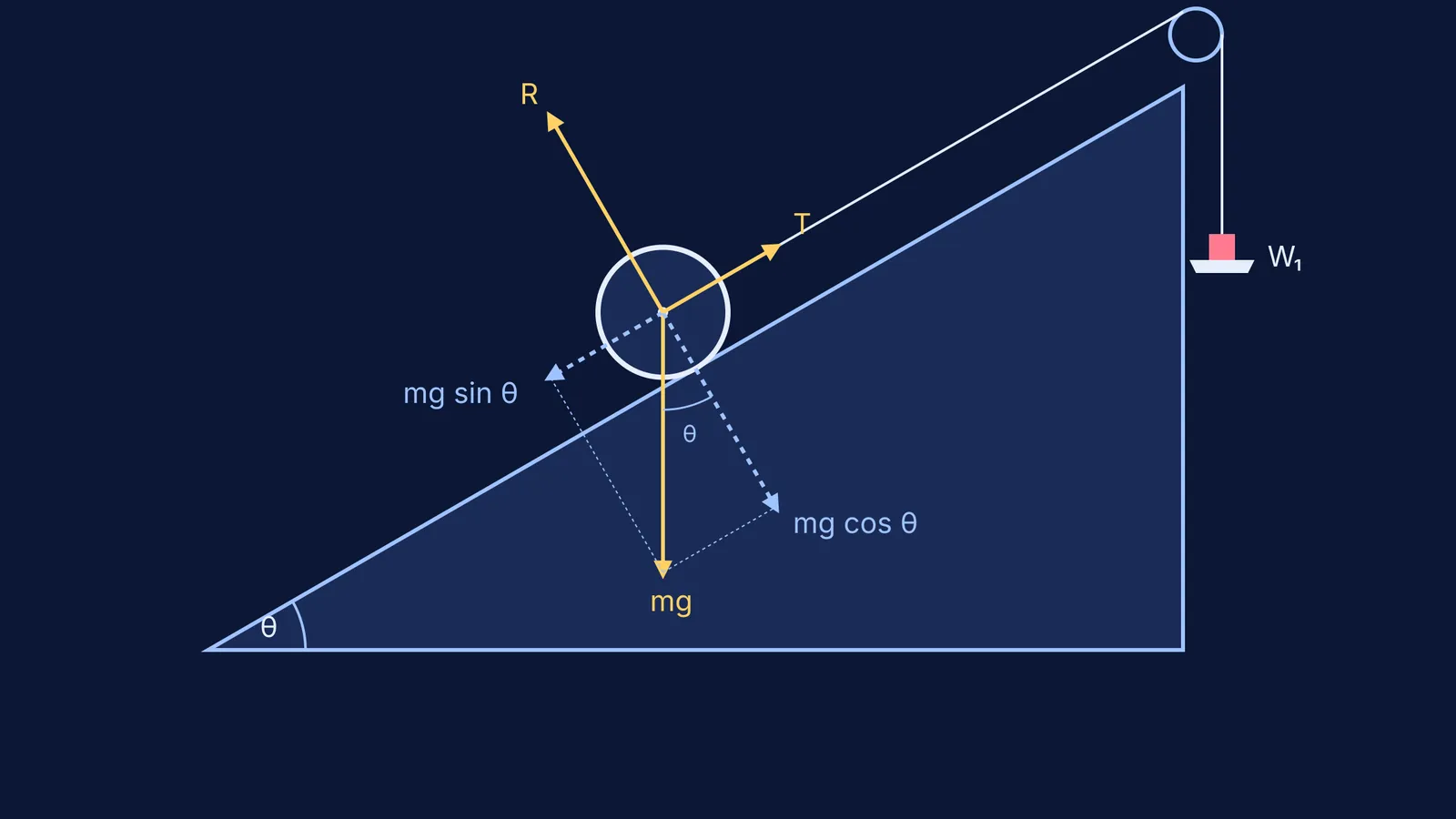
When a roller of mass m sits on a plane tilted at an angle θ, the theoretical downward force acting along the inclined plane is W = mg sin θ 1. Its full weight (mg) splits into two components:
mg cos θ: This acts perpendicular to the surface and is balanced by the normal reaction (R).
mg sin θ: This acts parallel to the plane, pulling the roller downwards.
To measure this downward force (W) experimentally, you place a heavy metal roller on a glass-topped inclined plane and connect it to a weight pan using a thread passed over a frictionless pulley.
First, you add weights to the pan until the roller just starts moving upward with a uniform velocity. This total weight in the pan is W1.
Next, you remove weights until the roller just begins sliding downward with uniform velocity. This weight is W2.
If you are unsure how to resolve weight into perpendicular and parallel components, the Fermi Concept Library has a lesson for every concept in physics, each with its place in the map.
Why do we calculate the mean force?
In a real laboratory, friction (f) between the roller and the glass plane affects the movement.
When the roller moves up, friction acts down the slope. The weights in the pan must overcome both the downward force and friction: W1 = mg sin θ + f 1.
When the roller moves down, friction acts up the slope. The pan only needs to balance the downward force minus friction: W2 = mg sin θ - f 1.
By taking the average, you cancel out the friction: Mean Force W = (W1 + W2) / 2 = mg sin θ.
This allows you to isolate the pure gravitational effect.
For related mechanics concepts involving surfaces, see our guide on the Angle of repose and angle of friction: the tan θ = μ result.
What precautions reduce error in the inclined plane practical?
To get a perfectly straight line passing through the origin, minimizing experimental errors is crucial. Friction and inaccurate mass measurements are the biggest obstacles.
Ensure uniform velocity: When finding W1 and W2, the roller must move with uniform velocity, not acceleration. If the roller accelerates, Newton's second law (F = ma) introduces an extra force term that ruins the W = mg sin θ calculation.
Lubricate the pulley: A sticky pulley adds unknown friction to the thread. Adding a drop of oil helps ensure the tension in the thread exactly matches the weight in the pan.
Keep the thread parallel: The thread pulling the roller must be exactly parallel to the surface of the inclined plane. If it pulls at an angle, it creates an upward vertical component that artificially reduces the normal reaction (R) and alters the required balancing force.
Level the base: Use a spirit level to ensure the wooden base of the apparatus is perfectly horizontal before measuring the inclination angle θ.
Why do we plot force vs sin θ?
After recording the mean force W for several angles (such as 30°, 35°, and 40°), you plot W on the y-axis against sin θ on the x-axis 1.
Because W = mg sin θ, this matches the equation of a straight line, y = mx, where m (the slope) is a constant. The resulting graph is a straight line passing through the origin. This straight line confirms that the downward force is directly proportional to the sine of the angle of inclination 1.
Example: Finding the mass of the roller from the graph
Once you have drawn the graph of W versus sin θ, you can calculate the roller's mass directly from the line of best fit.
Suppose you pick two points on your straight line. At point A, sin θ = 0.4 and the measured force W = 100 gf (grams-weight). At point B, sin θ = 0.6 and the force W = 150 gf.
Find the change in force (ΔW): 150 - 100 = 50 gf.
Find the change in sin θ (Δsin θ): 0.6 - 0.4 = 0.2.
Calculate the slope: 50 / 0.2 = 250 gf.
Since the slope equals the total weight of the roller (mg), you have mg = 250 gf. Because we are working in grams-weight, the mass of the roller is directly 250 g.
Practicing the math behind these force equations builds intuition for harder mechanics topics, much like calculating the Simple pendulum string tension at any angle: mg cos θ + mv²/l. When you need to practice problems on inclined planes, the Fermi Problem Library has worked problems with a step-by-step solver that explains the reasoning rather than printing an answer.


