

On this page
Fertilisation questions in NEET-UG biology can look like simple recall, but some turn on timing. Two numbers do most of the work: how long the egg stays usable after release, and how long sperm stay alive while they wait. Know both and you can work out the fertile window instead of memorising it.
How long does the egg survive after ovulation?
What the ovary releases is not a finished ovum but a secondary oocyte. OpenStax's Anatomy and Physiology chapter on fertilisation notes that secondary oocytes stay arrested in metaphase of meiosis II until fertilisation.
That cell does not last long. The same OpenStax chapter says an oocyte can survive on its own for only about 24 hours after ovulation. UCSF Health gives a range: the egg can be fertilised for only 12 to 24 hours.
This short life explains where fertilisation happens. OpenStax says it must take place in the distal uterine tube because an unfertilised oocyte cannot survive the 72-hour journey to the uterus. Its chapter on the ovarian reproductive system names the middle region of the tube, the ampulla, as where fertilisation often occurs.
An egg that waits too long may also be less viable. In a 1998 study in Human Reproduction, Allen Wilcox, Clarice Weinberg and Donna Baird found that the risk of early pregnancy loss rose as the likelihood that the oocyte had aged before fertilisation increased. They suggested this ageing may cause early pregnancy failure in humans, as it does in several other mammals.
How long do sperm survive in the female tract?
Much longer than the egg. UCSF Health says motile sperm can survive in the female reproductive tract for up to five days, with cervical mucus acting as a reservoir. OpenStax says that if they do not meet an oocyte straight away, they can survive in the uterine tubes for another 3 to 5 days.
They also arrive fast: OpenStax says the journey to the tubes usually takes 30 minutes to 2 hours. On the way, fluids in the tract prepare them through capacitation, explained in our post on what sperm capacitation means.
Why is the fertile window about six days?
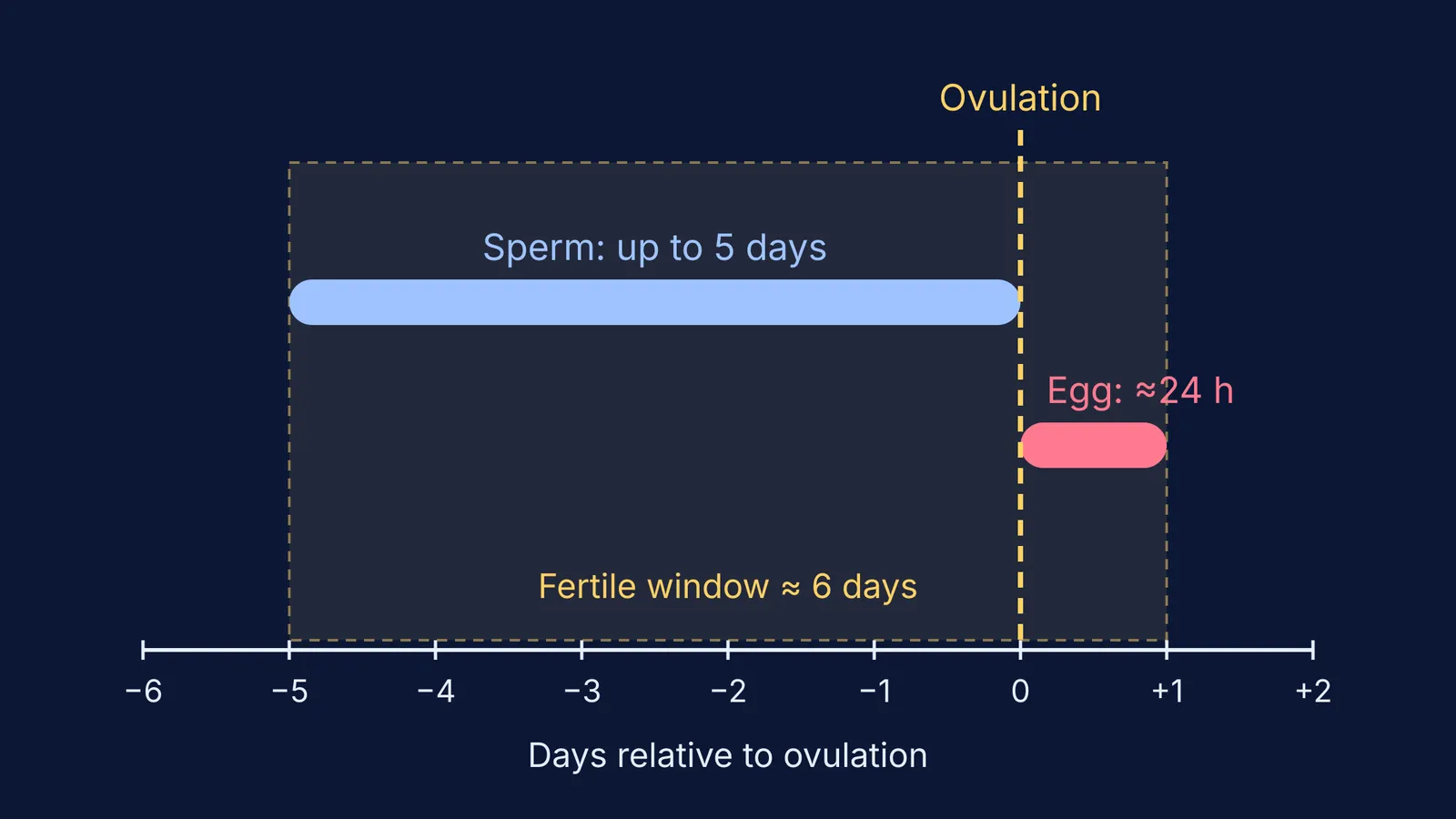
Add the two numbers: up to five days of sperm survival before ovulation (UCSF Health), plus about one day of egg survival (OpenStax).
Real data match this. In a 1995 study in the New England Journal of Medicine, Wilcox, Weinberg and Baird followed 221 healthy women planning to conceive across 625 menstrual cycles and recorded 192 pregnancies. Conception happened only when intercourse took place during a six-day period ending on the estimated day of ovulation.
Those days were not equal. The same study found the probability of conception rose from 0.10 when intercourse was five days before ovulation to 0.33 on the day of ovulation itself. Only 6 percent of pregnancies could be firmly attributed to sperm three or more days old.
How can NEET-UG questions test fertilisation timing?
Timing can come up in assertion-reason items, statement questions and short cycle problems. Here is a worked example built on the textbook timings from OpenStax.
Question: A woman has a regular 28-day cycle. On which of these days could intercourse lead to fertilisation: day 8, day 12, day 14 or day 16?
Find ovulation. OpenStax states that in a typical 28-day cycle, ovulation occurs on day 14.
Count sperm survival backwards. Sperm live up to five days (UCSF Health), so the earliest useful day is day 9. Day 8 is too early.
Count egg survival forwards. The egg lasts about 24 hours (OpenStax), so by day 16 it is gone.
Answer: day 12 and day 14.
If the cycle length changes, only step 1 changes; our guide to calculating the ovulation day from cycle length shows how. Before you mark an answer, check:
Did you call the released cell a secondary oocyte?
Did you count sperm survival backwards from ovulation?
Did you give the egg only about one day?
Did you place fertilisation in the ampulla, not the uterus?
What happens after the zygote forms is in our post on fertilisation to implantation.
Where can you revise oocytes, sperm and the fertile window?
If oocyte, ampulla and capacitation still blur together, the Fermi Concept Library gives each biology concept its own lesson and shows its place in the map. Not sure where to start with human reproduction? Fermi's AI tutor can work out what you already know and build a plan for the session, so you begin with your actual gap.


