On this page
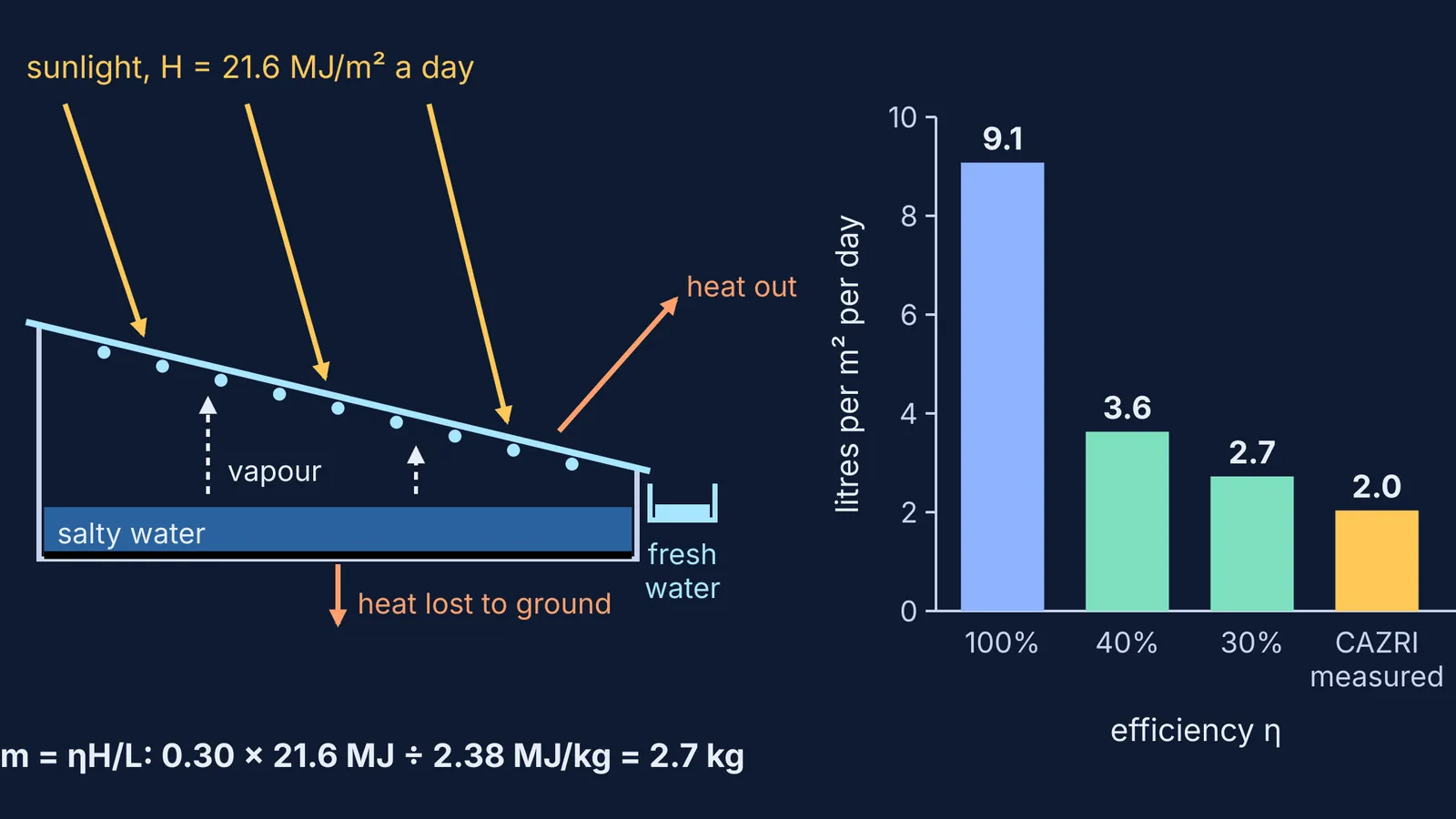
A solar still is a shallow black tray of salty or dirty water under a sloping sheet of glass. Sunlight warms the water, vapour rises, condenses on the cooler glass and runs down into a channel. The salt stays behind in the tray. There are no moving parts and no fuel, which is why stills are tried in dry, sunny places where groundwater is brackish, such as western Rajasthan. The physics question is simple: how many litres can one square metre of sunshine give you in a day? One line of energy balance answers it, and explains why stills are slow.
How does a basin solar still work?
Absorb. Sunlight passes through the glass and is absorbed by the blackened base and the water.
Evaporate. The water warms well above air temperature but stays far below boiling, and evaporates from its surface.
Condense. The glass is cooler because outside air and the sky cool it, so vapour condenses on its underside.
Collect. The droplets run down the sloping glass into a channel at the lower edge and out to a bottle.
Two points are easy to miss. The still does not boil the water; it only evaporates it. And when the vapour condenses, it gives back its latent heat to the glass. That heat then has to escape to the outside air, or the glass would warm up and stop condensing. So every kilogram of water carries its full latent heat to the glass and the heat is thrown away. That is the whole reason a simple still is slow.
The idea is old. Maria Telkes designed an inflatable solar still for life rafts, which is mentioned in Maria Telkes and storing the Sun's heat in salts.
How much water can one square metre of sunshine make?
Use the energy balance:
mass of water per day = η × H ÷ L
H is the solar energy falling on one square metre in a day.
L is the latent heat of vaporisation at the water's temperature.
η is the fraction of the sunshine that ends up evaporating water, the still's efficiency.
For Jodhpur, a peer-reviewed review from ICAR-CAZRI gives a mean annual daily solar radiation of 6.0 kWh/m² per day with 8.9 hours of sunshine (Poonia and Singh, Annals of Arid Zone, 2024). Convert: 6.0 kWh × 3.6 MJ/kWh = 21.6 MJ per square metre per day.
For L, do not use 2.26 MJ/kg. That is the value at 100 °C. Latent heat is larger at lower temperatures, and steam tables give about 2.38 MJ/kg at 50 °C. Why vaporisation needs so much energy at all is covered in why latent heat of vaporisation is greater than fusion.
If every joule went into evaporation (η = 1):
21.6 MJ ÷ 2.38 MJ/kg = 9.1 kg, which is about 9.1 litres per m² per day.
That is the ceiling for a simple single-glass still in Jodhpur on an average day.
Why is a real solar still only about 30% efficient?
The ceiling assumes nothing is lost. In practice, sunlight and heat leave by several routes:
Some light is reflected or absorbed by the glass before it reaches the water.
The base and sides conduct heat into the ground and air.
The warm water and glass radiate heat, and wind carries heat off the glass.
The water and tray store heat during the day and release some of it in the evening.
Most of the loss is heat conducted and radiated away, not light bounced off the glass. The same CAZRI review describes a brick basin still at Jodhpur with a 4.2 m² absorber and a 20° glass cover, which gave an average of 8,540 ml of distillate a day at an average efficiency of 30.25%.
How big a still does a household need?
Question. A still in Jodhpur receives 6.0 kWh/m² a day. Its efficiency is 30%. Take L = 2.38 MJ/kg. (a) What is its daily output per m²? (b) What area gives 10 litres a day? (c) Compare with the measured CAZRI still.
Daily energy. H = 6.0 × 3.6 = 21.6 MJ per m².
Energy into evaporation. 0.30 × 21.6 = 6.48 MJ per m².
Water. 6.48 ÷ 2.38 = 2.72 kg, so about 2.7 litres per m² per day (1 kg of water is about 1 litre).
Area for 10 litres. 10 ÷ 2.72 = 3.7 m².
Measured unit. 8.54 litres ÷ 4.2 m² = 2.0 litres per m² per day.
Implied efficiency. 2.03 × 2.38 ÷ 21.6 = 0.22, or 22%.
Answer. About 2.7 litres per m² a day, so about 3.7 m² for 10 litres. The measured still gives 2.0 litres per m², which would need about 4.9 m². The gap is expected. The 30.25% efficiency in the paper was measured on the authors' test days, and the 6.0 kWh/m² is a yearly average, not the sunshine on those days. Real output swings with season, cloud, wind and water depth.
Check the units: (dimensionless) × (MJ/m²) ÷ (MJ/kg) = kg/m², a mass per area, as it should be.
Why can't a simple solar still beat about 9 litres a day?
Because each kilogram needs its 2.38 MJ, and in a single-glass still that heat is lost through the glass once the water condenses. The day's sunshine can pay for at most 21.6 ÷ 2.38 = 9.1 kg.
The ceiling applies to single-effect stills. Multi-effect designs pass the heat released by condensation in one stage to evaporate water in the next stage, so they reuse the latent heat and can go past the single-effect limit. Reverse osmosis avoids evaporation entirely; it pushes water through a membrane, as explained in how seawater is made drinkable by reverse osmosis in Chennai.
Compare with fuel. Distilling a litre on a stove, starting from 25 °C, takes 4.19 × 75 kJ to reach 100 °C plus 2,257 kJ to boil it off: about 2.57 MJ, or 0.71 kWh per litre. The still does the same job with free sunshine, which is why its slowness is acceptable where fuel is scarce.
Is solar still water ready to drink?
Distillate contains very little dissolved salt. The CAZRI authors write that distilled water from their unit should be mixed with salt water in proportions suitable for drinking, and that up to 20 litres a day of drinking water at 150 ppm TDS can be made this way from raw water containing 300 ppm TDS. Beyond what that source states, this article makes no claim about drinking-water safety; follow local water-quality testing and health guidance.
For more energy-balance problems like this one, the Fermi Problem Library has a step-by-step solver that explains the reasoning.
Quick checklist
Output = ηH/L, per square metre per day.
Jodhpur: about 6.0 kWh/m² a day, which is 21.6 MJ.
Use L ≈ 2.38 MJ/kg at 50 °C, not 2.26 MJ/kg.
Ceiling for a single-effect still: about 9.1 litres per m² a day.
At 30% efficiency: about 2.7 litres per m² a day.
Losses are mostly heat through the glass, base and sides.
Multi-effect stills reuse latent heat and can beat the single-effect ceiling.