

On this page
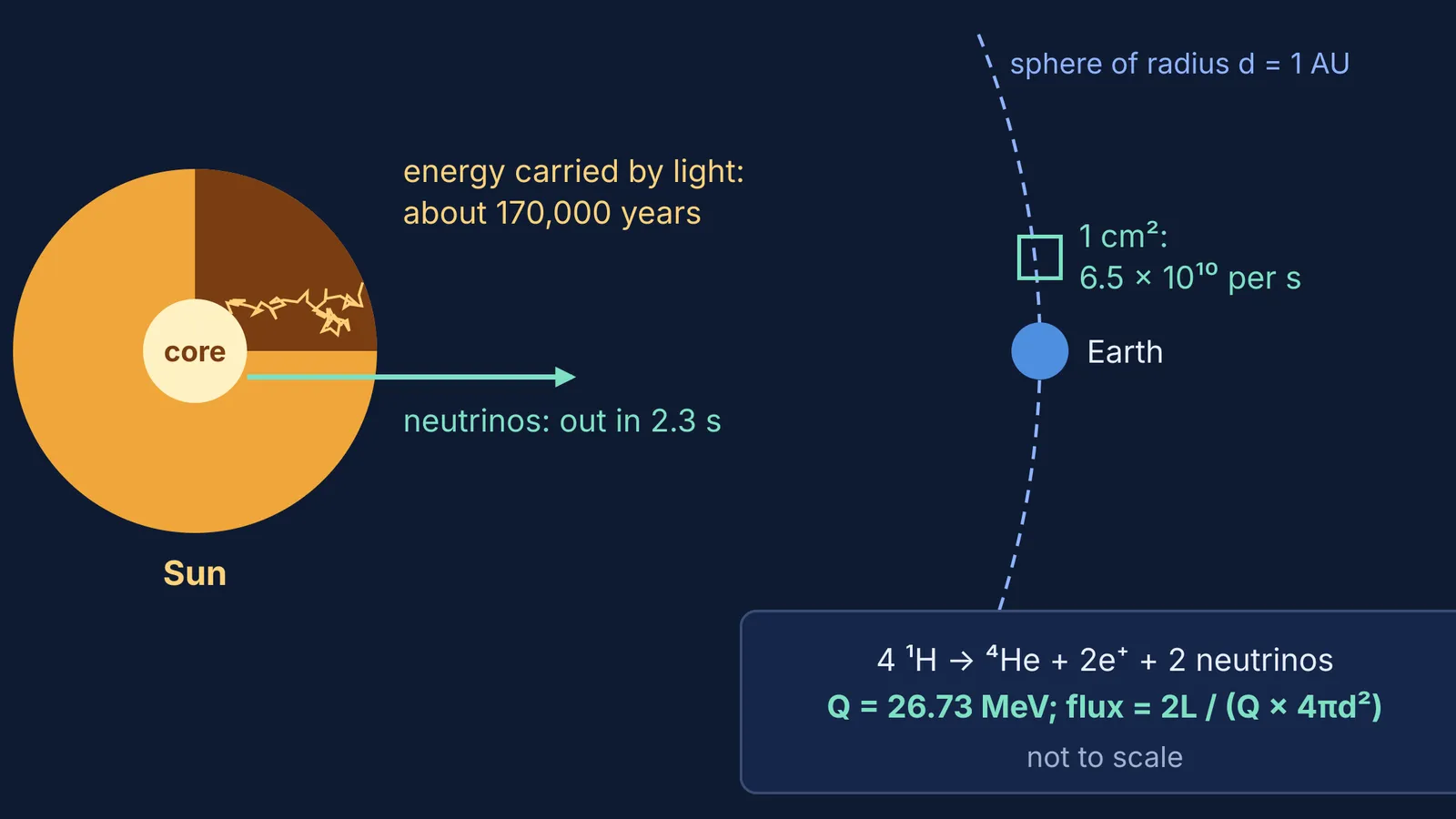
Hold up your thumb. Every second, about 65 billion neutrinos from the Sun pass through each square centimetre of it, and almost none of them stop. They pass through you at night too, after crossing the whole Earth. You can get that number yourself from three facts: the Sun's power, the energy released when hydrogen becomes helium, and the inverse-square law. The same sum explains why neutrinos tell us what the Sun's core is doing right now, while sunlight reports on the distant past.
Where do solar neutrinos come from?
The Sun turns hydrogen into helium. Whatever the route, the net change is
4 ¹H → ⁴He + 2e⁺ + 2ν
Two of the four protons must become neutrons, and each of those conversions releases one electron neutrino (almost always with a positron). So every helium nucleus made comes with exactly two neutrinos. That fixed ratio is what lets us count them. The individual steps of the proton–proton chain and the hydrogen burned each second are covered in how nuclear fusion powers the Sun, so here we start from the net reaction.
The energy released per helium nucleus comes from the mass difference. Using atomic masses (the electrons balance once the positrons annihilate):
Q = (4 × 1.007825 u − 4.002603 u) × 931.494 MeV/u = 26.73 MeV
Most of this becomes heat in the core and, eventually, sunlight. A small part leaves with the neutrinos and never heats anything. The pp-chain neutrinos carry at most 0.42 MeV each, according to a 2025 review of solar neutrinos by Chen and Xu, so in the main branch the pair takes away less than 0.84 MeV, about 3% of Q at most. The same review notes that the pp chain makes about 99% of the Sun's energy and the CNO cycle about 1%, so treating all of it as hydrogen to helium by the pp chain is a good approximation.
How many neutrinos reach each square centimetre of Earth?
Worked example: the solar neutrino flux
Data: solar luminosity L = 3.828 × 10²⁶ W, 1 AU = 1.496 × 10¹¹ m, 1 MeV = 1.602 × 10⁻¹³ J.
Energy per helium nucleus in joules. 26.73 MeV × 1.602 × 10⁻¹³ J/MeV = 4.28 × 10⁻¹² J.
Helium nuclei made per second. N = L / Q = 3.828 × 10²⁶ / 4.28 × 10⁻¹² = 8.9 × 10³⁷ per second.
Neutrinos per second. Two per helium nucleus: 1.8 × 10³⁸ neutrinos leave the Sun every second.
Spread over a sphere. At Earth's distance they are spread over 4πd² = 4π × (1.496 × 10¹¹)² = 2.81 × 10²³ m².
Flux. 1.79 × 10³⁸ / 2.81 × 10²³ = 6.4 × 10¹⁴ per m² per second. Since 1 m² = 10⁴ cm², that is 6.4 × 10¹⁰ per cm² per second.
Correct for the neutrinos' own share. If the neutrinos take up to 0.84 MeV, only about 25.9 MeV per helium nucleus becomes sunlight, so slightly more reactions are needed to supply L. Redoing step 2 with 25.9 MeV gives 6.6 × 10¹⁰ per cm² per second. Either way, about 6.5 × 10¹⁰, or 65 billion.
Check the units. W ÷ J gives s⁻¹; divided by m² gives m⁻² s⁻¹. A flux, as expected.
The whole result fits in one line: flux = 2L / (Q × 4πd²).
How good is this back-of-envelope number? Detailed solar models listed in the same review predict a pp-neutrino flux of about 6.0 × 10¹⁰ per cm² per second, which the review says is 91% of the total, so the full predicted flux is about 6.6 × 10¹⁰. The Borexino experiment, reporting in Nature in 2014, measured the pp neutrinos directly at (6.6 ± 0.7) × 10¹⁰ per cm² per second. Our three-fact estimate lands within the measurement's uncertainty.
How many pass through your body?
Take an illustrative area of 0.5 m² for an adult facing the Sun (roughly 1.7 m tall and 0.3 m wide). Then 6.5 × 10¹⁴ × 0.5 ≈ 3 × 10¹⁴ neutrinos pass through you every second. At night the number is almost the same, because neutrinos cross the whole Earth with hardly any being absorbed. They pass through you without effect; the reason detectors need thousands of tonnes of material is that a neutrino so rarely interacts with anything.
Why do neutrinos show the Sun's core as it is now?
Compare the two messengers.
Neutrinos leave the core almost unhindered. Crossing the Sun's radius of 6.96 × 10⁸ m at nearly the speed of light takes 6.96 × 10⁸ / 3.00 × 10⁸ = 2.3 seconds. The trip from the Sun to Earth takes 1.496 × 10¹¹ / 2.998 × 10⁸ = 499 s, or 8 minutes 19 seconds.
Energy carried by light is absorbed and re-emitted countless times on its way out of the dense interior. A random-walk calculation by Mitalas and Sills in The Astrophysical Journal (1992) gives about 170,000 years for this diffusion. Other estimates range from tens of thousands to millions of years depending on the assumptions; John Bahcall's essay "How the Sun Shines" quotes about ten million. All of them are vastly longer than 2 seconds.
So the sunlight on your face tells you how hard the core was burning many thousands of years ago. The neutrinos passing through you tell you how hard it is burning now. Since the neutrino flux matches what today's sunlight requires, the core's output has stayed steady over that time.
Early neutrino detectors found fewer neutrinos than predicted. That shortfall was not an error in the flux calculated above: neutrinos change type on the way, and detectors that saw only one type missed the rest. That story is told in Ray Davis and the missing neutrinos from the Sun. India's own early underground work at the Kolar Gold Fields is covered in M. G. K. Menon and the deep mine experiments.
If you want to practise more flux and inverse-square numericals like this one, the Fermi Problem Library has a step-by-step solver that explains the reasoning.
What mistakes cost marks here?
Forgetting the factor 2: two neutrinos per helium nucleus.
Using the Sun's radius instead of the Earth–Sun distance in 4πd².
Leaving the answer in m⁻² s⁻¹ when the question asks per cm² (divide by 10⁴).
Saying the early shortfall meant the Sun was burning less. It was neutrinos changing type.
Quick checklist
Net reaction: 4 ¹H → ⁴He + 2e⁺ + 2ν, Q = 26.73 MeV.
Helium nuclei per second: L/Q ≈ 9 × 10³⁷; neutrinos: about 1.8 × 10³⁸ per second.
Flux = 2L / (Q × 4πd²) ≈ 6.5 × 10¹⁰ per cm² per second at Earth.
Borexino measured (6.6 ± 0.7) × 10¹⁰ per cm² per second for pp neutrinos.
Neutrinos escape the core in about 2 s; energy carried by light takes many thousands of years.


