

On this page
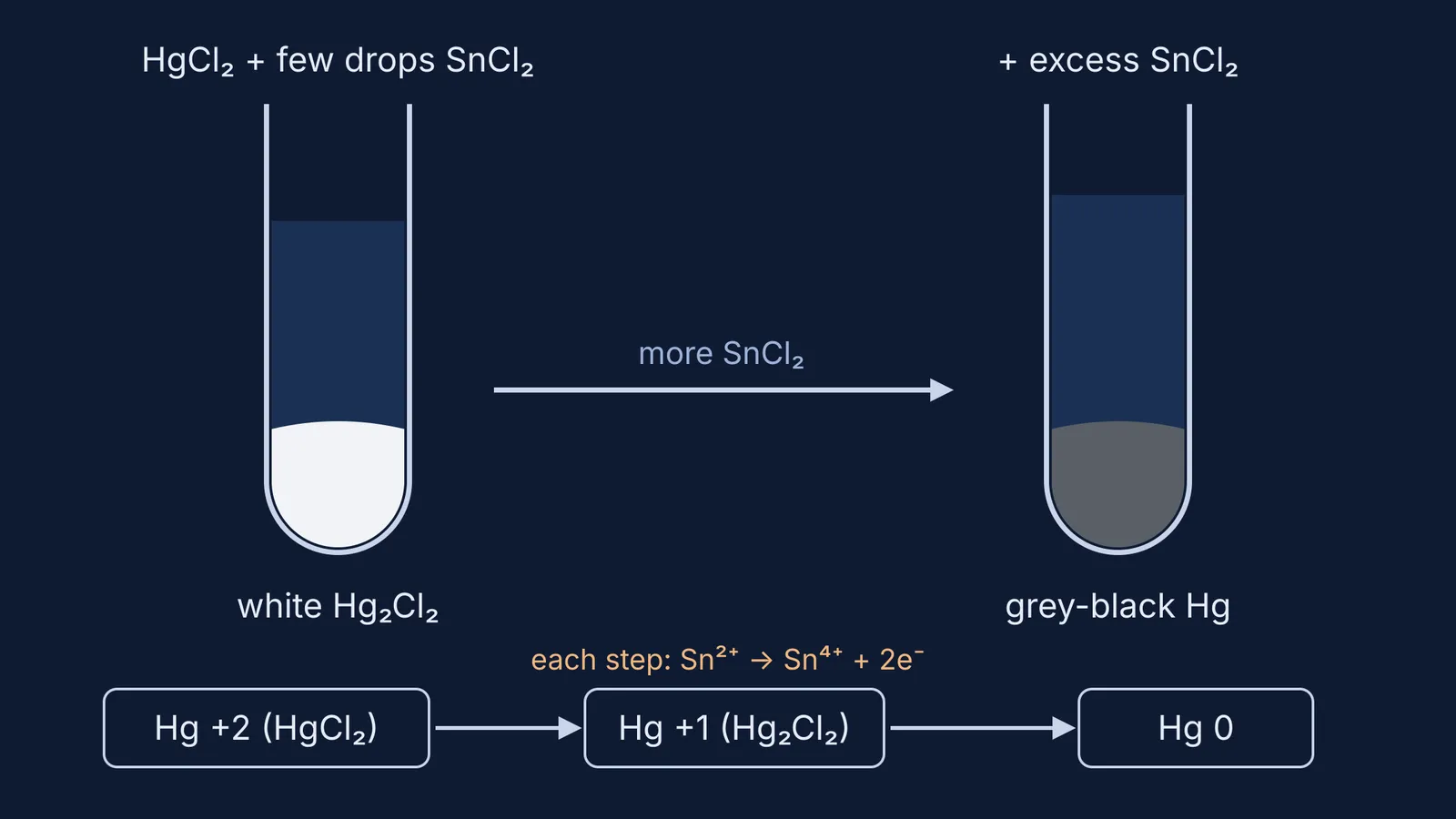
Add a few drops of tin(II) chloride to a solution of mercury(II) chloride and a silky white precipitate appears. Keep adding SnCl₂ and the white solid turns grey, then black. That colour change is the classic test for Hg²⁺, and it works because SnCl₂ is a good reducing agent. The reason sits in group 14. For tin, +4 is the more stable oxidation state, so Sn²⁺ gives up two electrons readily. Lead, just below it, behaves the other way round.
Why is SnCl₂ a reducing agent when PbCl₂ is not?
Both tin and lead have an ns² np² outer configuration and can show +2 and +4. Going down group 14, the ns² pair becomes less willing to take part in bonding. This is the inert pair effect. It is strong for lead, so Pb(II) is the stable state and Pb(IV) is an oxidiser. You can read the full trend in the inert pair effect and why heavy p-block elements prefer lower states.
For tin the effect is much weaker. Sn(IV) is the more stable state, as in SnO₂ (the ore cassiterite) and SnCl₄. So Sn(II) tends to lose two electrons and move up to Sn(IV). That makes it a reducing agent.
The standard electrode potentials show the contrast (values are approximate and vary slightly between tables):
Sn⁴⁺ + 2e⁻ → Sn²⁺, E° ≈ +0.15 V. This is a low value, so Sn²⁺ is easily oxidised.
PbO₂ + 4H⁺ + 2e⁻ → Pb²⁺ + 2H₂O, E° ≈ +1.46 V. This is a high value, so Pb(IV) is easily reduced.
Any oxidising agent whose reduction potential is well above +0.15 V can, in principle, be reduced by Sn²⁺. Fe³⁺, Hg²⁺, I₂ and acidified dichromate all qualify.
One more detail. In hydrochloric acid, tin(IV) is not present as a bare Sn⁴⁺ ion. It exists as the complex ion [SnCl₆]²⁻. Writing Sn⁴⁺ in equations is a shorthand that exam papers accept.
What happens in the HgCl₂ and SnCl₂ test?
Mercury goes down two oxidation states in two steps, and each step gives a different colour.
Step 1: a little SnCl₂. Hg(II) is reduced to Hg(I), which forms insoluble white mercury(I) chloride, Hg₂Cl₂ (calomel):
2HgCl₂ + SnCl₂ → Hg₂Cl₂ + SnCl₄
Step 2: excess SnCl₂. Hg(I) is reduced further to metallic mercury. It forms as tiny droplets, so it looks grey to black:
Hg₂Cl₂ + SnCl₂ → 2Hg + SnCl₄
Check both equations. In step 1: Hg 2 = 2, Sn 1 = 1, Cl 4 + 2 = 2 + 4. In step 2: Hg 2 = 2, Cl 2 + 2 = 4. In each step tin loses 2e⁻ and the two mercury atoms gain 1e⁻ each.
Why does the second step happen at all? The calomel half-reaction, Hg₂Cl₂ + 2e⁻ → 2Hg + 2Cl⁻, has E° ≈ +0.27 V. This is the same couple used in the calomel reference electrode. It sits above +0.15 V, so Sn²⁺ can still push it downhill, though by a smaller margin than in step 1.
Note that Hg₂Cl₂ contains the Hg₂²⁺ ion, with a Hg–Hg bond. The reason mercury(I) is a dimer is covered in why the mercurous ion exists as Hg₂²⁺. This post is about how the test forms it.
How is SnCl₂ used before a dichromate titration of iron?
To find total iron in an ore with K₂Cr₂O₇, all the iron must first be Fe²⁺, because dichromate only oxidises Fe²⁺. Any Fe³⁺ is reduced first with SnCl₂ in hot HCl:
2Fe³⁺ + Sn²⁺ → 2Fe²⁺ + Sn⁴⁺
The charges balance at +8 on each side. The yellow colour of Fe³⁺ in HCl fades as the reaction goes, which tells you when to stop. A slight excess of SnCl₂ is added to be sure every Fe³⁺ is reduced.
That excess must go before you titrate, or it will also be oxidised by dichromate and use up titrant. You remove it by adding HgCl₂ quickly and in excess:
SnCl₂ + 2HgCl₂ → Hg₂Cl₂ + SnCl₄
You should see a small amount of silky white Hg₂Cl₂, which does not interfere with the titration. If the precipitate is grey or black, too much SnCl₂ was present and some Hg formed. Finely divided mercury can react with dichromate, so that sample is discarded. A titration that uses this step is the two-titration method for an Fe²⁺ and Fe³⁺ mixture.
Worked example: how far does Sn²⁺ + 2Fe³⁺ go?
Question. Use E°(Fe³⁺/Fe²⁺) = +0.77 V and E°(Sn⁴⁺/Sn²⁺) = +0.15 V. Find E°cell, ΔG° and K at 298 K for 2Fe³⁺ + Sn²⁺ → 2Fe²⁺ + Sn⁴⁺.
Pick the cathode and anode. Fe³⁺ is reduced (cathode) and Sn²⁺ is oxidised (anode).
E°cell. E°cathode − E°anode = 0.77 − 0.15 = +0.62 V.
Electrons transferred. Each Sn²⁺ loses 2e⁻, and two Fe³⁺ each gain 1e⁻, so n = 2.
ΔG°. ΔG° = −nFE° = −2 × 96485 × 0.62 ≈ −1.20 × 10⁵ J mol⁻¹, or about −120 kJ mol⁻¹.
K. log K = nE°/0.0591 = (2 × 0.62)/0.0591 ≈ 21.0, so K ≈ 10²¹.
Answer. E°cell = +0.62 V, ΔG° ≈ −120 kJ mol⁻¹ and K ≈ 10²¹. The reduction is complete for practical purposes, which is why it works as a quantitative step before a titration. The same −nFE° = −RT ln K link works for any redox pair.
Follow-up. How much SnCl₂ reduces 25.0 mL of 0.100 M Fe³⁺? Fe³⁺ = 0.00250 mol. SnCl₂ needed = 0.00250/2 = 0.00125 mol. With M(SnCl₂) = 189.6 g mol⁻¹, that is about 0.237 g.
If you mix up n or the sign of E°cell in problems like this, the Fermi Problem Library has a step-by-step solver that explains the reasoning at each line.
Where else does Sn or SnCl₂ act as a reducing agent?
In organic chemistry, tin and HCl reduce nitro groups to amines. Tin is oxidised to SnCl₂, which can itself act as a reductant and end up as Sn(IV). The overall equation for nitrobenzene, when tin ends as SnCl₂, is:
C₆H₅NO₂ + 3Sn + 7HCl → C₆H₅NH₃⁺Cl⁻ + 3SnCl₂ + 2H₂O
The nitro group takes 6e⁻, and three Sn atoms give 2e⁻ each. Adding a base then frees aniline.
SnCl₂ and HCl are also used in the Stephen reduction, which turns a nitrile into an aldehyde through an imine, which is then hydrolysed.
Why are SnCl₂ solutions stored with tin metal and HCl?
Two things spoil a SnCl₂ solution:
Air oxidation. 2SnCl₂ + O₂ + 4HCl → 2SnCl₄ + 2H₂O. Tin metal in the bottle reverses this: Sn + SnCl₄ → 2SnCl₂.
Hydrolysis. SnCl₂ + H₂O ⇌ Sn(OH)Cl + HCl. This gives a white, milky basic salt. Extra HCl pushes the equilibrium back to the left.
Quick checklist
For tin, +4 is more stable than +2, so Sn²⁺ is a reducing agent. For lead it is the reverse.
E°(Sn⁴⁺/Sn²⁺) ≈ +0.15 V; in HCl, Sn(IV) is really [SnCl₆]²⁻.
A little SnCl₂ + HgCl₂ gives white Hg₂Cl₂. Excess SnCl₂ gives grey-black Hg.
SnCl₂ reduces Fe³⁺ to Fe²⁺ before a dichromate titration. Remove the excess with HgCl₂, and discard the sample if the precipitate turns grey.
2Fe³⁺ + Sn²⁺: E°cell = 0.62 V, n = 2, K ≈ 10²¹.
Keep SnCl₂ solution with tin metal and HCl.


