

On this page
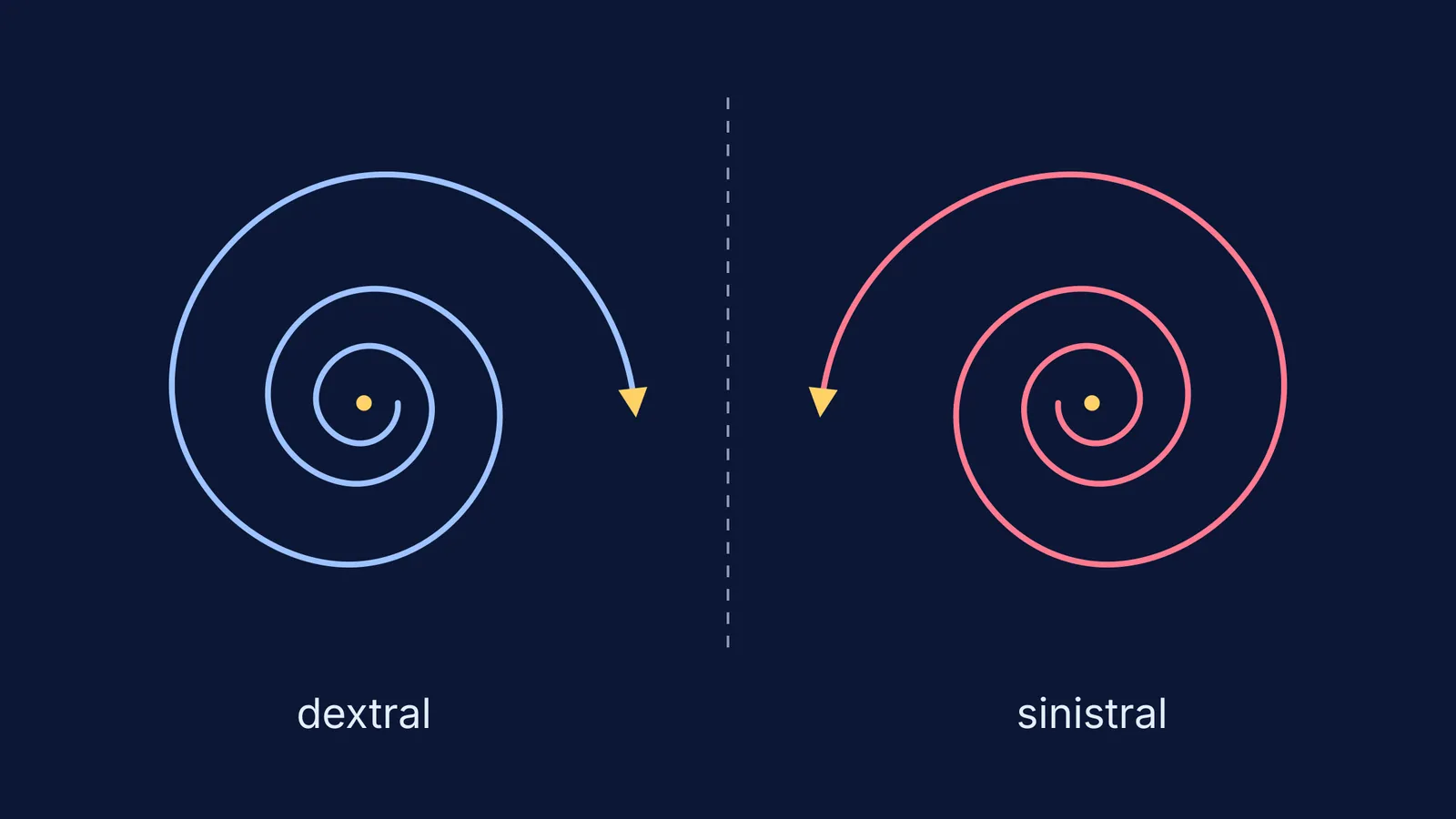
Pick up a snail shell and it very likely coils the same way as the last one you saw. The Conchological Society of Great Britain and Ireland gives a simple test: place the shell so that its apex (the pointed tip) is uppermost and its mouth faces you. If the mouth sits to the right, the shell is dextral. If it sits to the left, it is sinistral.
What do dextral and sinistral mean?
Dextral means coiled in a right-handed fashion and sinistral means coiled in a left-handed fashion, as the Conchological Society's identification guide defines them. The two forms are mirror images, like your left and right hands, and the handedness runs through the whole body, not just the shell.
Don't confuse coiling with torsion, the separate larval twist covered in why a snail larva twists its body.
Why do most snail shells coil to the right?
More than 90% of snail taxa are dextral, according to a 2005 review by Menno Schilthuizen and Angus Davison in Naturwissenschaften. Left-coiled forms still turn up, the same review notes, as mutant individuals, as populations inside right-coiled species, and as whole species, genera and even families.
Why right rather than left became the default is not settled; the review lists the preponderance of dextral species as a target for future research. What is better understood is why a population, once it coils one way, stays that way: mating, covered below.
How does one maternal gene set the direction in the egg?
In 1923, Boycott and Diver reported that broods from a single isolated pond snail (*Limnaea*) were wholly dextral or wholly sinistral, with rare exceptions, as Sturtevant's paper, reprinted by Electronic Scholarly Publishing, describes. A. H. Sturtevant of Columbia University offered a simple answer in Science. Dextral is dominant, he wrote, but the coiling of each snail is determined "not by its own constitution but by that of the unreduced egg from which it arose."
This is called a maternal effect. The 2005 review describes it as a single locus with delayed inheritance, "which means that the genotype is expressed in the mother's offspring" (Schilthuizen and Davison).
Finding the gene took nearly a century. A 2016 study led by Angus Davison in Current Biology linked coiling to a formin, a protein that helps build the cell's internal actin scaffolding, and found a single-base deletion in that gene in sinistral snails. Then, in the first use of CRISPR gene editing in a mollusc, Masanori Abe and Reiko Kuroda showed in 2019 that frameshift mutations in the formin gene they call *Lsdia1* produced left-coiled offspring generation after generation in an otherwise right-coiled line. They also found that it sets handedness at the one-cell stage, the earliest symmetry-breaking event they could link directly to body handedness.
How does Sturtevant's cross work, step by step?
Use Sturtevant's own symbols from the 1923 paper: *L* for the dominant dextral allele, *l* for the recessive sinistral one.
An *Ll* snail self-fertilises. Its offspring are *LL*, *Ll* and *ll*.
All of them coil right, even the *ll* ones, because their mother carried *L*.
Each *ll* snail will produce only sinistral offspring.
If an *ll* snail mates as the female with an *LL* snail, all the young coil left, because the mother had no *L*.
Those left-coiled young are *Ll*, so their own offspring will all coil right.
The rule: to predict a snail's shell, look at its mother's genotype.
Compare it with why mitochondrial DNA comes only from your mother.
Why can't left-coiled snails mate with right-coiled ones?
Copulation between dextral and sinistral snails "is usually strongly impeded by genital and behavioral mismatches," according to a 2010 study by Masaki Hoso and colleagues in Nature Communications. So a rare left-coiled snail, with its genitalia on the wrong side, struggles to find a partner, and selection usually works against it (Schilthuizen and Davison).
There is a twist. Most pareatid snakes have more teeth on one side of the lower jaw, which probably helps them eat right-coiled snails. In Hoso's trials with *Pareas iwasakii*, none of the dextral *Satsuma* snails survived, while 87.5% of sinistral snails did (Nature Communications). The authors argue that such predators can help a left-coiled form take over, and since the two forms barely interbreed, one gene might split a species. The 2005 review judged such single-gene speciation rare.
How do you answer a coiling question in an exam?
Define dextral (right-handed) and sinistral (left-handed).
Say the mother's genotype decides the phenotype, not the snail's own.
Write the cross one generation at a time.
Explain why populations stay one way: rare forms struggle to mate. Why right dominates overall is still open.
Keep maternal effect and mitochondrial inheritance apart.
If you lose marks on crosses where the phenotype skips a generation, the Fermi Problem Library has worked problems with a step-by-step solver that explains the reasoning rather than printing an answer. For the wider topic, the Fermi Concept Library gives each biology concept its own lesson, and our principles of inheritance mnemonics help with revision.


