

On this page
A young snail larva swims with its gut running from the mouth at the front to the anus at the back. Then, during larval development, the shell and everything inside it swing round by half a turn, leaving the anus over the head. That swing is torsion, and gastropods (snails, slugs, limpets, abalones) go through it as larvae. Biologists still argue about why it evolved.
What is torsion in gastropods?
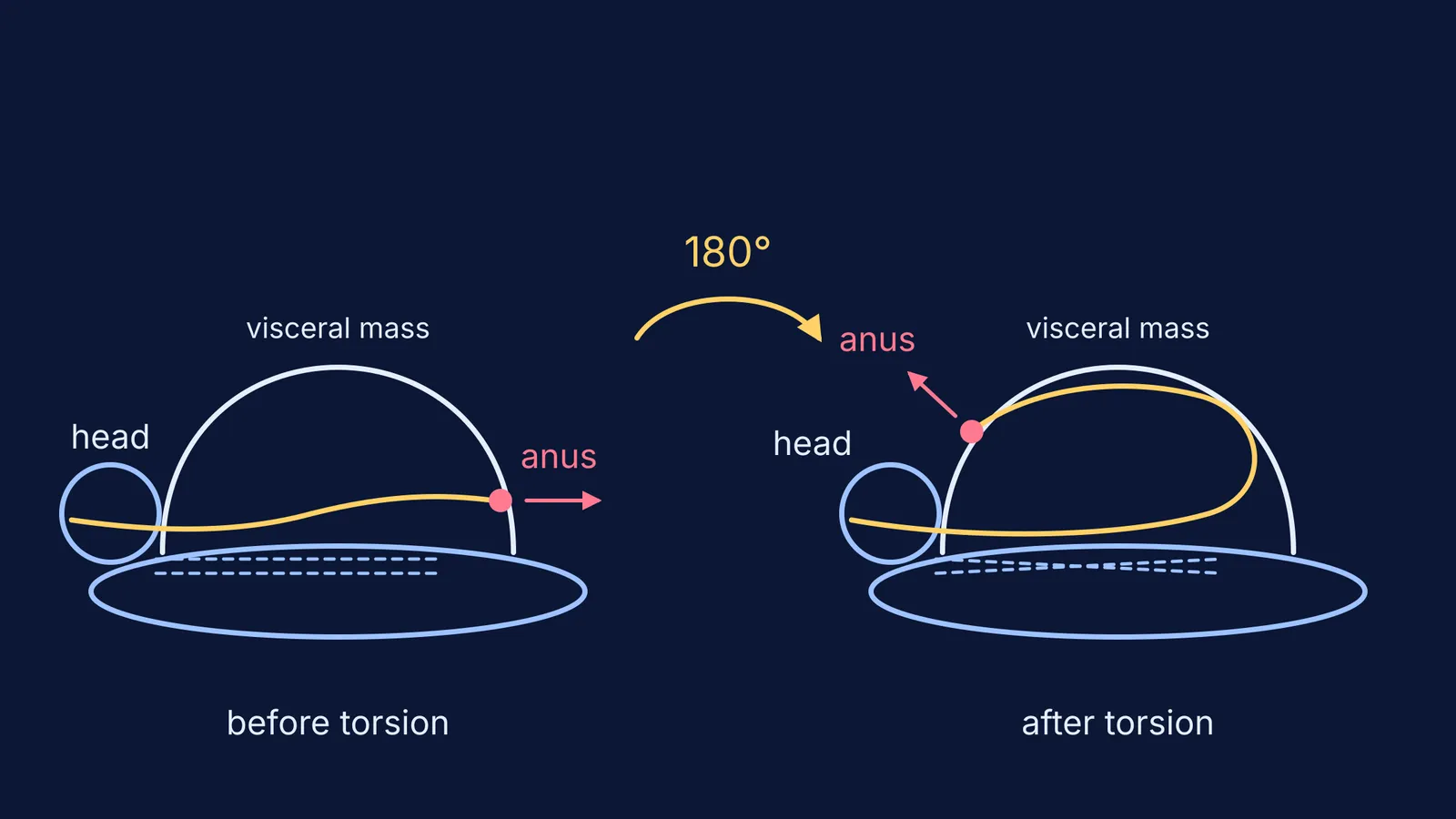
Torsion is a 180° twisting of the shell and viscera relative to the head and foot of the veliger larva, as Pennington and Chia define it in their 1985 paper in The Biological Bulletin. The veliger is the swimming larval stage of many molluscs.
The head and foot stay where they were. Only the upper part of the body turns: the visceral mass (gut, kidney, heart), the mantle and the shell. Seen from above, the rotation goes anticlockwise).
How does the twist happen in a snail larva?
Textbooks describe two stages: a quick first 90° from uneven muscle contraction, then a slow second 90° from uneven growth on one side (Wikipedia summary)).
Real larvae are messier. In the limpet *Patella caerulea*, Wanninger, Ruthensteiner and Haszprunar found that the full 180° rotation took about 2 hours at 20 to 22°C, as one smooth movement rather than two phases (Invertebrate Biology, 2000). They put it down to larval shell muscles working together with hydraulic (fluid pressure) activity.
Muscles may not even be essential. Louise Page treated larvae of two basal gastropods, *Calliostoma ligatum* and *Diodora aspera*, with antibiotics so that their larval retractor muscles failed to attach to the shell. The larvae still completed torsion, or almost completed it (Evolution and Development, 2002).
Why does the anus end up above the head?
Before torsion, the mantle cavity (the space under the mantle that holds the gills) opens towards the back. Turn it through 180° and it opens forwards, so the anus sits above the head) and the gut bends into a U.
The two long nerve cords that ran side by side now cross in a figure of eight, a state called streptoneury (same source)). In the abalone *Haliotis kamtschatkana*, Page found that the full crossing of these cords happens gradually, after the rotation itself, as the mantle cavity grows towards the left (Evolution and Development, 2006).
Waste released over your own head can foul the head region. Some gastropods solve it with a hole in the shell. In the keyhole limpet *Diodora aspera*, water is drawn in at the front, passes over the gills and leaves through the hole at the top, carrying waste with it (Animal Diversity Web).
Why did torsion evolve?
Its significance in gastropod evolution is disputed (Canadian Encyclopedia). The main ideas:
Larval defence (Garstang). Walter Garstang proposed in 1928 and 1929 that torsion lets a veliger pull its head into the shell first and then seal the opening with its foot and operculum (as summarised by Pennington and Chia).
Defence put to the test. Pennington and Chia offered pre-torsion and post-torsion abalone larvae to seven species of planktonic predator from four phyla. In only one case was the rate of predation lower on twisted larvae, so they concluded that torsion does not appear to work as a defence (The Biological Bulletin, 1985).
Benefits for adults. Suggestions include keeping sediment out of a front-facing mantle cavity, sensing the water ahead of the animal, better ventilation in land snails, and better balance of the shell (Wikipedia overview)).
No sudden rotation at all (Page). Page argues that development conserves not a 180° spin but a layout with the mantle cavity on one side, which could have evolved from one side of an ancestral two-sided structure (Integrative and Comparative Biology, 2006).
How do you draw and explain torsion in an exam?
A labelled pair of sketches shows the change more clearly than a paragraph. Practise this in under a minute:
Draw a flat foot and a head on the left. Put a dome (the visceral mass) on top.
Before torsion: run the gut from the mouth to an anus at the back, and draw two nerve cords side by side.
After torsion: keep the head and foot the same. Bend the gut into a U so the anus sits above the head, and cross the nerve cords.
Write "180°, anticlockwise from above, veliger larva" between the two sketches.
Then check your written answer covers:
What turns (visceral mass, mantle, shell) and what does not (head, foot)
Results (mantle cavity and anus in front, U-shaped gut, crossed nerve cords)
Why it is debated (Garstang's idea, the 1985 predator test, adult benefits)
If the mantle cavity is still a fuzzy idea, the biology section of the Fermi Concept Library gives each concept its own lesson and shows where it sits on the map. For more on mollusc and animal body plans, read our explainers on what the mollusc mantle, radula and gills do, cephalization and which animals show it and the phyla in Animal Kingdom for Class 11.


