

On this page
Cephalization is worth knowing alongside body symmetry when you study the Class 11 animal kingdom chapter for school exams and NEET-UG. The idea is simple: animals that move forward keep their brain and sense organs at the front. Here is what it means and which animals show it.
What is cephalization?
Cephalization is the concentration of the nervous system at the front (anterior) end of the body, in the head, as defined in OpenStax Introduction to Behavioral Neuroscience.
The Animal Sciences entry on Encyclopedia.com puts it as the process by which nervous and sensory tissues become concentrated in the head. In practice, you are looking for a brain (or a cluster of nerve cells called ganglia) and the main sense organs sitting together at one end of the animal.
Why does cephalization come with bilateral symmetry and forward movement?
OpenStax Biology 2e explains that bilateral symmetry allows streamlined, directional motion, and that the head and tail ends it creates promoted cephalization. An animal with left and right sides also has a front, and it travels front first.
That front end meets the world first. Encyclopedia.com notes that, with cephalization, the anterior end became the part most likely to first encounter food, predators and other important features of the environment. Sense organs there get the news early, and a brain just behind them can act on it.
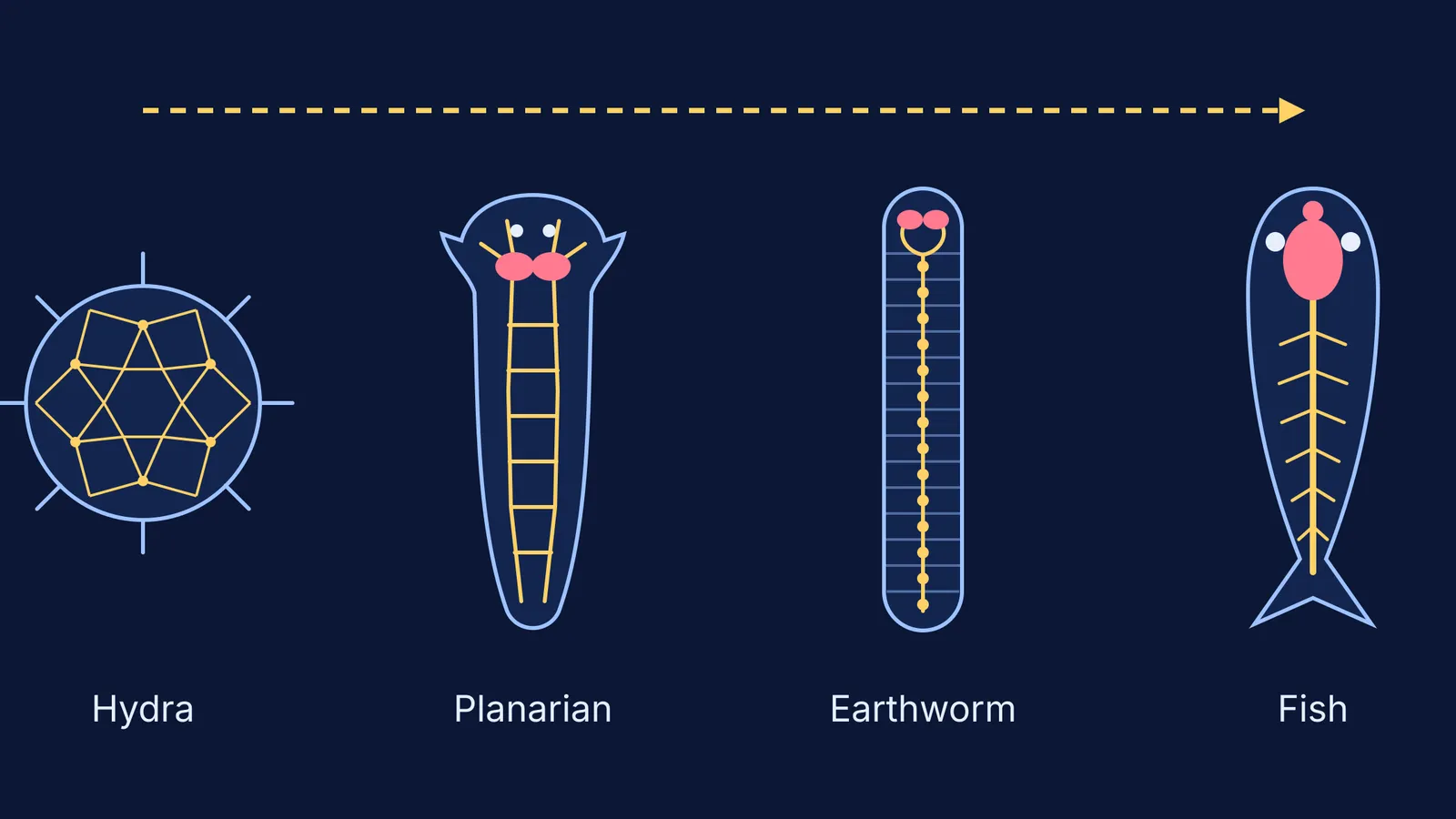
Radially symmetric animals have no front. OpenStax describes them as possibly sedentary, slow-moving or floating, and in cnidarians such as Hydra and jellyfish the nerve cells form a decentralised nerve net instead of a brain (OpenStax Biology 2e, section 35.1).
Which animals show cephalization, from flatworms to vertebrates?
Walk up the animal kingdom and the head becomes more defined at each step.
Cnidarians (Hydra, jellyfish): radial symmetry and a nerve net with no centre, the baseline with little or no head (OpenStax Biology 2e).
Flatworms (Planaria): among the simplest bilateral animals, with ganglia at the front end, so they show both centralisation and cephalization (OpenStax Behavioral Neuroscience). A planarian has a two-lobed brain, two light-sensitive eyespots on its triangular head, and two nerve cords joined by cross nerves like a ladder (Planarian, Wikipedia).
Annelids (earthworm): a body of repeated segments, with ganglia that control different segments (OpenStax Behavioral Neuroscience).
Arthropods (insects, prawns): a brain plus clusters of nerve cell bodies, called ganglia, along a ventral nerve cord (OpenStax Biology 2e).
Molluscs (octopus, squid): hunters with complex brains; an octopus has about 300 million neurons, according to OpenStax Biology 2e.
Vertebrates (fish to humans): a brain in the head and a spinal cord running along the back, encased in vertebrae (OpenStax Behavioral Neuroscience). The human brain holds about 86 billion neurons, based on adult male brains counted by Azevedo and colleagues in 2009.
Notice the switch between steps 4 and 6: an insect's main nerve cord runs along its belly (ventral side), while yours runs along your back (dorsal side).
Are there animals that lost cephalization?
Yes: echinoderms such as starfish. Their larvae, such as the bipinnaria, start out bilaterally symmetrical and then change into radially symmetrical adults (OpenStax Biology 2e). The adult has a nerve ring in the centre of the body, with radial nerves running into the five arms, rather than a brain at one end (OpenStax Biology 2e, section 35.1). Encyclopedia.com gives echinoderms as a group that lost cephalization, though their larvae stay bilateral and cephalized.
For more cases like this, see our list of animal phyla exception facts.
How do you answer a cephalization question in an exam?
Run this three-step check on any animal:
Symmetry: radial, bilateral, or a bilateral larva that becomes a radial adult?
Movement: fixed in place, drifting, or moving forward?
Nervous system: nerve net, nerve ring, front ganglia, or a brain with a nerve cord?
Worked example. Question: "Starfish larvae are bilaterally symmetrical. Why does an adult starfish show no cephalization?" A three-mark answer:
Adult starfish are radially symmetrical, even though their larvae are bilateral.
With no front end, no single part of the body meets food or danger first.
So the nervous system is a central nerve ring with radial nerves into each arm, not a brain at one end.
If symmetry itself is shaky, start with our guide to types of animal symmetry, then read the full Class 11 animal kingdom chapter guide. If a term like ganglion or coelom keeps tripping you up, the Fermi Concept Library gives every biology concept its own lesson and its place in the map, so you can see how symmetry, nervous systems and phyla connect. For practice, the Fermi Problem Library has worked problems with a step-by-step solver that explains the reasoning rather than printing an answer.


