

On this page
Your biceps can contract in a fraction of a second, and it tires within minutes if you hold a heavy bag at arm's length. The muscle in the walls of your arteries and gut works the other way round. It tightens slowly, then keeps a steady grip for long stretches. That trade, slow but cheap, is exactly what a blood vessel or an intestine needs.
If you are still sorting out the three muscle types, start with our guide to striated, smooth and cardiac muscle differences.
Why does smooth muscle contract so slowly?
Three things slow it down.
A longer switch. In skeletal muscle, calcium binds troponin and the filaments slide almost at once. In smooth muscle, "the Ca++-calmodulin complex then activates an enzyme called myosin (light chain) kinase, which, in turn, activates the myosin heads", as the OpenStax Anatomy and Physiology textbook explains.
Slower motors in blood vessels. Tonic smooth muscle, as in most blood vessels, mostly makes a myosin form lacking a short insert. It stays attached to actin longer and moves actin more slowly in lab tests than the form common in gut muscle, as a 2022 study in the Journal of General Physiology summarises.
Speed follows the switch. A review by Richard Murphy and Christopher Rembold describes how, unlike in striated muscle, both force and shortening speed in smooth muscle depend on how many myosin heads are phosphorylated.
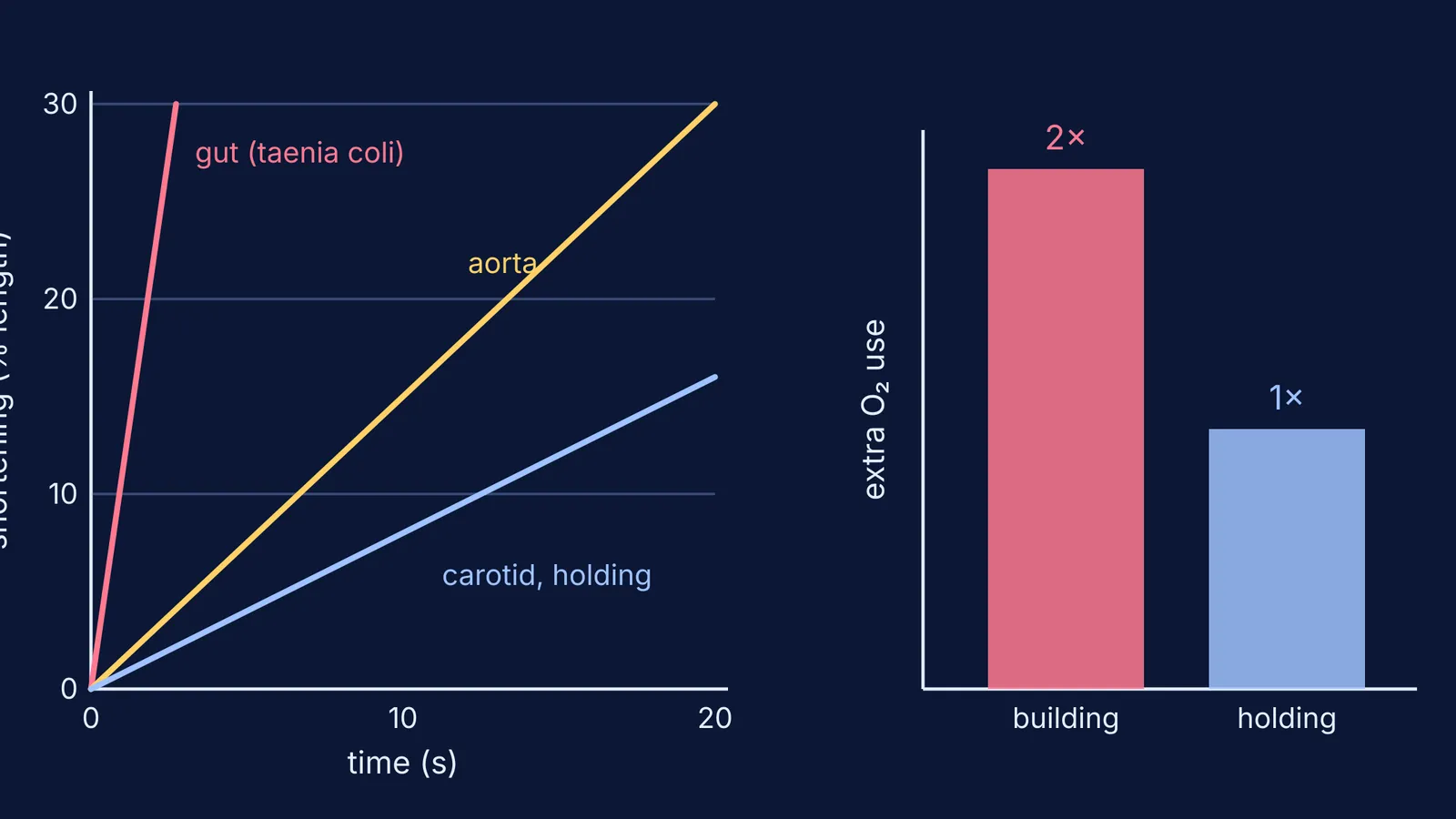
How slow is slow? In a 2001 study of guinea-pig muscle, top unloaded shortening speed in chemically skinned fibres was 0.015 muscle lengths per second for the aorta and 0.11 muscle lengths per second for the taenia coli, a band of gut muscle, at 22°C.
Worked example: how long to shorten by a fifth?
Time = distance ÷ speed, with distance as a fraction of the muscle's length. Using the speeds from the 2001 guinea-pig study:
Aorta: 0.20 ÷ 0.015 = about 13 seconds.
Taenia coli: 0.20 ÷ 0.11 = about 1.8 seconds.
These are no-load maximums. Smooth muscles also differ among themselves: here the gut muscle is about seven times faster than the aorta.
How does smooth muscle hold tension without tiring?
The answer is the latch state. In 1981, Patrick Dillon, Richard Murphy and colleagues presented evidence in Science that a dephosphorylated myosin head can stay attached to actin as a "latch-bridge" that holds force without cycling, explaining the high economy of force maintenance in arterial smooth muscle.
The Murphy and Rembold review sums up the pattern: in sustained contractions, calcium, myosin phosphorylation and ATP use all fall, yet force stays up.
You can see it in the energy bill. A 1984 study of pig carotid artery found that the peak extra oxygen use while tension was building was roughly twice the rate measured 10 minutes later, when the muscle was just holding. During that hold, unloaded shortening speed was only 0.008 tissue lengths per second at body temperature.
The same paper adds a caveat: the two- to fourfold changes it measured in energy use and shortening speed are not enough on their own to explain how cheaply the artery holds tension. The 2022 paper says this low-cost holding has "puzzled researchers for a long time".
Where do you see slow, sustained contraction in your body?
Peristalsis in the gut. Visceral smooth muscle "produces slow, steady contractions that allow substances, such as food in the digestive tract, to move through the body", says OpenStax. Its fibres are joined by gap junctions, so a ring of muscle contracts as one unit and the squeeze travels down the tube as a wave. Thicker rings, the sphincters, stay closed for long stretches; see how sphincter muscles in the digestive system work.
Blood vessel tone. The same chapter notes that a low level of calcium stays in the cell to maintain muscle tone, which matters around blood vessels.
Skeletal muscle has no latch. To hold force it must keep firing, fusing rapid twitches into a steady pull called tetanus; our post on twitch, summation and tetanus shows that graph.
How should you write this in an exam?
A four-point answer:
Regulation: calcium binds calmodulin, which activates myosin light chain kinase; there is no troponin switch.
Speed: myosin heads must be phosphorylated and cycle slowly, so contraction is slow.
Economy: dephosphorylated heads can stay attached as latch-bridges, holding force with little ATP.
Examples: peristalsis in the gut and tone in blood vessel walls.
If the calcium-to-myosin chain keeps slipping, the Fermi Concept Library gives each biology concept its own lesson and shows where it sits in the map. For ideas that are easier to see than to read, such as a wave moving down a tube, the Fermi Simulation Lab has interactive simulations.
Slow to start, cheap to hold: that is why the muscle lining your arteries and gut is built the way it is.


