

On this page
Your gut, blood vessels and airways are lined with smooth muscle, and it contracts all day without the protein that NEET-UG biology makes so much of in skeletal muscle. OpenStax Anatomy and Physiology puts it plainly: smooth muscle cells do not contain troponin, so cross-bridge formation is not regulated by the troponin-tropomyosin complex. Calcium is still the trigger. It just flips a different switch.
How does skeletal muscle use troponin as a switch?
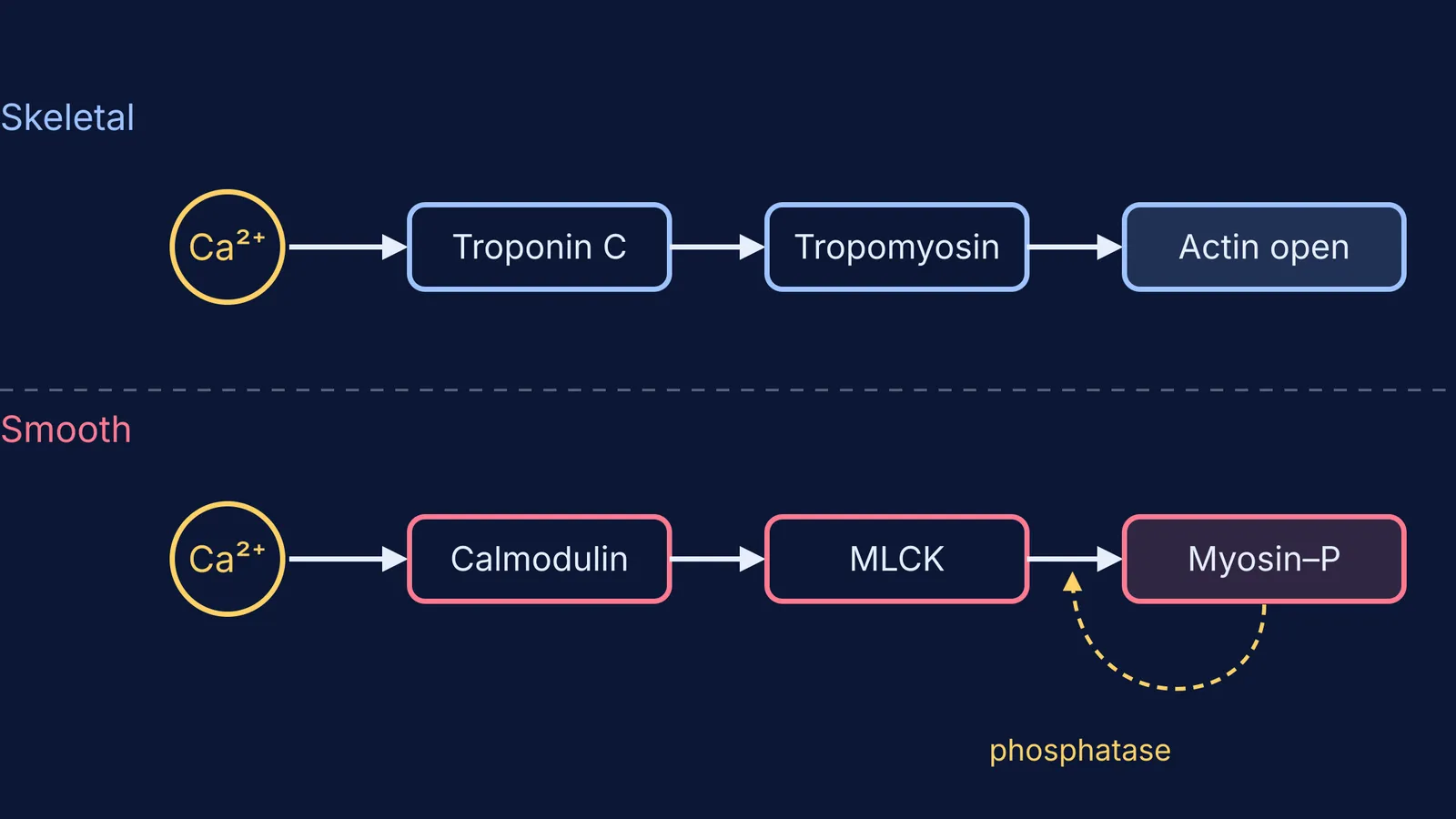
In skeletal muscle, calcium switches on the actin (thin) filament. A review in Physiological Reviews by Gordon, Homsher and Regnier (2000) describes the sequence: calcium binds troponin C, troponin I loosens its grip, and tropomyosin moves to expose the myosin-binding sites on actin. The myosin heads were ready all along; the actin track was simply blocked. For the full skeletal sequence, read our step-by-step guide to calcium, actin and myosin.
How does smooth muscle contract without troponin?
Smooth muscle moves the switch from actin to myosin. According to OpenStax and a teaching review by R. Clinton Webb in Advances in Physiology Education (2003), the steps are:
Calcium rises inside the cell.
Calcium binds calmodulin, a calcium-sensing protein.
The calcium-calmodulin complex activates myosin light-chain kinase (MLCK).
MLCK phosphorylates the myosin head, using ATP.
The phosphorylated myosin binds actin and cycles, pulling on dense bodies, which are analogous to Z-discs.
To relax, calcium is removed and myosin phosphatase removes the phosphate.
Webb adds a second dial: the RhoA/Rho kinase pathway inhibits myosin phosphatase, which keeps the light chains phosphorylated and maintains force (Webb, 2003).
Why is smooth muscle slow but economical?
A switch built from an enzyme and its opposite enzyme is not built for speed, but it is good at holding. Physiologist R. J. Paul summarised the energetics in the American Journal of Physiology (1990): smooth muscle's tension cost, the rate of ATP use per unit of force held, is 100 to 500 times lower than skeletal muscle's. The same paper notes that its efficiency when doing work is about 4 times lower, so smooth muscle is cheap at holding, not at moving.
Paul attributes the low tension cost, at least in part, to the latch state. In a kinetic model by Hai and Murphy (1988), myosin heads that lose their phosphate while still attached to actin become "latch bridges" that detach slowly, which fits the observation that the muscle keeps high force with little myosin phosphorylation. Compare that with what happens when ATP runs out completely, in our post on rigor mortis and the stuck myosin head.
Measurements point the same way. In rabbit intestinal smooth muscle, Siegman and colleagues (1980) found that the rate of energy use while force was developing was about four times higher than while that force was being maintained, which they put down to a slower cross-bridge cycle. OpenStax also notes that smooth muscle's power output is relatively low, but its contractions can continue without using large amounts of energy.
Skeletal vs smooth muscle: what is different?
This comparison draws on OpenStax, Webb, Gordon et al. and Paul:
Calcium sensor: troponin C (skeletal); calmodulin (smooth).
Where the switch acts: on actin, by moving tropomyosin (skeletal); on myosin, by MLCK phosphorylating its light chain (smooth).
Off switch: calcium leaves troponin and tropomyosin blocks actin again (skeletal); myosin phosphatase removes the phosphate (smooth).
Anchors for thin filaments: Z-discs (skeletal); dense bodies (smooth).
Look and control: striated and voluntary (skeletal); unstriated and involuntary (smooth).
Cost of holding force: high (skeletal); 100 to 500 times lower, partly thanks to latch bridges (smooth).
For the three-way picture that includes cardiac muscle, see our note on striated, smooth and cardiac muscle differences.
Can you predict what a drug does to each muscle type?
Cover the answers and reason from the switch, not from memory.
A drug blocks MLCK. Smooth muscle cannot contract normally because its myosin is not phosphorylated; skeletal muscle carries on.
A drug blocks myosin phosphatase. Smooth muscle tends to stay contracted because the light chains stay phosphorylated, the same effect Rho kinase produces.
A toxin stops calcium binding to troponin C. Skeletal muscle cannot contract; smooth muscle has no troponin to block.
A smooth muscle cell lacks calmodulin. Calcium rises but cannot switch on MLCK, so the main route to contraction is blocked.
Why can a blood vessel hold its diameter for hours? Slowly detaching latch bridges help it hold force at a low ATP cost.
If a link in this chain is still fuzzy, the Fermi Concept Library gives each concept in biology its own lesson and its place in the map, so you can see how calmodulin and MLCK fit together. For practice, the Fermi Problem Library has worked problems with a step-by-step solver that explains the reasoning rather than printing an answer.


