

On this page
Every breath brings in dust, soot and pollen. The NCERT Class 11 Biology chapter on breathing says the conducting part of the respiratory system, from the nostrils to the terminal bronchioles, "clears it from foreign particles, humidifies and also brings the air to body temperature." A key part of that clearing is a moving belt of mucus called the mucociliary escalator. This post explains how it works and what cigarette smoke does to it.
What is the mucociliary escalator?
Mucociliary clearance is the process in which beating cilia carry mucus, and anything stuck in it, up the respiratory tract towards the mouth, where it is swallowed or coughed out (Bustamante-Marin and Ostrowski, 2017). That review describes four parts:
Ciliated cells: a mature airway ciliated cell has more than 100 cilia on its surface.
Cilia: a typical airway cilium is 6.5 to 7 µm long and 0.1 µm wide.
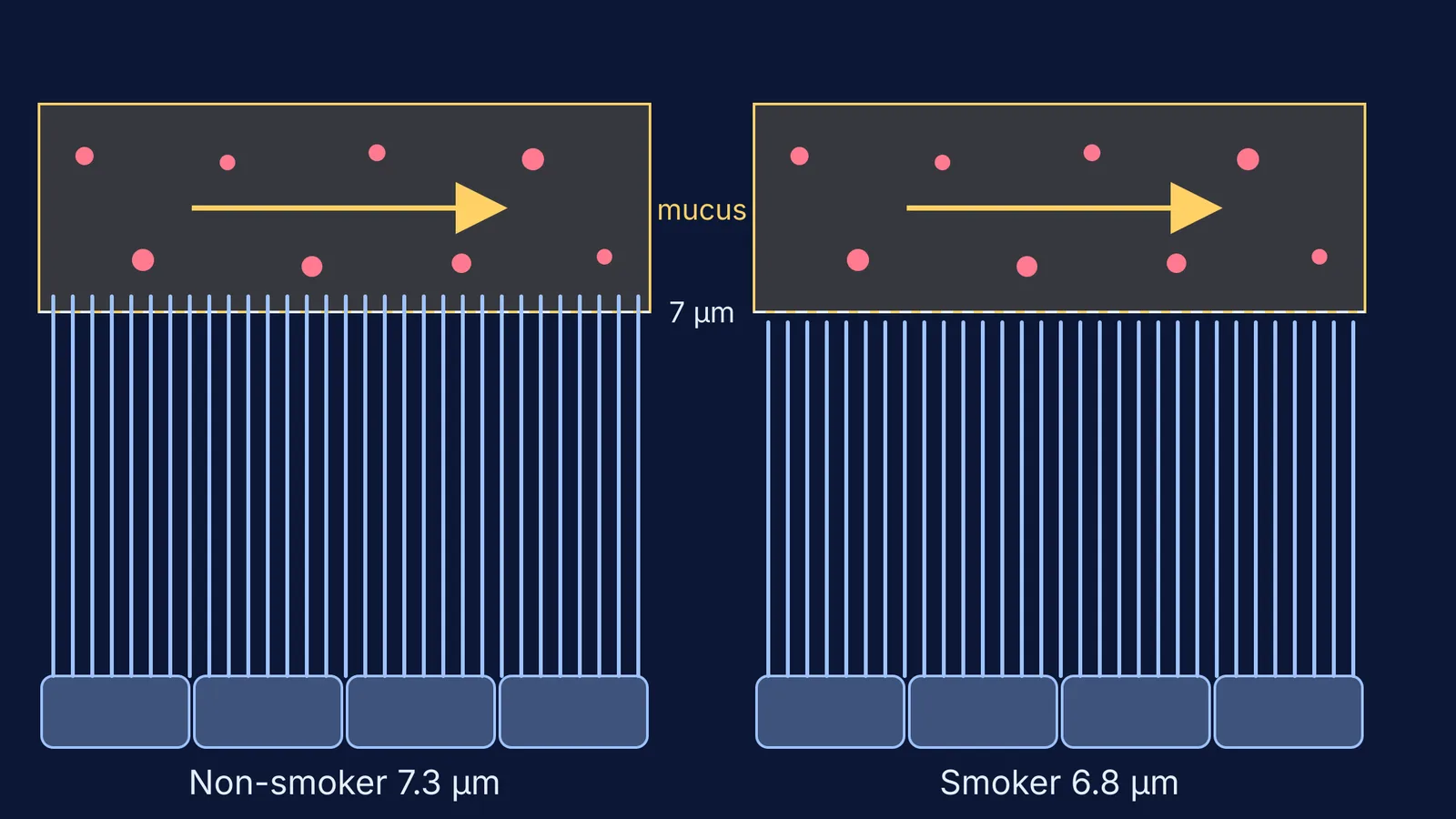
Periciliary layer: a gel that sits around the cilia and is about as tall as an extended cilium, roughly 7 µm.
Mucus layer: a sticky blanket on top, 2 to 5 µm thick in the trachea, that traps particles.
For what is inside each cilium, see the 9 + 2 axoneme in cilia and flagella.
How do cilia move mucus out of the airways?
According to the same review, each cilium beats with an effective stroke and a recovery stroke in the same plane. Neighbouring cilia beat slightly out of step, so a metachronal wave travels across the airway lining and pushes the mucus towards the head, like a Mexican wave in a cricket stadium. At rest, the cilia beat 10 to 20 times per second (10 to 20 Hz).
Length matters here. A 2009 study in PLoS ONE explains that models of mucociliary clearance predict a cilium must be longer than the 6 to 7 µm depth of the airway surface fluid to push on the mucus layer (Leopold and colleagues, 2009). On the effective stroke, the tip reaches into the mucus and drags it forward. On the recovery stroke, the cilium bends and slides back through the thinner fluid underneath. The trachea, held open by C-shaped cartilage rings, is one of the airways this lining covers.
How does smoking affect cilia in the respiratory tract?
The 2017 review lists three effects seen in studies of humans and mice. Cigarette smoke significantly lowers ciliary beat frequency. It increases mucus secretion. It also generates reactive oxygen species, which reduce the number of ciliated cells.
A fourth effect concerns the cilia themselves. In the 2009 PLoS ONE study, Philip Leopold, Ronald Crystal and colleagues sampled the large airways of healthy smokers and non-smokers by bronchoscopy and measured cilia length four ways. In hydrated, unfixed cells, the cilia were 7.3 µm long in non-smokers and 6.8 µm in smokers. In tissue biopsies, smokers' cilia were 15% shorter. Because the airway fluid is 6 to 7 µm deep, the authors calculated that the shorter cilia would mean roughly 18 to 38% fewer cilia able to reach the mucus, depending on how deep the fluid is. That figure comes from a model. The study measured cilia length, not the speed of clearance.
Put together, the escalator has fewer steps, slower and shorter steps, and a heavier load. NCERT's section on disorders of the respiratory system, in the same chapter, says emphysema damages alveolar walls and adds: "One of the major causes of this is cigarette smoking." To see how emphysema compares with asthma, read our explainer on asthma, emphysema and occupational lung disease.
How do you explain this in a biology exam answer?
A strong answer is a clear chain of cause and effect. Use these four links in order:
Structure: ciliated cells line the conducting airways. A sticky mucus layer sits on a watery periciliary layer.
Mechanism: the cilia beat in a power stroke and a recovery stroke. A metachronal wave moves the mucus towards the pharynx, where it is swallowed or coughed out.
Damage: smoke slows the beat, adds mucus, reduces the number of ciliated cells and is linked to shorter cilia.
Consequence: the escalator is expected to clear mucus more slowly, so particles stay in the airways for longer.
Three common mistakes to avoid:
Saying cilia "filter" the air. The mucus traps particles, and the cilia move the mucus.
Placing the escalator in the alveoli. NCERT puts the work of clearing particles in the conducting part, which ends at the terminal bronchioles.
Writing that cilia beat towards the lungs. They move mucus up and out.
If the beat cycle is hard to picture from text, the Fermi Concept Library covers every concept in biology, each with its own lesson and its place in the map. Fermi's AI tutor can draw the figure and check your understanding as you go, so you can practise the four-link answer.
This post explains biology. It is not medical advice. If you or someone at home has a cough that will not go away or wants help to stop smoking, a doctor is the right person to talk to.


