

On this page
Take a ball of silicon about the size of a large orange, weigh it, measure its diameter and measure the spacing of the atoms inside it. From those three numbers you can count every atom in it, all 2.15 × 10²⁵ of them, to about 2 parts in 100 million. That is what an international team, including Germany's national metrology institute PTB, did with two spheres of almost pure silicon-28. Their count was one of the two measurements that fixed the numbers behind the 2019 definitions of the kilogram and the mole. The physics is unit-cell counting and the volume of a sphere, so it makes a good exam problem.
How do you count the atoms in a silicon sphere?
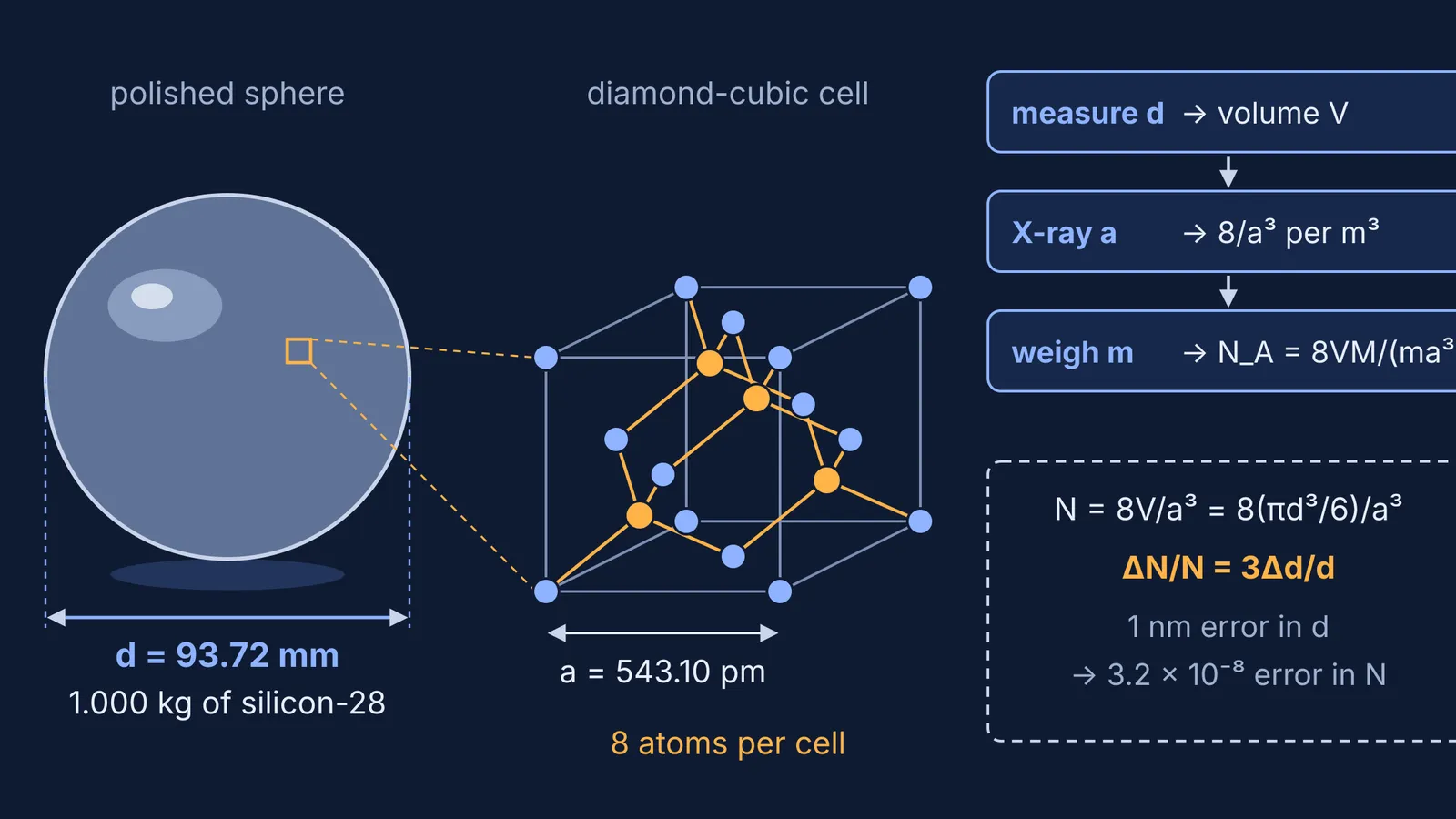
You never count atoms one by one. You count unit cells and multiply.
Silicon is a crystal. Its atoms repeat in a cubic cell of side a, the lattice parameter.
Each cell holds 8 atoms, so the number of atoms per cubic metre is 8/a³.
A sphere of diameter d has volume V = πd³/6.
So the sphere holds N = 8V/a³ atoms.
Before 2019 the team then weighed the sphere (mass m) and used the molar mass M to get Avogadro's number: N_A = N × M/m = 8VM/(ma³). The lattice parameter comes from X-ray interferometry, which works on the same idea of X-rays reflecting off planes of atoms that you meet in Bragg's law and how X-rays map crystals. This is called the X-ray crystal density (XRCD) method.
Why does a silicon unit cell hold 8 atoms?
Silicon has the diamond-cubic structure. Count the atoms that belong to one cubic cell:
8 corner atoms, each shared by 8 cells: 8 × 1/8 = 1.
6 face-centre atoms, each shared by 2 cells: 6 × 1/2 = 3.
4 atoms fully inside the cell, at a quarter of the way along the body diagonals: 4 × 1 = 4.
Total: 1 + 3 + 4 = 8. The first two lines are just a face-centred cubic lattice (4 atoms). Diamond cubic is two such lattices, one shifted by a quarter of the body diagonal, so it has twice as many.
Worked example: how many atoms are in 1 kg of silicon-28?
Use the values published by the international team in Azuma and co-workers, Metrologia 2015: lattice parameter a = 543.0996 pm (they quote the (220) plane spacing, 192.014712 pm, which is a/√8) and molar mass M = 27.976970 g/mol for their enriched crystal. Since 2019, N_A = 6.02214076 × 10²³ mol⁻¹ exactly.
Cell volume. a³ = (543.0996 × 10⁻¹² m)³ = 1.6019 × 10⁻²⁸ m³.
Mass of one atom. M/N_A = 0.027976970 kg/mol ÷ 6.02214076 × 10²³ mol⁻¹ = 4.6457 × 10⁻²⁶ kg.
Mass of one cell. 8 × 4.6457 × 10⁻²⁶ = 3.7165 × 10⁻²⁵ kg.
Density. ρ = 3.7165 × 10⁻²⁵ ÷ 1.6019 × 10⁻²⁸ = 2,320.07 kg/m³. Check the unit: kg divided by m³, as it should be.
Volume of 1.000 kg. V = 1/2,320.07 = 4.3102 × 10⁻⁴ m³ = 431.02 cm³.
Diameter. d = (6V/π)^(1/3) = 0.093720 m = 93.720 mm.
Number of atoms. N = 8V/a³ = 2.1525 × 10²⁵. As a check, (1,000 g ÷ 27.977 g/mol) × N_A gives the same number.
Size in cells. d/a = 1.73 × 10⁸, so about 173 million cells fit across the sphere.
The real sphere called AVO28-S5c had a mean core diameter of 93.710811 mm in the same paper. Put that into step 7 and you get 2.1519 × 10²⁵ atoms and a mass of 0.999698 kg, which matches the paper's weighed mass of 0.999698 kg to all six figures. The atom count and the balance agree.
Why did the sphere have to be so round?
Because N depends on d³, a small error in the diameter is tripled: ΔN/N = 3Δd/d.
A 1 nm error in d gives 3 × 10⁻⁹ m ÷ 0.0937 m = 3.2 × 10⁻⁸ in N.
The target for the new kilogram was a total uncertainty of 2 × 10⁻⁸, so the mean diameter had to be known to about 0.6 nm, a few atoms' width.
The repolished spheres were round to within 70 nm and 40 nm peak to valley, according to the same paper. A single 40 nm bump would give an error of 1.3 × 10⁻⁶, about 60 times too big.
So no single diameter is good enough. PTB's interferometer measured about 10⁵ diameters over the whole surface and averaged them into a volume. The quoted uncertainty of the mean diameter was 0.83 nm. A rounder sphere makes that average easier to trust, but it is the mapping, not perfect roundness, that gets you to 10⁻⁸.
The surface matters too. A thin oxide and contamination layer, about 2 nm thick in total, covers each sphere. Left in, a 2 nm shell would change the volume by 3 × 2 nm ÷ 46.86 mm = 1.3 × 10⁻⁷, six times the target. So the team measured that layer with X-ray and optical methods and subtracted it, using only the "core" silicon in the count.
Why use silicon-28 instead of ordinary silicon?
Ordinary silicon has three stable isotopes. The IUPAC atomic weights commission (CIAAW) gives about 92.2% silicon-28, 4.7% silicon-29 and 3.1% silicon-30, with an atomic weight of about 28.085. The molar mass in the formula is the average over that mix, so any doubt about the mix goes straight into N_A. Moving just 0.01% of atoms from silicon-28 to silicon-29 changes M by 3.6 × 10⁻⁶, nearly 200 times the target.
The enriched crystal was 99.9957% silicon-28. With so little of the other two isotopes, a small error in measuring them hardly moves M. Silicon was chosen in the first place because the chip industry can grow huge, almost perfect single crystals of it.
What does the sphere do now that N_A is fixed?
Since 20 May 2019, N_A is no longer measured. It is defined as exactly 6.02214076 × 10²³ mol⁻¹, and the kilogram is defined by fixing Planck's constant. The value fixed for N_A came partly from these spheres. Now the logic runs the other way: count the atoms with the same formula, multiply by the mass of one atom, and you have made a kilogram. This is one of two routes to the new kilogram. The other, the Kibble balance, is covered in why the kilogram was redefined using Planck's constant. For an earlier and much rougher way of counting molecules, see how Jean Perrin counted atoms grain by grain.
If you want to practise density and unit cell problems like this one, the Fermi Problem Library has a step-by-step solver that explains the reasoning at each stage.
Quick checklist
Atoms per cell: simple cubic 1, BCC 2, FCC 4, diamond cubic 8.
Density of a crystal: ρ = nM/(N_A a³). For silicon-28, 2,320 kg/m³.
Atoms in a sphere: N = 8(πd³/6)/a³; for 1 kg of silicon-28, d = 93.72 mm and N = 2.15 × 10²⁵.
Errors in d are tripled in N: ΔN/N = 3Δd/d.
Subtract the surface layer, and use one isotope to pin down M.
Since 2019, N_A is exact and the sphere realises the kilogram instead of measuring N_A.


