On this page
From 1889 until 2019, a kilogram was defined as the mass of one small platinum-iridium cylinder, as the BIPM's history of the kilogram records. If that cylinder picked up dust or lost a few atoms when cleaned, every kilogram on Earth changed with it. In November 2018, scientists voted to end that.
What was the old definition of the kilogram?
The kilogram was "exactly equal to the mass of a small polished cylinder, cast in 1879 of platinum and iridium," according to the US National Institute of Standards and Technology (NIST). It was called the International Prototype of the Kilogram (IPK), and it was kept in a triple-locked vault by the International Bureau of Weights and Measures (BIPM) in Sèvres, France.
The IPK is 90% platinum and 10% iridium, a cylinder 39 mm across and 39 mm high, as CSIR-National Physical Laboratory (CSIR-NPL) describes it. India's copy is number 57, kept at CSIR-NPL in New Delhi, and the BIPM recalibrated it six times between 1955 and 2022, the same page says.
Why was the kilogram redefined?
Because the copies and the original slowly disagreed, and nobody could say which one had changed.
In the 1989-1991 verification, the original 1889 prototypes differed from the IPK by a median of about 25 micrograms, the BIPM reports.
Twenty-five micrograms is 25 parts per billion of a kilogram. The best balances compare one kilogram with another to a few parts in a billion, says NIST, so that gap was large. The 2019 change also redefined the ampere, the kelvin and the mole.
How is the kilogram defined now?
Since 20 May 2019, all SI units have been defined by fixing the numerical values of seven defining constants, says the BIPM. The constant behind the kilogram is the Planck constant, h.
The fixed value is h = 6.62607015 × 10⁻³⁴ kg m²/s, exactly, according to NIST.
Look at h's unit, kg m²/s. The second and the metre are already fixed by two other constants on that BIPM list, the caesium-133 frequency and the speed of light. Fix h too, and the kilogram is the only thing left free.
How does a Kibble balance measure a kilogram?
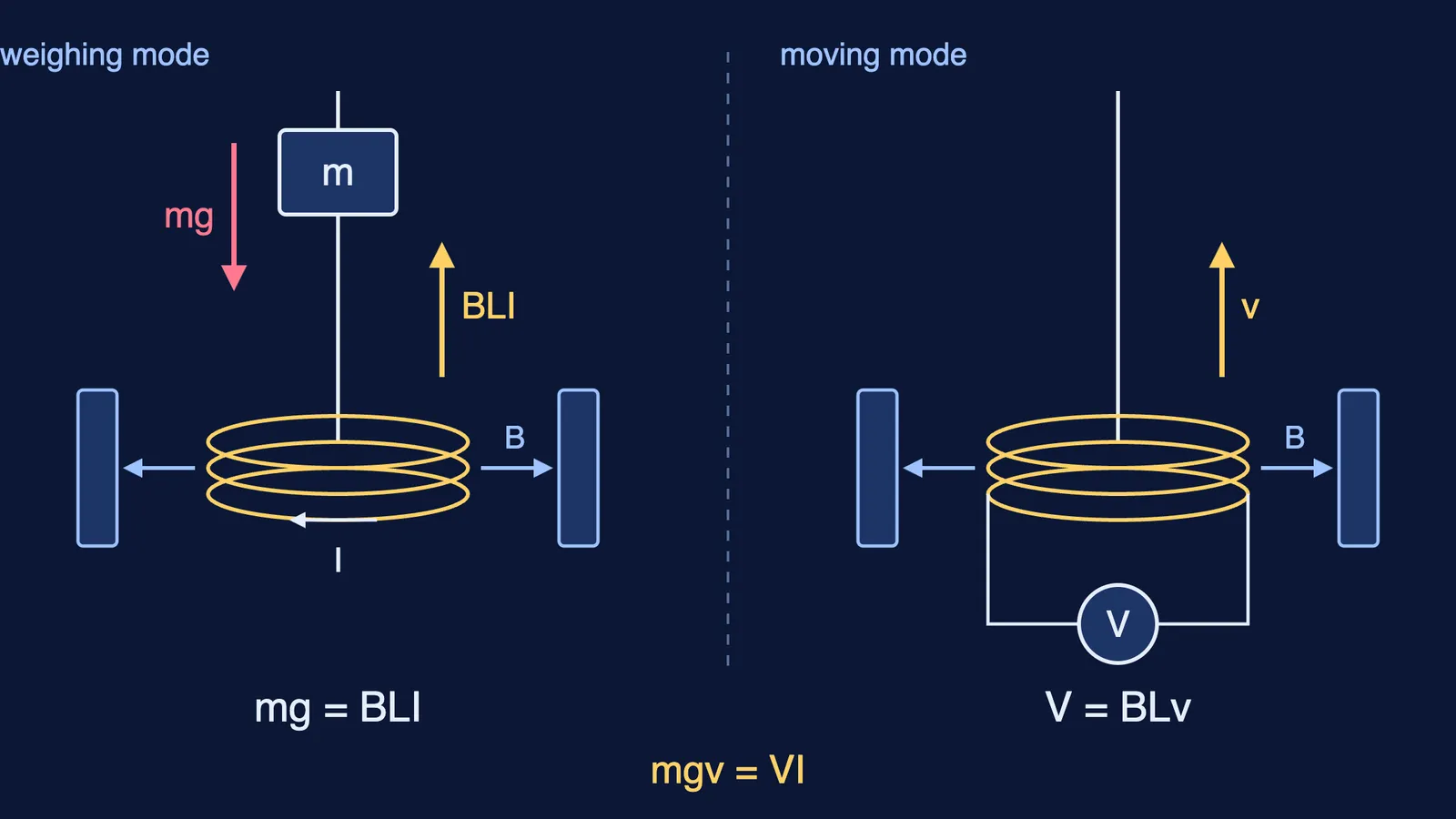
The balance is named after Bryan Kibble of the UK's National Physical Laboratory, who conceived it in 1975. It balances the weight of a mass against the force on a current-carrying coil in a magnetic field, in two steps:
Weighing mode. The test mass pulls down with force mg. The current I in the coil is adjusted until the magnetic force BLI exactly balances it.
Moving mode. The mass is removed and the coil is moved through the same field at a steady speed v, which induces a voltage V = BLv.
The product BL (field strength times wire length) is hard to measure directly, but it is the same in both steps, so it cancels. That leaves mgv = VI, as NIST's Kibble balance page writes it. The voltage is measured with the Josephson effect and resistance with the quantum Hall effect, both defined in terms of h and the electron charge e. That is how the Planck constant gets into a weighing.
Before 2019 it ran the other way, measuring h from a known mass. NIST's final submitted measurement had an uncertainty of 13 parts in a billion; the rules asked for at least three experiments at no more than 50 parts per billion, according to NIST's page on mass and the Planck constant.
Worked example: can you check the units yourself?
JEE questions on dimensions test exactly this. Try it with a pen.
Write the unit of h: kg m² s⁻¹.
Rearrange: kg = h × s / m².
Put in the exact value: 1 kg = h × (1 s / 1 m²) ÷ (6.62607015 × 10⁻³⁴).
Check the balance: mgv has units kg × m s⁻² × m s⁻¹ = kg m² s⁻³, a watt. VI is volts times amps, also a watt.
Step 4 is why the instrument was first called a watt balance, as NIST explains. For more practice, see how to find the Planck length using dimensional analysis, or how two wavelengths give you the work function and Planck's constant.
If step 2 trips you up, the Fermi Problem Library has worked problems with a step-by-step solver that explains the reasoning rather than printing an answer. If the two modes are hard to picture, the Fermi Simulation Lab has interactive simulations for ideas that are easier to see than to read.
What does it mean for India?
A kilogram of rice weighs what it did in 2018; the definition just no longer lives in one vault. CSIR-NPL says on its mass metrology page that it is working towards the new definition to keep an unbroken chain of traceability in the country, and its scientists reported a 1 g Kibble balance demonstration in Current Science in 2017.
The story of agreeing on units starts long before h, with handspans and cubits: read why we need standard units at all.