On this page
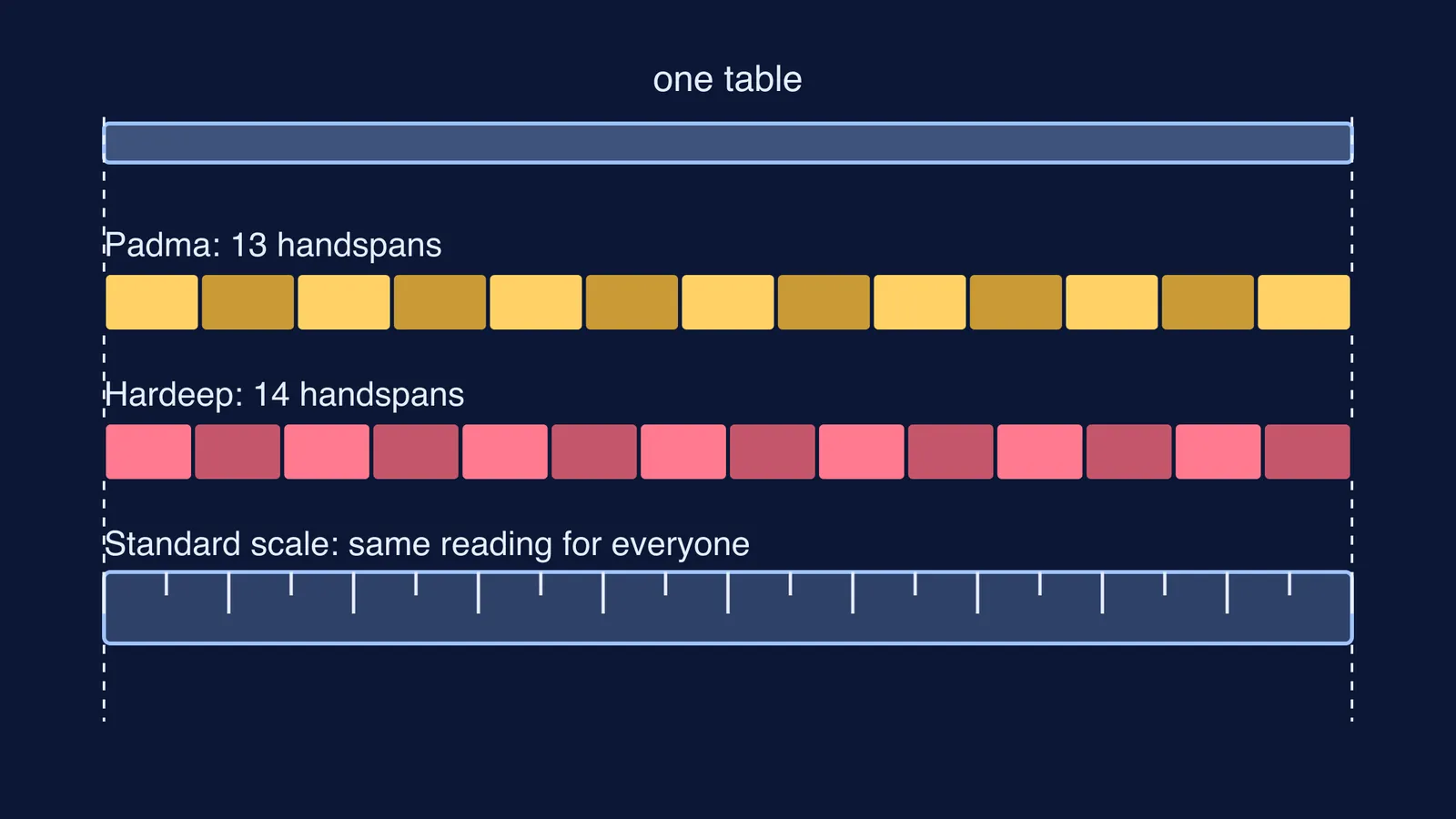
In Chapter 5 of NCERT's Class 6 science textbook, five friends measure the same classroom table with their handspans, which Deepa's mother calls a *balisht*. Padma counts 13 handspans and Hardeep counts 14; Anish gets slightly more than 13, Tasneem slightly less than 13, and Deepa between 13 and 14 (NCERT Curiosity, Chapter 5). The table did not change; the hands did.
The textbook draws the lesson in one line: handspans and similar units "differ from person to person. Thus, there is a need for such a unit for which measurements of the same length made by different people do not differ" (NCERT).
Why do handspans and cubits give different answers?
Every measurement has two parts, a number and a unit: if a table is 13 handspans long, 13 is the number and the handspan is the unit (NCERT).
The oldest units of length came from the body, so they shared the same weakness. The cubit was the first recorded unit used by ancient peoples to measure length, and the common cubit was the length of the forearm from the elbow to the tip of the middle finger (NIST Handbook 44, Appendix B). The span of the hand was counted as half a cubit, so both units depended on whose arm and hand were doing the measuring.
India had its own system. *Angula* (finger width), *dhanusa* and *yojana* are among the units mentioned in ancient Indian literature, and the *angula* is still used by traditional craftspeople such as carpenters and tailors (NCERT). NCERT notes that when people started travelling from one place to another, different systems "created a lot of confusion", which led countries to come together and adopt a set of standard units.
What makes SI units the same for everyone?
The International System of Units, or SI, is the internationally agreed system for measurement, and it has seven base units: the second, metre, kilogram, ampere, kelvin, mole and candela (BIPM).
Since 20 May 2019, all SI units have been defined by fixing the numerical values of seven defining constants (BIPM). The metre, for example, is defined by fixing the speed of light in vacuum at exactly 299 792 458 metres per second (BIPM, the metre). No forearm decides how long a metre is; light does, and the speed of light in vacuum is the same in Delhi and Paris.
A unit is fixed by definition; a standard is a physical realisation of it (NIST Handbook 44, Appendix B). In India, CSIR-National Physical Laboratory is the National Metrology Institute, and developing measurement and calibration standards is part of its mandate (CSIR-NPL). For more, read our explainer on the seven SI base units and their 2019 redefinition.
What happens when people use different units?
NASA's Mars Climate Orbiter Mishap Investigation Board, in its Phase I report dated 10 November 1999, found that the root cause of losing the spacecraft was the failure to use metric units in the coding of a ground software file (NASA MCO Phase I report). Thruster data was reported in pound-seconds instead of newton-seconds, so the navigation software underestimated its effect on the trajectory by a factor of 4.45. At Mars orbit insertion, the board found, the spacecraft's trajectory was about 170 kilometres lower than planned.
Classroom activity: one desk, two rulers
This extends the NCERT handspan activity (NCERT). You need one lesson period, plus a metre scale and a short ruler per group.
Each student measures the same desk in their own handspans and writes the count on the board, next to their name.
Ask: why are the numbers different if the desk is the same?
Each student measures their own handspan in centimetres with the ruler.
Multiply: number of handspans times handspan length gives the desk length in centimetres.
Measure the desk once with the metre scale and compare it with the spread of handspan results.
Finish with one question: what would a carpenter in another city need from you to build an identical desk?
A worked example with made-up, simple numbers: suppose the desk is 120 cm long. A student whose handspan is 15 cm counts 8 handspans; a student whose handspan is 20 cm counts 6. Both are right in their own unit; the metre scale gives 120 cm to everyone directly.
Parents can run the same game at home with the dining table; see estimation games for kids: guess first, then measure. For the full chapter, read measurement of length and motion in Class 6.
How do standard units help in exams?
The habit that carries into Class 11 physics: write the unit on every line, convert to SI before substituting, and check both sides of an equation match. If units and measurement still feel shaky, the Fermi Concept Library has a lesson for each concept in physics, chemistry, biology, mathematics and computing. When you know the idea but keep losing marks on conversions, the Fermi Problem Library has worked problems with a step-by-step solver that explains the reasoning rather than printing an answer.
Try the desk activity this week: many hands, one metre scale.