
On this page
Three constants sit underneath modern physics: Planck's constant h (quantum mechanics), the gravitational constant G (gravity) and the speed of light c (relativity). Only one set of powers combines them into a length (up to a pure number), and the Class 11 units-and-dimensions method finds it. Below is the worked example, then a method you can reuse.
What is the Planck length?
The Planck length is the length built from h (or ħ), G and c alone, with no other numbers. The current recommended value is 1.616255 × 10⁻³⁵ m, according to the 2022 CODATA values on the NIST site. The matching Planck time is 5.391247 × 10⁻⁴⁴ s, also from NIST's CODATA table.
The modern definitions use the reduced Planck constant ħ = h/2π: the Planck length is √(ħG/c³) and the Planck time is √(ħG/c⁵), as set out on the Planck units reference page. The same page notes that Max Planck proposed these natural units in 1899 using h itself, so his versions differ from today's by a factor involving 2π.
How do you find the Planck length using dimensional analysis?
Start from the dimensions of each constant. The units come from NIST: h is 6.62607015 × 10⁻³⁴ J Hz⁻¹, an exact value; G is 6.67430 × 10⁻¹¹ m³ kg⁻¹ s⁻²; c is exactly 299 792 458 m s⁻¹.
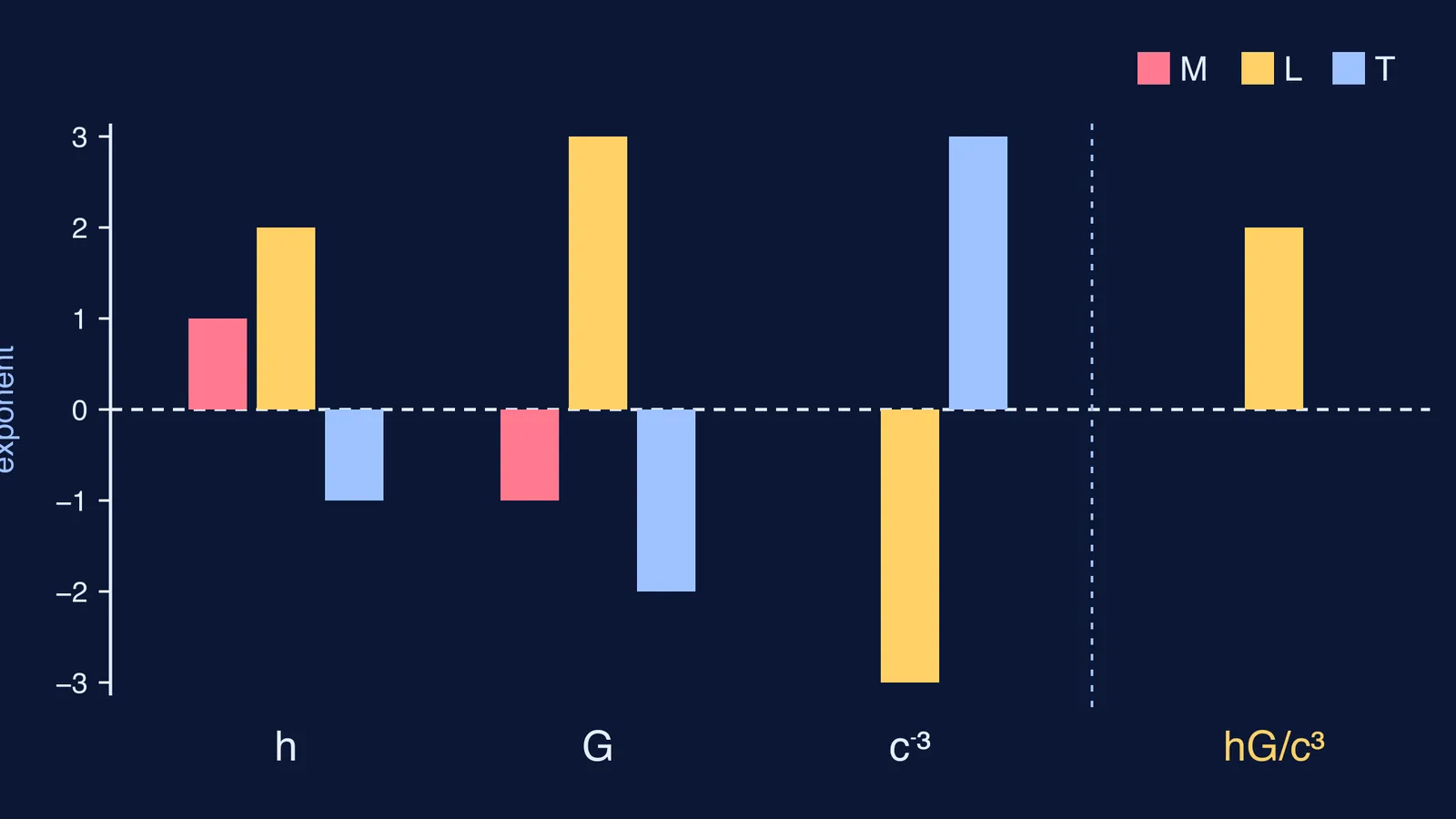
h, in joule-seconds: [M L² T⁻¹]
G, in m³ kg⁻¹ s⁻²: [M⁻¹ L³ T⁻²] (a full derivation is in our post on the dimensional formula of G and the Boltzmann constant)
c, in m s⁻¹: [L T⁻¹]
Now assume the length is l = h^a G^b c^d and make the dimensions on both sides agree.
Mass: a − b = 0
Length: 2a + 3b + d = 1
Time: −a − 2b − d = 0
From the mass equation, b = a. The time equation becomes −3a − d = 0, so d = −3a. Put both into the length equation: 2a + 3a − 3a = 1, so a = 1/2. That gives b = 1/2 and d = −3/2.
So l = h^(1/2) G^(1/2) c^(−3/2) = √(hG/c³).
Now the numbers. hG = 6.62607015 × 10⁻³⁴ × 6.67430 × 10⁻¹¹ ≈ 4.4224 × 10⁻⁴⁴. c³ ≈ 2.6944 × 10²⁵. Their ratio is about 1.6413 × 10⁻⁶⁹ m², and the square root is about 4.05 × 10⁻³⁵ m.
That blind spot is a general limit of the method, explained in why dimensional analysis cannot find dimensionless constants.
How do you get the Planck time from the same constants?
You could set up three new equations with the target [T], but there is a shortcut: a time is a length divided by a speed. Divide the Planck length by c and you get t = √(hG/c³)/c = √(hG/c⁵).
With h, that is 4.05 × 10⁻³⁵ m ÷ 2.998 × 10⁸ m s⁻¹ ≈ 1.35 × 10⁻⁴³ s. With ħ, it is about 5.39 × 10⁻⁴⁴ s, which matches the NIST Planck time of 5.391247 × 10⁻⁴⁴ s. Solving the exponent equations for [T] directly gives the same a = b = 1/2, d = −5/2.
What is the reusable method for building a quantity from constants?
The same five steps work for the Planck mass, the period of a spring or the speed of a wave.
Write the target's dimensions (here [L] or [T]).
Write each constant in base dimensions M, L, T (add A or K if charge or temperature is involved).
Assume the answer is a product of the constants with unknown powers.
Write one equation per base dimension and solve. You need as many independent equations as unknown powers.
Put in the numbers, check the order of magnitude, and remember that a missing 2π or ½ is invisible to this method.
Common slips: writing G as [M⁻¹ L³ T⁻¹] instead of T⁻², putting c³ in the numerator, and forgetting the final square root.
Try this one yourself: find the mass built from h, c and G. You should get √(hc/G), about 5.46 × 10⁻⁸ kg with h. Swap in ħ and it drops to about 2.18 × 10⁻⁸ kg, the Planck mass listed by NIST as 2.176434 × 10⁻⁸ kg.
For a classroom example of the same steps, see how to derive the spring-mass period using dimensional analysis.
If step 4 is where you get stuck, the Fermi Problem Library has worked problems with a step-by-step solver that explains the reasoning rather than printing an answer. If dimensions themselves still feel shaky, the Fermi Concept Library gives every physics concept its own lesson and its place in the map.
This week, do one constant-building question on paper with the five steps, then check it against the NIST table.