

On this page
Physics constants can seem like a random collection of units and powers to memorise. But dimensional analysis gives you a reliable way to recreate them on the spot.
By taking a fundamental equation that uses the constant, making the constant the subject, and substituting the known dimensions of the other variables, you can find the dimensional formula for any constant. This method works for everything from the gravitational constant to Planck's constant.
What is the dimensional formula of the gravitational constant?
The dimensional formula of the universal gravitational constant (G) is [M⁻¹L³T⁻²] (Wikipedia).
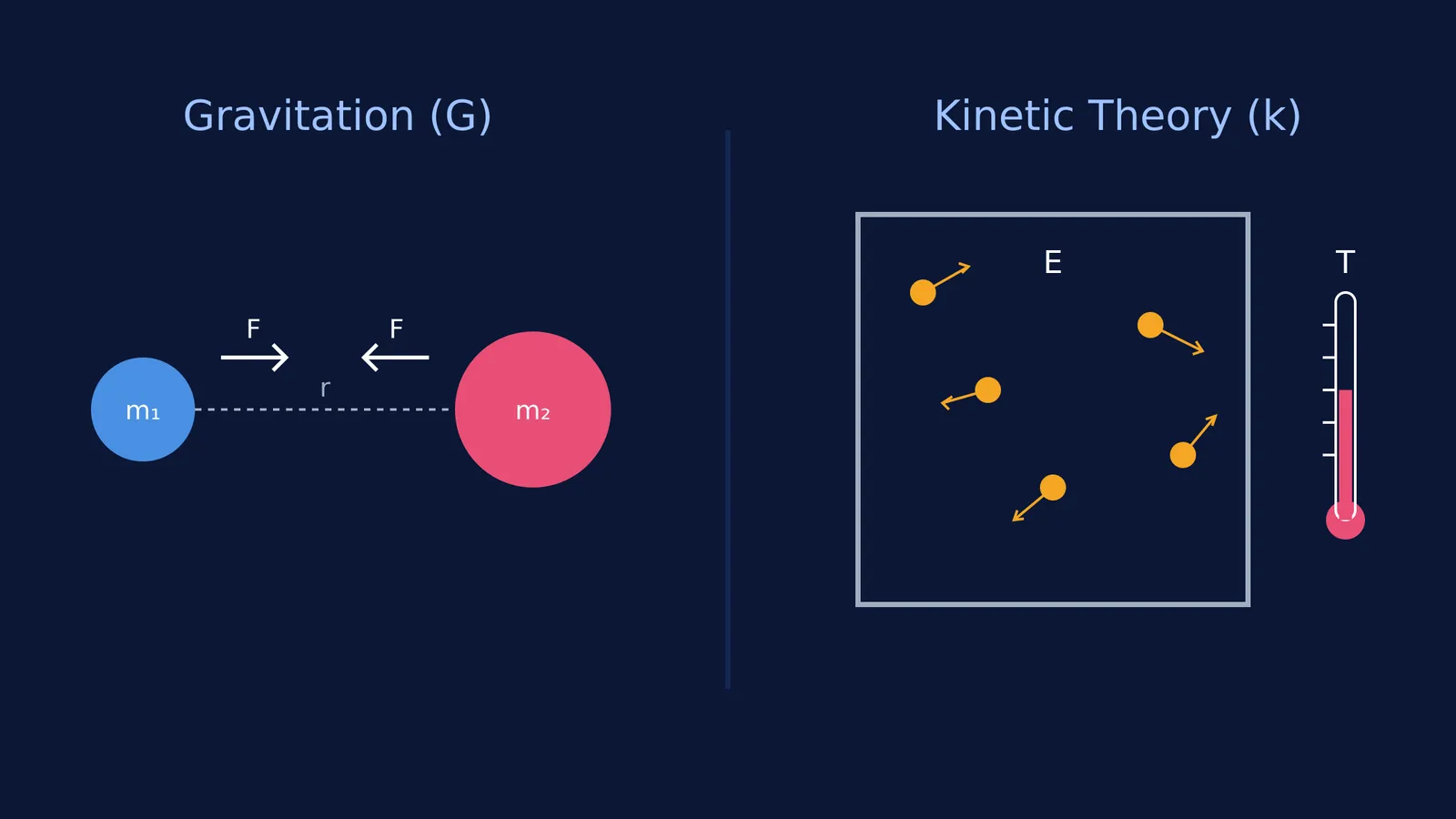
You can derive this from Newton's law of universal gravitation, which states that the force (F) between two masses (m₁ and m₂) separated by a distance (r) is F = G m₁m₂ / r².
To find the dimensions, rearrange the equation to make G the subject: G = (F × r²) / (m₁ × m₂)
Now, substitute the dimensional formulas for the known quantities:
Force (F) is mass times acceleration: [MLT⁻²]
Distance squared (r²) is length squared: [L²]
Mass times mass (m₁ × m₂) is mass squared: [M²]
Putting it all together: [G] = [MLT⁻²] × [L²] / [M²] [G] = [ML³T⁻²] / [M²] [G] = [M⁻¹L³T⁻²]
If you forget a formula during exam prep, the Fermi Problem Library has worked problems with a step-by-step solver that explains the reasoning rather than printing an answer.
What is the dimensional formula of the Boltzmann constant?
The dimensional formula of the Boltzmann constant (k) is [ML²T⁻²Θ⁻¹] (Wikipedia). (The dimension of thermodynamic temperature is often denoted as [Θ] or [K]).
The Boltzmann constant relates the average kinetic energy of particles in a gas to the temperature of that gas. The fundamental equation is E = (3/2)kT, where E is energy and T is absolute temperature.
Rearrange the equation for k, ignoring the dimensionless fraction (3/2): k = E / T
Substitute the dimensions:
Energy (E) is force times distance: [ML²T⁻²]
Temperature (T) uses the base dimension of thermodynamic temperature: [Θ]
Dividing the energy by the temperature gives: [k] = [ML²T⁻²] / [Θ] [k] = [ML²T⁻²Θ⁻¹]
If you need a refresher on the underlying definitions of energy and temperature, the Fermi Concept Library contains every concept in physics, chemistry, biology, mathematics and computing, each with its own lesson and its place in the map.
How do you find the dimensional formula of Planck's constant?
Planck's constant (h) connects the energy of a photon to its frequency. Its dimensional formula is [ML²T⁻¹] (Wikipedia).
The fundamental equation is E = hν, where E is the energy of the photon and ν (nu) is its frequency. You might use this relationship when calculating photon energy with E = 1240/λ.
Rearranging for h gives: h = E / ν
Substitute the dimensions:
Energy (E): [ML²T⁻²]
Frequency (ν) is cycles per second: [T⁻¹]
Putting these into the rearranged equation: [h] = [ML²T⁻²] / [T⁻¹] [h] = [ML²T⁻¹]
Notice that [ML²T⁻¹] is exactly the same as the dimensional formula for angular momentum (mvr).
Why are dimensional formulas useful in exams?
Knowing how to find the dimensional formulas of constants like G, k, and h is a powerful tool for checking your work in physics exams like the JEE or NEET.
First, it allows you to verify equations. If you derive an expression for velocity, the final dimensional formula must simplify to [LT⁻¹]. If a formula contains a constant like G, substituting [M⁻¹L³T⁻²] into the equation will instantly tell you if your final arrangement is dimensionally consistent.
Second, many multiple-choice questions simply ask you to identify the physical quantity that has the same dimensions as a given expression. For example, you might be asked what physical quantity matches the dimensions of Planck's constant. By knowing that [h] = [ML²T⁻¹], you can compare it to the dimensions of angular momentum (mvr), which are [M] × [LT⁻¹] × [L] = [ML²T⁻¹]. This confirms they share the same dimensional formula.
When you practice converting a quantity between unit systems using dimensions, knowing how to derive these formulas step-by-step ensures you never lose marks to a forgotten exponent. Instead of trying to hold [M⁻¹L³T⁻²] in your head, just remember F = G m₁m₂ / r² and work it out in seconds.


