

On this page
A loaded ship can float in a dredged channel with less than a metre of water under its keel. At rest that is enough. But as the ship speeds up, it sinks lower, even though its weight has not changed. Pilots call this squat, and it is one of the reasons ships touch the bottom in channels that are deep enough on paper. The physics is the equation of continuity and Bernoulli's principle, applied to water squeezing past a hull.
What is ship squat?
Squat is the extra sinkage of a moving ship compared with the same ship at rest, caused by its own speed through shallow, confined water. It reduces the under-keel clearance, the gap between the bottom of the hull and the channel bed. In deep open water squat is small. In a narrow, shallow channel, where the hull fills a large part of the water's cross-section, it can be a metre or more.
Why does a moving ship sink lower in a shallow channel?
Look at the flow from the ship's frame. The ship is still, and the channel's water streams past it at the ship's speed V.
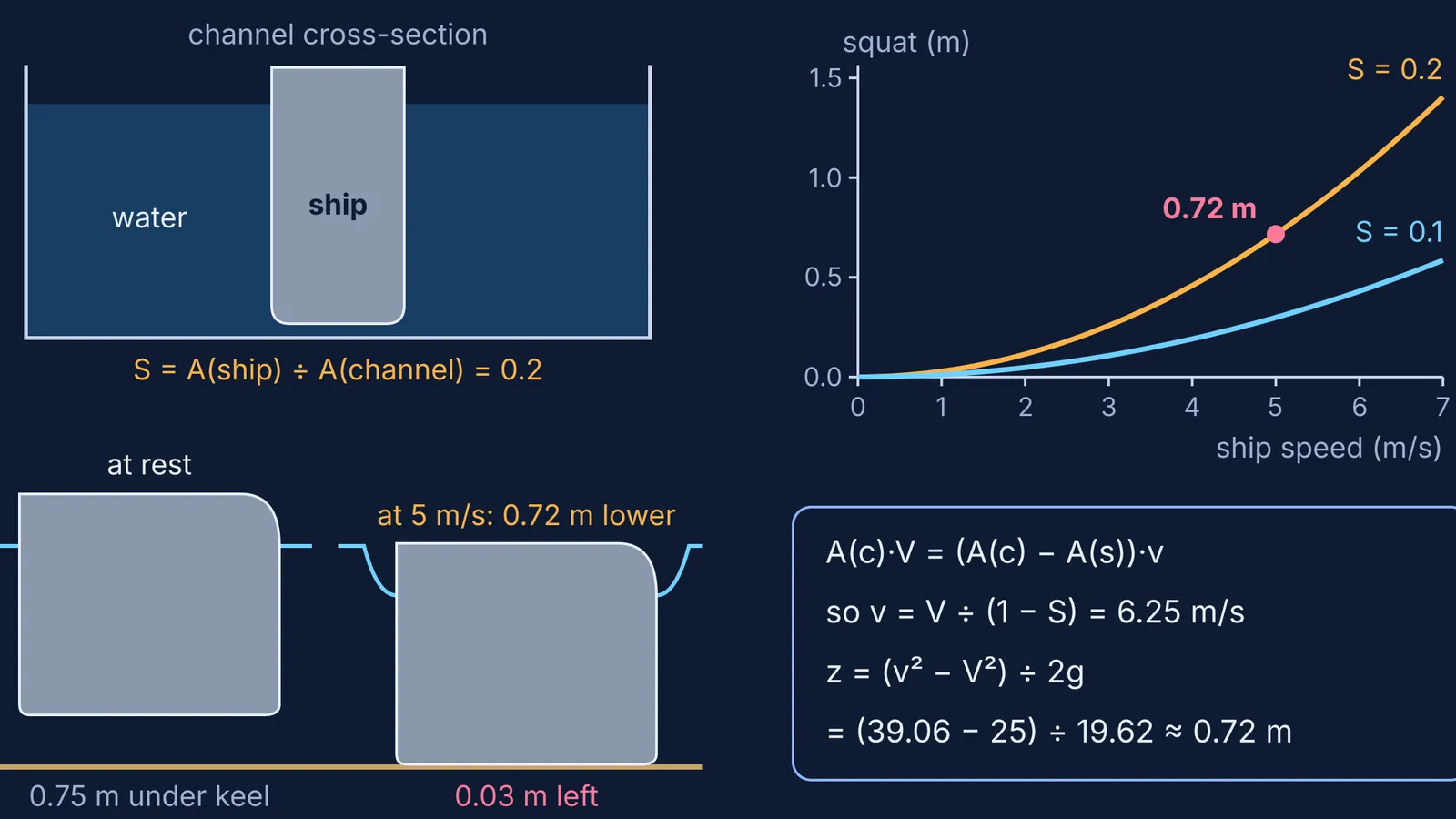
Continuity. Far ahead, water flows through the whole channel cross-section A(c). Beside and under the hull, it has only A(c) − A(s), where A(s) is the ship's underwater midship area. The same volume per second must pass both sections, so A(c)V = (A(c) − A(s))v.
Blockage ratio. Write S = A(s)/A(c), the fraction of the channel the ship blocks. Then v = V/(1 − S). The water round the hull moves faster than the ship.
Bernoulli. Along the water surface the pressure is atmospheric, so faster water means a lower surface. Between a point far ahead and a point beside the hull, the surface drops by z = (v² − V²)/2g.
The ship follows the water. A floating ship sits at the level of the water around it. When that level drops by z, the ship drops with it.
Putting these together gives z = (V²/2g)[1/(1 − S)² − 1].
This is the same pressure drop in a constriction that explains a pipe narrowing and drives the venturimeter. Here the constriction is made by the ship itself, and the drop shows up as a lower water surface instead of a manometer reading.
Worked example: how much does a ship squat at 5 m/s?
A ship with a midship section about 32 m wide and 11.25 m deep (area about 360 m²) moves along a channel 150 m wide and 12 m deep. At rest it has 12 − 11.25 = 0.75 m under its keel. It moves at 5 m/s, about 9.7 knots.
Channel area. A(c) = 150 × 12 = 1,800 m².
Blockage. S = 360 ÷ 1,800 = 0.20.
Water speed beside the hull. v = 5 ÷ (1 − 0.20) = 6.25 m/s.
Surface drop. z = (6.25² − 5²) ÷ (2 × 9.81) = (39.06 − 25) ÷ 19.62 = 0.72 m.
What is left. Clearance = 0.75 − 0.72 = 0.03 m. The ship that floated with 75 cm to spare now has about 3 cm.
When it touches. Setting z = 0.75 m and solving, V = √(2 × 9.81 × 0.75 ÷ 0.5625) = 5.1 m/s, about 9.9 knots. A little faster and the hull reaches the bed.
Units check: (m/s)² ÷ (m/s²) = m. The pressure drop that matches 0.72 m of sea water is about ½ × 1,025 × (6.25² − 5²) = 7.2 kPa.
Why does squat grow so fast with speed?
For a fixed S, z is proportional to V². Doubling speed quadruples squat, and halving speed cuts it to a quarter. With S = 0.2:
3 m/s gives 0.26 m.
5 m/s gives 0.72 m.
7 m/s gives 1.41 m.
Blockage matters too. At 5 m/s with S = 0.1, z = 1.274 × 0.235 = 0.30 m, less than half the S = 0.2 value. This is why ships slow down in narrow channels: speed is the one thing the master can change quickly, and it pays back as the square.
How do pilots estimate squat in practice?
The one-dimensional model treats the flow as uniform across each section and ignores the hull's shape. It also ignores that the lowered surface beside the ship shrinks the flow area further, which makes the water speed up even more. So it gives the right size, not a figure to steer by.
Pilots use empirical formulas fitted to model tests and ship trials. One widely quoted formula, from C. B. Barrass, gives maximum squat as C(b) × S₂^(2/3) × V(k)^2.08 ÷ 30 in metres, where C(b) is the block coefficient (how full the hull is), S₂ = A(s)/(A(c) − A(s)) and V(k) is the speed in knots. It appears with other squat formulas in a US Army Corps of Engineers technical note comparing them with ship measurements in Charleston Harbor. For our ship, with C(b) = 0.8 as an illustrative value for a full-bodied hull, S₂ = 360 ÷ 1,440 = 0.25 and V(k) = 9.72, this gives about 1.2 m. That note found Barrass's formula predicted more squat than was measured there, which is the safe side for a pilot. Our simple model's 0.72 m is the same order of magnitude.
A ship also does not sink evenly. The bow and the stern usually squat by different amounts, depending on the hull shape, and that note treats bow and stern squat separately. The same speeding-up of water near a hull also changes the wave pattern around the bow, which is what the bulb on a ship's bow is designed to work with.
If continuity and Bernoulli problems like this one still trip you up, the Fermi Problem Library has a step-by-step solver that explains the reasoning at each stage.
Quick checklist
Squat: a moving ship sinks lower in shallow, confined water.
In the ship's frame, continuity gives v = V ÷ (1 − S), with S = A(ship) ÷ A(channel).
Bernoulli along the surface gives the drop z = (v² − V²) ÷ 2g; the ship sinks with the water.
z ∝ V²: halve the speed and squat falls to a quarter.
At 5 m/s and S = 0.2, z ≈ 0.72 m, enough to use up 0.75 m of clearance.
Real pilots use empirical formulas such as Barrass's, which give larger, conservative values.


