

On this page
Why is pressure lower where fluid flows faster?
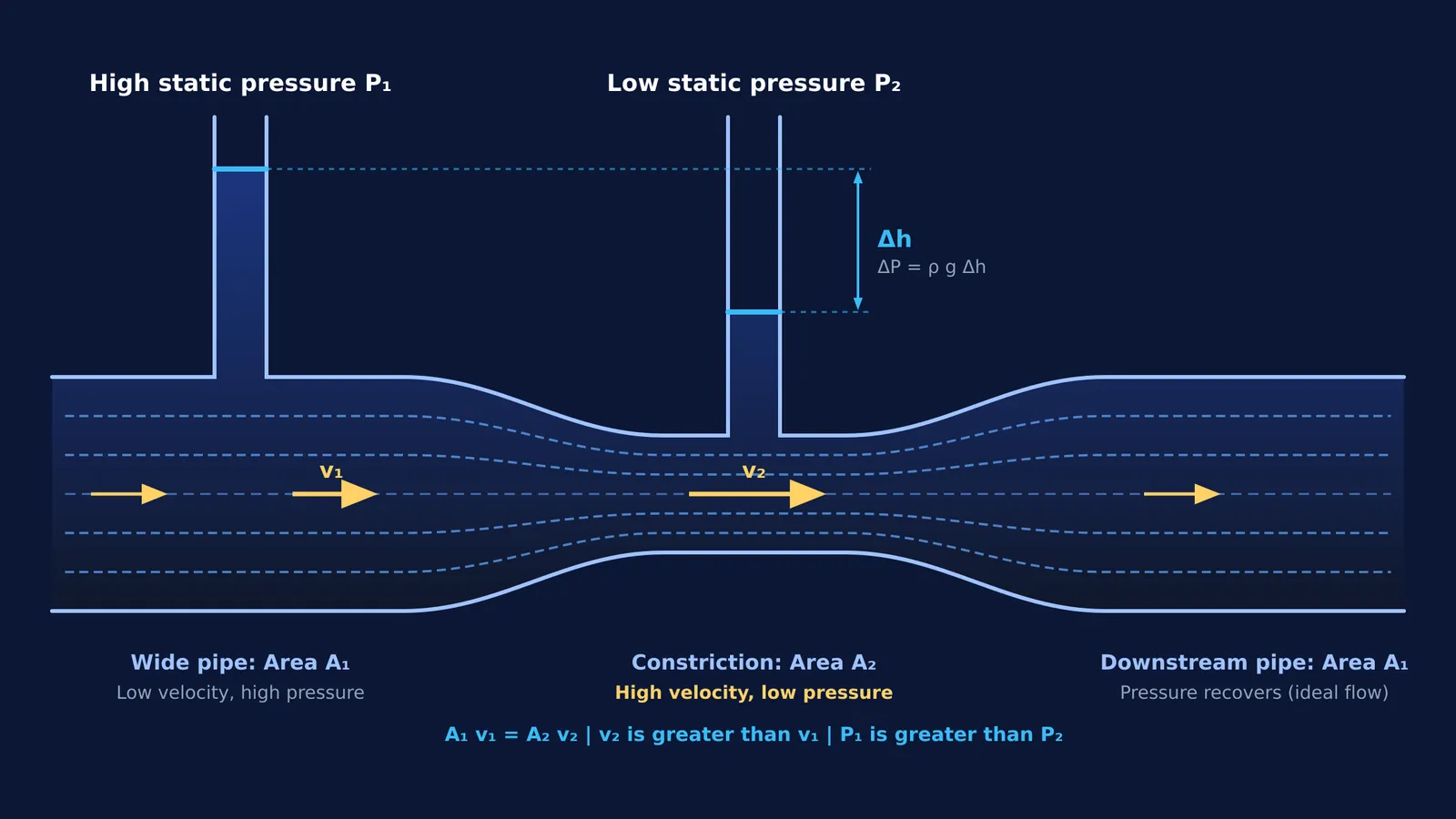
Ask physics students what happens to water pressure inside a pipe constriction, and most will guess that pressure increases. Intuition suggests that cramming fluid into a narrower space ought to compress it and push harder against pipe walls, like cars jamming together on a highway. Yet as Robert P. Bauman and Rolf Schwaneberg explained in The Physics Teacher, this intuition confuses static pressure with particulate crowding and ignores Newton's second law.
Liquids like water are practically incompressible under standard laboratory conditions, so density ρ remains constant throughout the pipe. As fluid moves toward a narrower section, it does not bunch up; it accelerates to maintain steady volume flow. By Newton's second law, acceleration requires an unbalanced forward force, which can only arise from surrounding fluid pressure acting on its rear and front faces.
To accelerate into the constriction, the upstream push behind the fluid parcel must exceed the downstream push ahead of it. Thus, upstream pressure P₁ must be strictly greater than throat pressure P₂. The negative pressure gradient along the streamline is the physical force accelerating the fluid.
How do continuity and Bernoulli combine in a horizontal pipe?
Quantifying this pressure drop requires combining mass conservation with energy conservation. In the official NCERT Class 11 Physics curriculum, fluid flow in conduits begins with the equation of continuity: A₁ v₁ = A₂ v₂. When the pipe narrows (A₂ < A₁), flow speed increases by v₂ = (A₁ / A₂) v₁. Halving the cross-sectional area doubles the speed to transport the same volume per second.
Next, apply Bernoulli's principle along a streamline, formulated by Daniel Bernoulli in 1738 as documented by G. K. Mikhailov in Landmark Writings in Western Mathematics. For horizontal streamline flow where elevation remains constant (y₁ = y₂):
P₁ + ½ ρ v₁² = P₂ + ½ ρ v₂²
Rearranging reveals that the static pressure difference balances the change in kinetic energy density:
P₁ − P₂ = ½ ρ (v₂² − v₁²) = ½ ρ v₁² [(A₁ / A₂)² − 1]
Because A₁ > A₂, the term [(A₁ / A₂)² − 1] is positive, proving that static pressure in the wide section P₁ exceeds pressure in the throat P₂. Readers can explore Bernoulli's original derivations in our portrait of Daniel Bernoulli and the origins of fluid dynamics.
How do you calculate the pressure difference in a constriction?
As verified in laboratory apparatus designed for introductory fluid mechanics in the American Journal of Physics, calculating the pressure difference across a horizontal constriction follows a four-step framework:
Find cross-sectional areas A₁ and A₂ from pipe diameters using A = π d² / 4.
Apply continuity to determine throat velocity: v₂ = (A₁ / A₂) v₁.
Compute the pressure drop from kinetic energy density: ΔP = P₁ − P₂ = ½ ρ (v₂² − v₁²).
Convert the pressure drop to a vertical manometer column height difference: Δh = (P₁ − P₂) / (ρ g).
Consider water of density ρ = 1000 kg/m³ flowing through a horizontal pipe where wide area A₁ = 4.0 × 10⁻³ m² and throat area A₂ = 1.0 × 10⁻³ m². The wide flow speed is v₁ = 1.5 m/s.
First, find the throat speed:
v₂ = (4.0 × 10⁻³ / 1.0 × 10⁻³) × 1.5 m/s = 6.0 m/s
Second, evaluate the kinetic energy terms: v₁² = (1.5)² = 2.25 m²/s² and v₂² = (6.0)² = 36.0 m²/s², yielding v₂² − v₁² = 33.75 m²/s².
Third, compute the static pressure drop:
P₁ − P₂ = ½ × 1000 kg/m³ × 33.75 m²/s² = 16,875 Pa ≈ 16.9 kPa
Fourth, calculate the height difference in open vertical piezometers using g = 9.8 m/s²:
Δh = 16,875 / (1000 × 9.8) ≈ 1.72 m
The open columns confirm that liquid level drops by 1.72 m at the throat. For multi-step physics derivations where continuity and energy conservation meet, the Fermi Problem Library offers worked problems with a step-by-step solver that explains the reasoning rather than simply printing an answer.
What mistakes do students make on Venturi tube questions?
In the official NCERT Class 11 Physics syllabus and competitive exams like JEE Main and NEET-UG, fluid dynamics questions frequently test students on subtle traps:
Squaring diameters once: Because area scales with diameter squared (A ∝ d²), velocity scales with (d₁ / d₂)², and kinetic energy density scales with (d₁ / d₂)⁴. Halving pipe diameter quadruples flow speed and increases dynamic pressure by 16 times.
Confusing static and stagnation pressure: A pitot tube facing oncoming flow measures stagnation pressure (P + ½ ρ v²), which stays constant along an ideal streamline. A wall tap measures static pressure P, which drops in the throat.
Neglecting elevation: In non-horizontal pipes, include gravitational potential energy density ρ g (y₂ − y₁).
Manometer fluid density: In U-tube manometers containing mercury of density ρ_m, the height difference reflects (ρ_m − ρ) g Δh rather than ρ g Δh.
For more common exam errors, read our guide on fluid mechanics mistakes to avoid. To visualize fluid behavior across conduit geometries, the Fermi Simulation Lab provides interactive simulations for ideas that are easier to see than to read, enabling learners to adjust constriction ratios and observe streamline spacing and pressure columns in real time.


