

On this page
A shark and a tuna can share the same patch of the Arabian Sea, yet the shark's blood is about as concentrated as the sea while the tuna's is far weaker. The difference is a molecule you probably know as waste: urea.
Why do sharks keep urea in their blood?
Water crosses a membrane by osmosis, from the more dilute side to the more concentrated side. A fish whose blood is weaker than seawater keeps losing water through its gills.
Sharks, skates and rays (the elasmobranchs) avoid this. Marine elasmobranchs keep their blood plasma at 900–1000 mosmol/kg, equal to or slightly above seawater, built mainly from sodium, chloride and urea, each about a quarter to a third of the total (Anderson, Takei and Hazon, Journal of Experimental Biology, 2002). Because their blood matches the sea, they "experience little or no osmotic loss of water", as Neil Hammerschlag's review puts it (Marine and Freshwater Behaviour and Physiology, 2006).
The same review lists plasma urea of 351 mM in the spiny dogfish, and notes that urea generally makes up more than 30% of plasma osmolarity in marine elasmobranchs. Sodium, chloride and other ions are kept below seawater levels. So the urea is not waste the shark failed to remove; it is a home-made solute that lets the shark match the sea without filling its blood with salt.
How does TMAO stop urea from damaging proteins?
There is a catch: at high concentrations urea unfolds proteins. Sharks answer this with a second molecule, trimethylamine N-oxide (TMAO).
In 1979 Paul Yancey and George Somero found that methylamines such as TMAO, at about half the concentration of urea, largely or fully offset urea's destabilising effect on proteins, including their heat stability and refolding (Biochemical Journal, 1979). Hammerschlag's review gives typical plasma TMAO of 75 mM, with TMAO inside cells approaching 200 mM, roughly half the urea level, a ratio that holds in most elasmobranchs (review).
Where does the urea come from, and how does a shark keep it?
Keeping 300-plus mM of a small molecule in the blood takes work at three sites, all described in Hammerschlag's review:
Liver: almost all elasmobranchs make urea through the ornithine–urea cycle in the liver, which makes them ureotelic, like humans. Our own urea is also made in the liver, not the kidney.
Gills: urea still leaks out here, but slowly. Rainbow trout gills can be up to 60 times more permeable to urea than spiny dogfish gills; cholesterol-rich gill membranes and pumps that return urea to the blood help explain the difference.
Kidney: about 70–99% of the urea filtered into the primary urine is reabsorbed.
Salt still diffuses in from the sea. A small organ called the rectal gland secretes the excess sodium and chloride.
How do bony marine fish solve the same problem?
Bony fish (teleosts) such as tuna and pomfret take the opposite route. Marine teleosts keep their body fluids at about one-third the osmolality of seawater, by drinking seawater and excreting sodium and chloride through their gills (Miyanishi and colleagues, Zoological Letters, 2016).
Their weaker blood loses water across the gills, so they must drink. Best estimates suggest as much as 50% of the salt in a swallowed mouthful is removed in the oesophagus before the gut absorbs the water (Esbaugh, Comparative Biochemistry and Physiology A, 2025). The freshwater-versus-marine side of this story is in our explainer on osmoregulation in freshwater and marine fish.
Worked example: a bull shark swims up a river
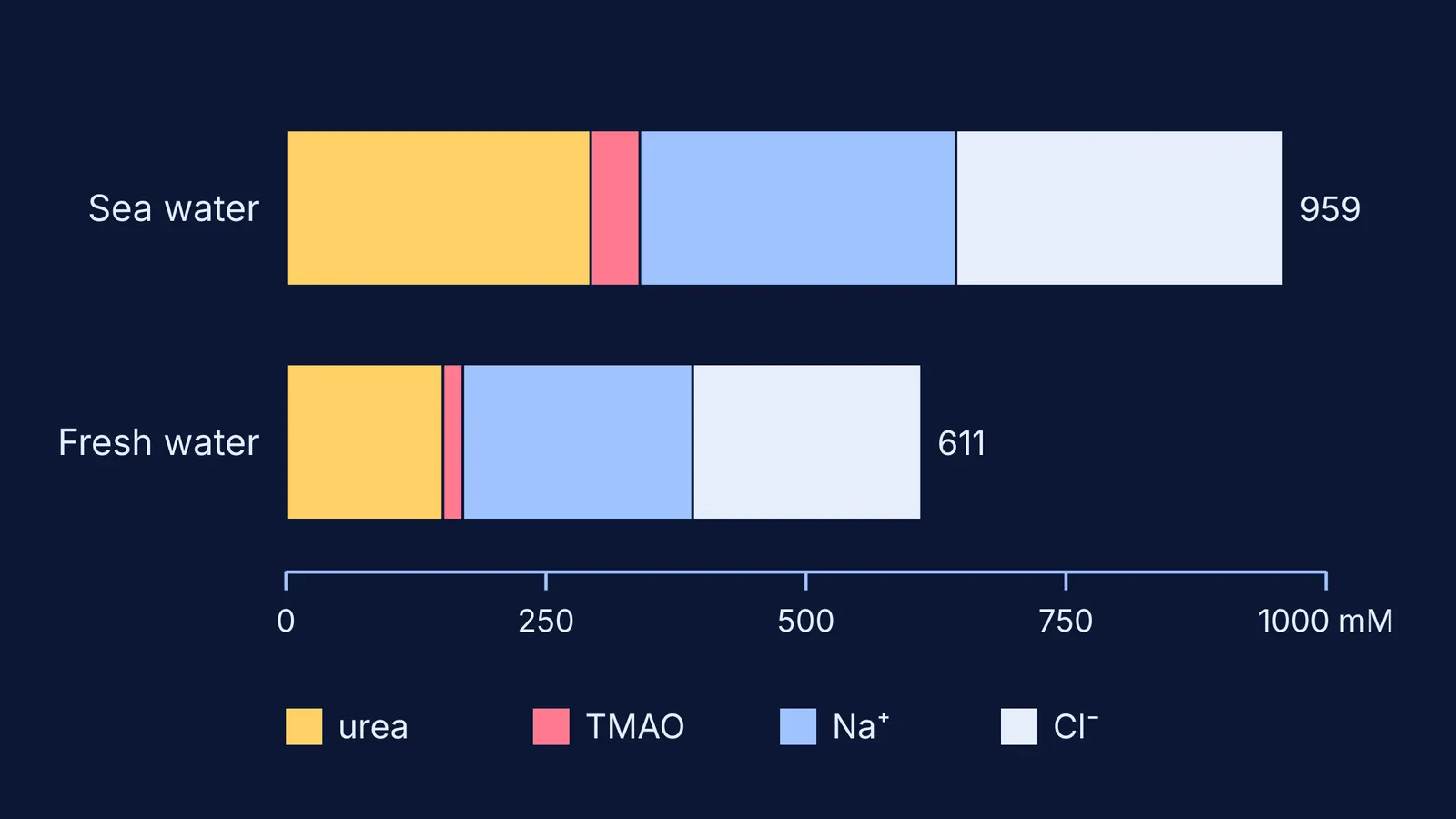
Bull sharks live in both the sea and rivers. Hammerschlag's review tabulates plasma data from a 2004 lab study by Pillans and colleagues that acclimated bull sharks to salt water and to fresh water (review):
Salt water: urea 293 mM, TMAO 47.3 mM, sodium 304 mM, chloride 315 mM
Fresh water: urea 151 mM, TMAO 19.1 mM, sodium 221 mM, chloride 220 mM
Add the four solutes: 959 mM in salt water, 611 mM in fresh water.
Urea's share: 293 ÷ 959 is about 31% in the sea; 151 ÷ 611 is about 25% in the river.
Urea change: 151 ÷ 293 is about 0.52, so urea roughly halves.
Why: in a river, concentrated blood would pull water in, so the shark makes and keeps less urea and passes more urine.
These sums skip potassium, calcium and other solutes, so treat them as rough totals.
A three-question check for any osmoregulation question
Is the blood more or less concentrated than the water outside?
So which way does water move, and how does the animal replace or remove it?
Which way does salt leak, and which organ pumps it back?
Marine shark: about equal; little water loss; the rectal gland removes salt. Marine bony fish: weaker; water leaks out, so it drinks; gills pump salt out.
If osmosis itself still feels shaky, the Fermi Concept Library has a lesson on every concept in biology and chemistry, each with its place in the map. Or work through the bull shark numbers with Fermi's AI tutor, which checks your understanding as it goes.
In the sea, urea is not just waste; it is how a shark holds on to its water.


