

On this page
Pour a little water into the heater pad of a self-heating meal pack, slide in the food pouch, and within about ten minutes your food is hot. There is no flame, no battery and no air supply. The heat comes from magnesium reacting with water, a reaction NCERT tells you is very slow in cold water. The trick that makes it fast is a set of tiny short-circuited galvanic cells, the same Mg/Fe pair used to protect iron pipes, now built to destroy the magnesium on purpose.
What is inside a self-heating meal heater?
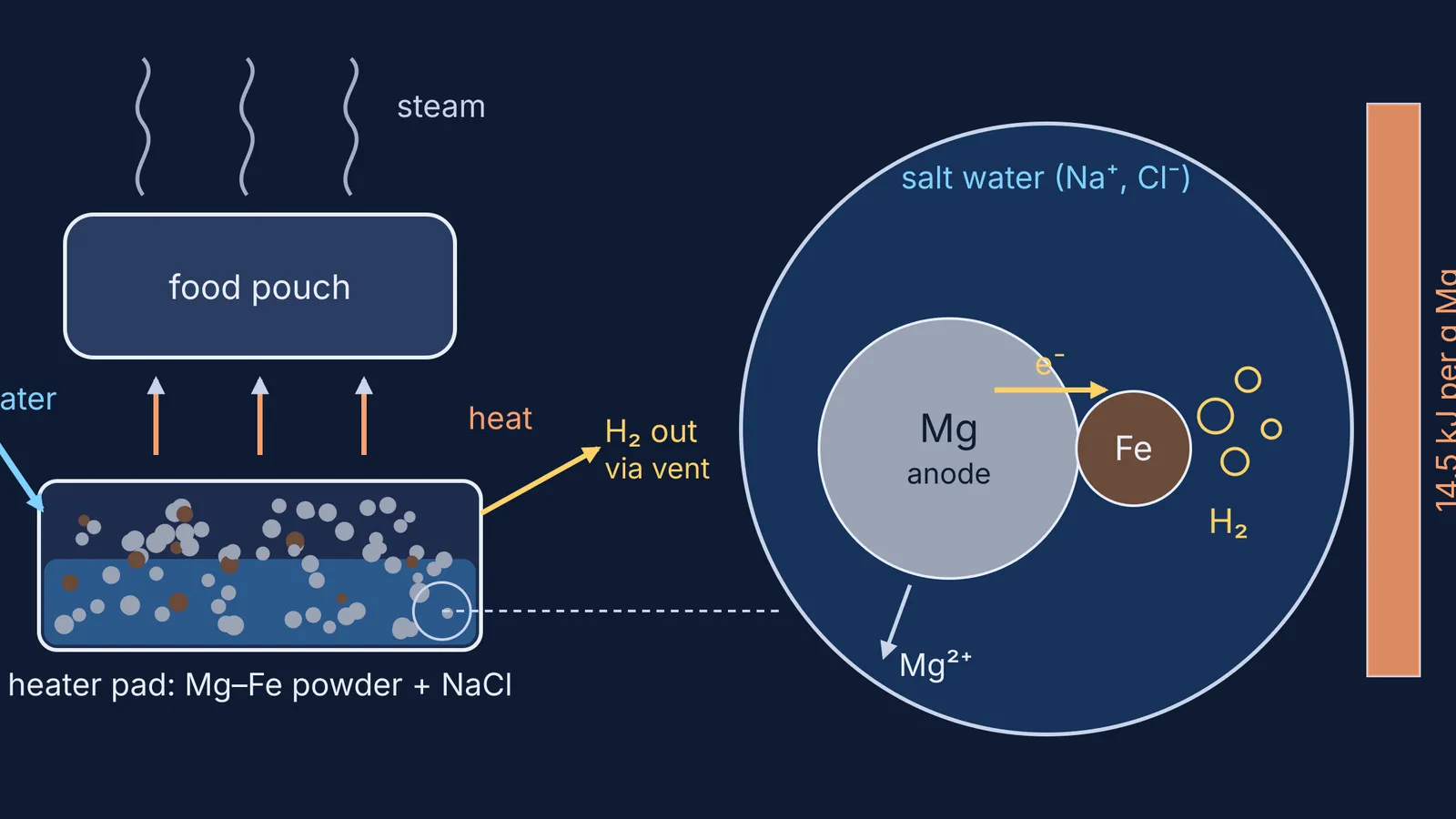
Military flameless ration heaters and many civilian self-heating meals use a pad of fine metal powder that holds:
Magnesium–iron alloy powder. Mostly magnesium with a few per cent iron.
Sodium chloride. Common salt, which becomes the electrolyte once water is added.
Filler. An inert material that spreads the powder out and holds the water.
One design, described in US patent 5,611,329, uses 7.5 g of a magnesium alloy containing about 5% iron, with 0.5 g of salt. The patent says it heats an 8-ounce (about 230 g) meal pouch by over 100 °F, a rise of about 56 °C, in under 12 minutes. Wikipedia's flameless ration heater page summarises this heater as giving out about 50 kJ at about 80 W. Other makers use different amounts, so treat these as one example.
What reaction makes the heat?
Magnesium reduces water to hydrogen and forms magnesium hydroxide:
Mg(s) + 2H₂O(l) → Mg(OH)₂(s) + H₂(g)
Check: 1 Mg, 2 O and 4 H on each side. The product is the hydroxide, not MgO, because the reaction runs in liquid water at well below 100 °C.
On its own this reaction barely moves in cold water. Mg(OH)₂ is almost insoluble, so a thin film of it forms on the metal and seals it off. That is why the NCERT activity series says magnesium reacts only slowly with cold water and faster with hot water or steam.
Why does iron make magnesium react so fast?
Each tiny iron particle touching a magnesium grain forms a short-circuited galvanic cell, with salt water as the electrolyte.
Anode (magnesium): Mg → Mg²⁺ + 2e⁻. The Mg²⁺ ions move into the salt water.
Cathode (iron surface): 2H₂O + 2e⁻ → H₂ + 2OH⁻. Hydrogen bubbles form on the iron, not on the magnesium.
Electron path: the direct metal contact between the grain and the particle.
Later: Mg²⁺ + 2OH⁻ → Mg(OH)₂, which settles out as a white solid.
Adding the half-reactions gives back Mg + 2H₂O → Mg(OH)₂ + H₂. The driving force is large. E°(Mg²⁺/Mg) = −2.37 V, and water reduction at pH 7 is about −0.41 V, so the cell has roughly 1.96 V to work with.
Iron helps because hydrogen forms much more easily on an iron surface than on magnesium. Iron is not a catalyst in the textbook sense: it does not lower the barrier of one single step. It speeds things up electrochemically by acting as the cathode of a cell.
Chloride does two jobs. It makes the water a good conductor, so ions can carry the current between the two surfaces. It also attacks the hydroxide film on magnesium, so fresh metal keeps reaching the water.
This is exactly the couple in sacrificial protection of iron with zinc or magnesium and in the magnesium rod inside your geyser. There, magnesium corrodes slowly to save the iron. Here, the cells are as small and as many as possible, so the magnesium is used up in minutes and the energy comes out as heat.
How much heat does one gram of magnesium give?
Use standard enthalpies of formation. H₂ is an element, so its value is zero.
Write the data. ΔfH°: Mg(OH)₂(s) = −924.5 kJ mol⁻¹; H₂O(l) = −285.8 kJ mol⁻¹; Mg(s) and H₂(g) = 0.
Apply products minus reactants. ΔrH° = (−924.5 + 0) − (0 + 2 × (−285.8)) = −924.5 + 571.6 = −352.9 kJ mol⁻¹.
Convert to per gram. Mg has M = 24.31 g mol⁻¹, so 352.9 / 24.31 = 14.5 kJ per gram of magnesium.
Energy needed for the food. Take 250 g of food, mostly water, with c ≈ 4 J g⁻¹ K⁻¹, heated from 25 °C to 75 °C. q = 250 × 4 × 50 = 50 000 J = 50 kJ.
Minimum magnesium. 50 / 14.5 = 3.4 g of Mg, if every joule reached the food.
Allow for losses. Much of the heat warms the pad, packaging and air. At an illustrative 50% efficiency you need about 6.9 g, or roughly 7 g.
Compare that with the patent heater: 7.5 g of alloy that is mostly magnesium holds roughly 7 g of Mg, which could release about 100 kJ. It is quoted as delivering about 50 kJ, so roughly half the energy goes into the food. The estimate and the real product agree.
How much hydrogen does the pack release, and is it safe?
From the equation, 1 mol of Mg gives 1 mol of H₂.
Take 7 g of Mg (illustrative). 7 ÷ 24.31 = 0.29 mol of Mg, so 0.29 mol of H₂.
At 25 °C and 1 bar, one mole of gas takes up about 24.8 L, so 0.29 × 24.8 ≈ 7 L of hydrogen.
Seven litres of a flammable gas from one meal is why the packs carry warnings. Hydrogen burns in air at concentrations from about 4% to about 75%. The safety rules that follow:
Use it in open air or a well-ventilated space. Not in a closed car, a small tent, or a cupboard.
Keep flames and sparks away while it is reacting.
Never seal the heater in a closed container. The vent must stay open.
Watch for heat and steam. The water and the pouch get hot enough to scald. Handle them by the edges.
Do not make one yourself. Fine magnesium powder is itself a fire hazard.
Airlines treat these packs as dangerous goods. Canada's screening authority, CATSA, says self-heating meals in bags "are not permitted in carry-on" and that checked baggage "requires air carrier approval". The US FAA issued a safety alert to airlines about the fire hazard from flameless ration heaters. Check your airline's own rules before you pack one.
How is this different from a hand warmer?
Disposable hand warmers also use a metal powder with salt and water, but the chemistry is different. They oxidise iron with oxygen from the air over several hours, and they produce no gas. The meal heater needs no air at all: water is the oxidising agent. It works in minutes, and it gives off hydrogen.
For more enthalpy-of-formation and stoichiometry problems like this one, the Fermi Problem Library has a step-by-step solver that explains the reasoning.
Quick checklist
Reaction: Mg + 2H₂O(l) → Mg(OH)₂ + H₂; ΔrH° = −352.9 kJ mol⁻¹, about 14.5 kJ per gram of Mg.
Mg alone is slow in cold water because a Mg(OH)₂ film coats it.
Iron particles are cathodes where H₂ forms; magnesium is the anode. Chloride conducts and breaks the film.
50 kJ of heat for food needs at least 3.4 g of Mg, about 7 g at 50% efficiency.
About 7 g of Mg releases about 7 L of H₂: use outdoors or with good ventilation, never sealed, away from flames.


