

On this page
Iron is the foundation of modern infrastructure, from ship hulls and bridges to underground pipelines. However, iron has a major weakness: when exposed to oxygen and moisture, it oxidises and forms rust. Replacing corroded infrastructure is an expensive global problem.
To solve this, engineers use a technique called sacrificial protection. By connecting the iron to a more reactive metal, they can force the other metal to corrode instead. This is a common application of electrochemistry and a key topic in board exams and entrance tests.
How does an anode protect iron?
Rusting is an electrochemical process. When iron corrodes, it loses electrons and is oxidised to iron(II) ions: Fe → Fe²⁺ + 2e⁻.
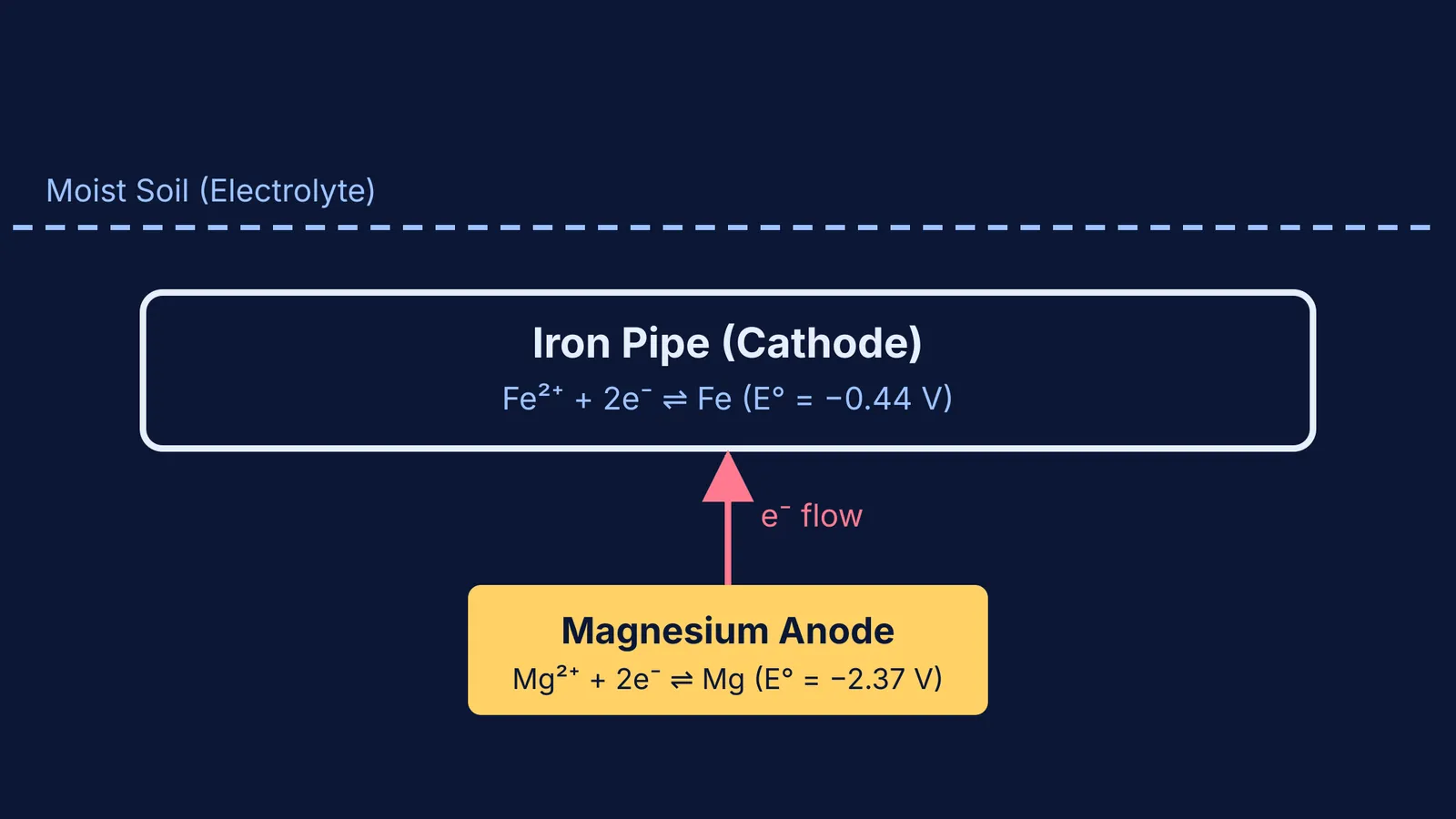
To prevent this oxidation, you can connect the iron to a metal that is more easily oxidised. In the language of electrochemistry, you need a metal with a lower standard reduction potential (E°) than iron. According to standard reduction potential tables (Wikipedia), iron has an E° value of −0.44 V.
Zinc (E° = −0.76 V) and magnesium (E° = −2.37 V) both have lower standard reduction potentials than iron. When one of these metals is connected to an iron structure in the presence of an electrolyte like seawater or damp soil, they form a galvanic cell.
The more reactive metal acts as the anode, giving up its electrons more readily. These electrons flow into the iron, turning the iron into the cathode. Because the iron is receiving electrons, it cannot be oxidised. The zinc or magnesium "sacrifices" itself by corroding away, leaving the iron completely protected.
If you are struggling to remember which metal oxidises first in a cell, the Fermi Concept Library explains how to compare standard reduction potentials and predict the direction of electron flow.
Why use zinc for ships and magnesium for pipelines?
The choice between zinc and magnesium depends on the environment where the iron structure is located.
Zinc is the standard sacrificial anode for marine environments. Seawater is highly conductive, so zinc's moderate driving voltage (the difference between its potential and iron's) is enough to provide a steady protective current. Large blocks of zinc are routinely bolted to the steel hulls of ships, submarines and offshore oil rigs.
Magnesium, on the other hand, is much more reactive. Its highly negative reduction potential provides a strong driving voltage. This makes magnesium the best choice for resistive environments, such as dry soil or freshwater, where a stronger push is needed to keep the current flowing. Engineers bury magnesium blocks next to underground steel pipelines and connect them with a wire to keep the pipelines from rusting away in the soil.
You can read more about how oxidation affects everyday metals in our guide to Class 10 science oxidation and corrosion.
How do galvanised sheets and scratched coatings work?
Sacrificial protection is also the science behind galvanisation. Galvanised steel is simply iron coated in a thin layer of zinc.
Unlike a simple coat of paint or tin, a zinc coating continues to protect the iron even if it gets scratched.
Because the zinc is more reactive, it will continue to preferentially lose electrons and oxidise, protecting the exposed iron patch from rusting. To understand why transition metals like iron have varying stability in different oxidation states, review our post on electrode potentials of 3d metals.
How do you predict the sacrificial metal?
When solving electrochemistry problems or designing a protection system, use this framework to determine which metal will corrode:
Find the standard reduction potentials (E°) for both metals in the electrochemical series.
The metal with the more negative E° value is the stronger reducing agent. It will act as the anode and be oxidised.
The metal with the less negative E° value will act as the cathode and be protected.
Ensure the two metals are in electrical contact (touching or connected by a wire) and immersed in an electrolyte (like water or soil) to allow ion flow.
Setting up the half-reactions and calculating the overall cell potential takes practice. Once the sacrificial block is completely consumed, it must be replaced, but this simple electrochemical trick saves billions of dollars in infrastructure maintenance every year.
To see how these principles appear in exam questions, try calculating a few cell potentials with the step-by-step solver in the Fermi Problem Library.


