On this page
Open the manual of your family's storage geyser and you may find a part most people never see: a metal rod, often magnesium, fitted inside the tank. Its job is to corrode, slowly, so that the steel tank around it does not. It is one of the clearest everyday uses of the reactivity series you study in Class 10.
What does the magnesium rod in a geyser actually do?
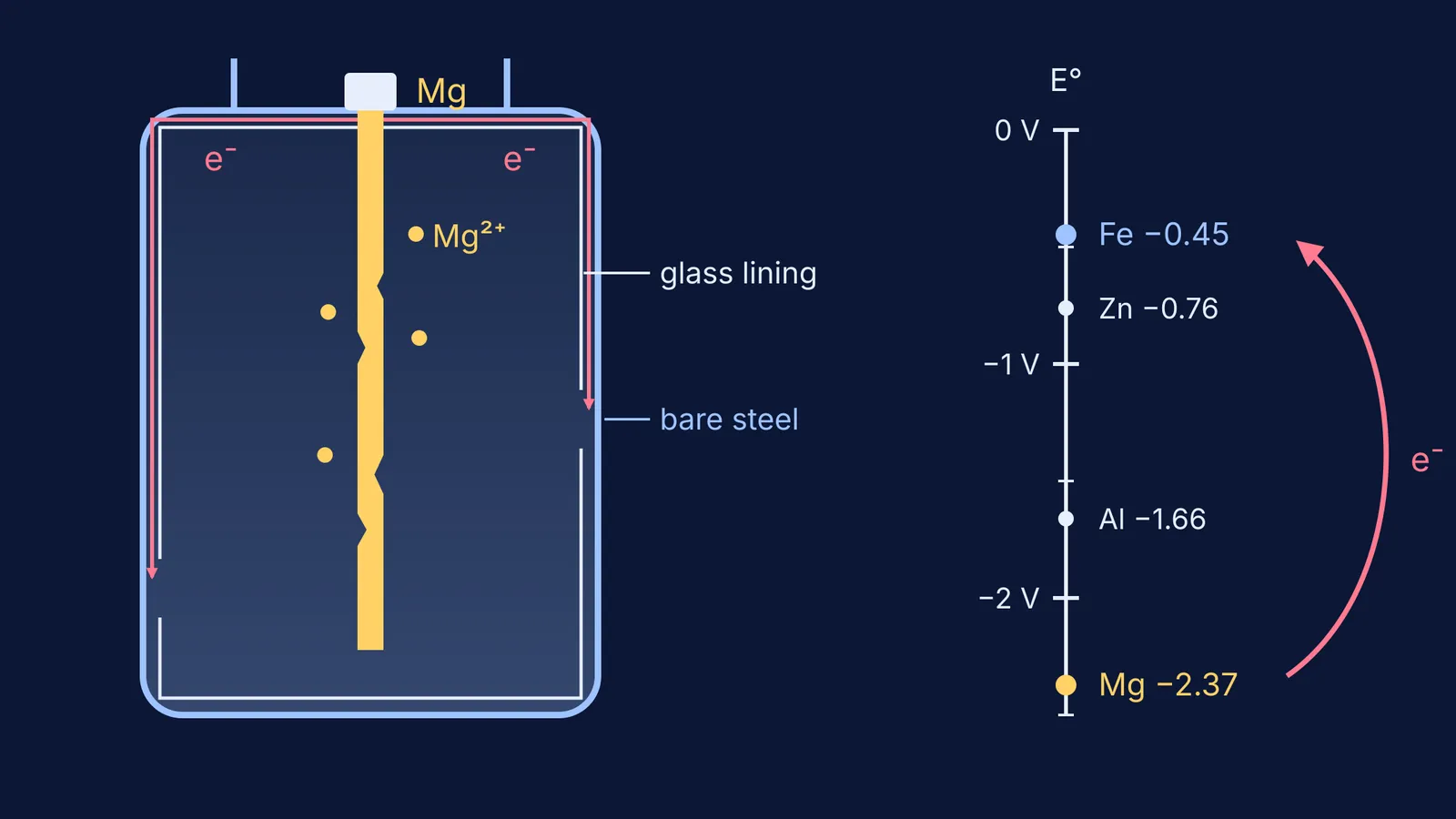
Many storage water heater tanks are lined with glass. A US patent on anode rods describes the tank being sprayed with a glass slurry and fired in a furnace, and says the magnesium anode sends electrons to "the exposed steel surface" (US patent 6611133). Wherever the lining has a chip or a thin spot, hot water touches bare steel, and that is where the rod earns its keep.
A sacrificial anode is a highly active metal used to stop a less active metal surface from corroding (Chemistry LibreTexts/Electrochemistry/Exemplars/Corrosion/Sacrificial_Anode)). The same page lists water heaters alongside ship hulls and pipelines as common uses. Rinnai, a water heater maker, says these anodes protect systems holding large quantities of stored water and are generally not used on instantaneous heaters (Rinnai UK).
Why does magnesium corrode before steel?
Because magnesium is more reactive than iron, and steel is mostly iron. In NCERT's Class 10 activity series (Table 3.2), magnesium sits above aluminium, zinc and iron, and the chapter states that reactivity decreases in the order Mg > Al > Zn > Fe (NCERT Science Class 10, Chapter 3).
The standard reduction potential of Mg²⁺/Mg is −2.372 V, and that of Fe²⁺/Fe is −0.447 V (OpenStax Chemistry: Atoms First, Appendix L). The more negative the value, the more readily a metal gives up electrons, so when the two are connected in the same water, magnesium becomes the anode and steel becomes the cathode. If the order slips your mind in an exam, try this easy way to remember the reactivity series.
How does sacrificial protection work, step by step?
Here is the worked example we would want you to be able to write, using the OpenStax values linked above.
Anode (the magnesium rod), oxidation: Mg → Mg²⁺ + 2e⁻
The electrons flow through the metal contact into the steel tank.
Cathode (exposed steel), dissolved oxygen is reduced: O₂ + 2H₂O + 4e⁻ → 4OH⁻, with E° = +0.401 V.
Because the steel is being fed electrons, iron does not have to lose its own, so Fe → Fe²⁺ + 2e⁻ is held back.
Gap between the two metals: −0.447 − (−2.372) = 1.925 V, almost 2 volts in magnesium's favour.
These are standard values at 25 °C, so in a hot geyser treat them as a ranking, not exact figures. The patent says the same thing in engineering terms: magnesium corrodes, "producing an abundance of electrons" that flow to the exposed steel (US patent 6611133). For a side-by-side look at the two usual choices, read our explainer on sacrificial protection of iron with zinc or magnesium.
If this still feels abstract, the Fermi Simulation Lab has interactive simulations for ideas that are easier to see than to read, and our post on predicting which metal displaces which, then simulating it shows the same reactivity order at work.
How do you know when the geyser anode rod needs replacing?
Once the rod is used up, the steel loses its protection. Bosch's guidance for its electric mini-tank water heaters lists these signs (Bosch Home Comfort):
Brown or orange hot water, which can mean the rod is completely depleted.
A rotten-egg smell, which Bosch says can come from a reaction between the anode rod and the water, especially softened water.
A rod worn down to less than half its original diameter.
Bosch advises checking the rod at least once a year. Your geyser's manual has the advice for your model. A simple plan for your family:
Find the manual and note what it says about the anode and how often to check it.
Ask an authorised service technician to inspect the rod at the yearly service. Do not open a geyser yourself: it holds hot water under pressure and runs on mains electricity.
Ask to see the old rod. A smooth rod has life left; a thin, pitted one has done its job.
Note the date and set a reminder for next year.
How should you write this in a board exam?
A three-mark answer could read: "The steel tank of a storage geyser is fitted with a magnesium rod. Magnesium is above iron in the reactivity series, so it is oxidised in preference to iron (Mg → Mg²⁺ + 2e⁻). The electrons it releases flow to the steel, which acts as the cathode and does not corrode. Because magnesium is used up to protect iron, this is called sacrificial protection."
If the trouble is the idea itself rather than the wording, the Fermi Concept Library gives every concept in chemistry its own lesson and shows its place in the map.