

On this page
If you have ever stared at a chemistry question asking whether zinc will displace copper in a solution, you are testing your knowledge of the reactivity series. This ranked list of elements dictates which metals can steal oxygen or swap places with others, forming the basis of chapters on metals and non-metals in the school curriculum.
The challenge is rarely understanding the idea; the challenge is recalling the exact order during an exam. Here is a simple memory sentence to lock the sequence into your mind, plus exactly what the list tells you about how these metals behave.
If you want to trace the reasons behind these chemical properties, the Fermi Concept Library has every concept in chemistry, each with its own lesson and its place in the map.
What is the reactivity series of metals?
The reactivity series is a list of metals arranged from the most reactive at the top to the least reactive at the bottom. A metal's position depends on how easily its atoms lose electrons to form positive ions.
According to the standard reactivity series, highly reactive metals like potassium sit at the top, while noble metals like gold and platinum sit at the bottom. Hydrogen is also included as a non-metal reference point to help predict reactions with acids.
What is an easy way to remember the reactivity series of metals?
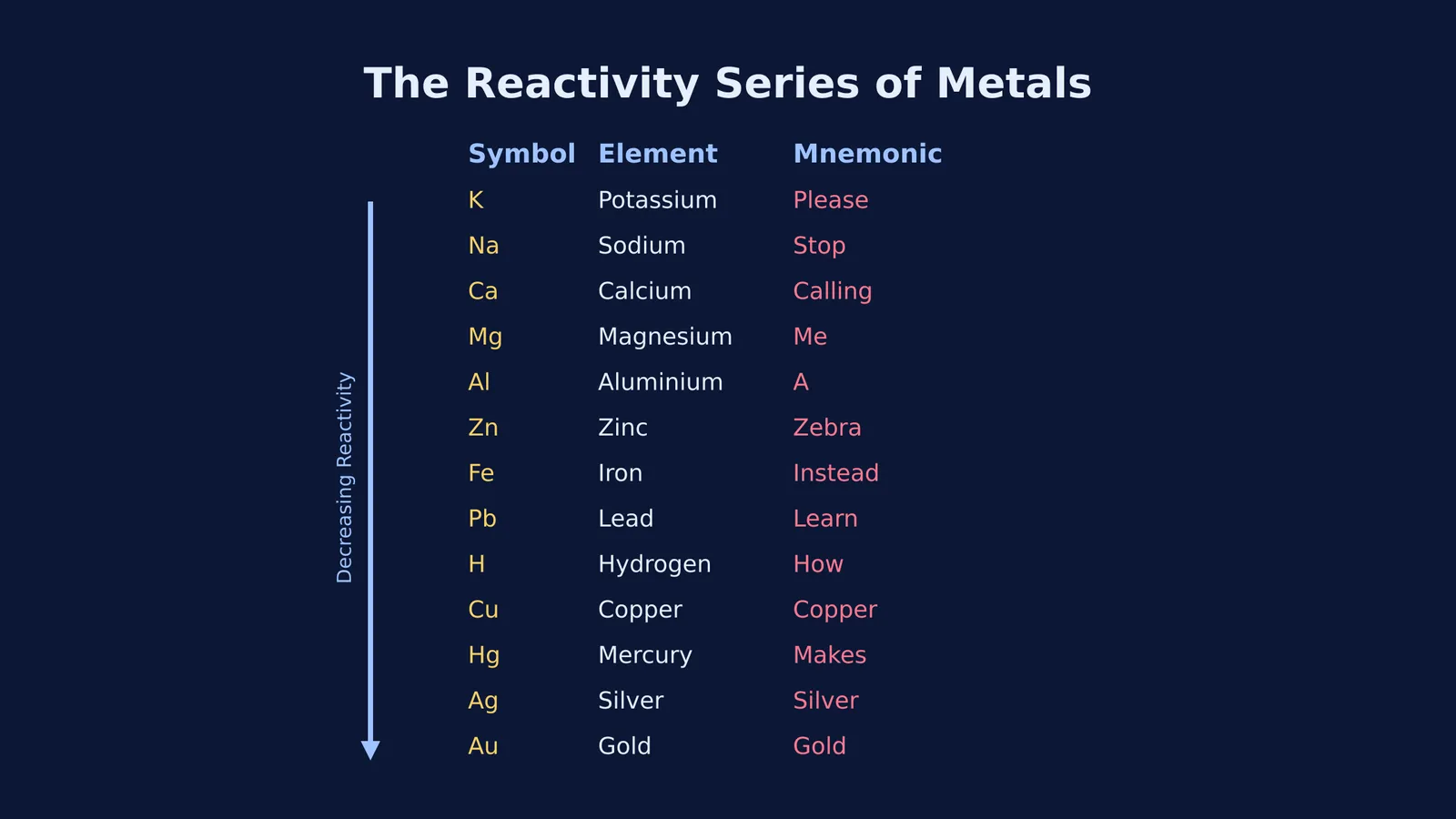
The most reliable way to memorise the thirteen core elements (K, Na, Ca, Mg, Al, Zn, Fe, Pb, H, Cu, Hg, Ag, Au) is to use a mnemonic sentence where the first letter of each word matches the metal.
Repeat this phrase: Please Stop Calling Me A Zebra Instead Learn How Copper Makes Silver Gold.
Please — Potassium (K)
Stop — Sodium (Na)
Calling — Calcium (Ca)
Me — Magnesium (Mg)
A — Aluminium (Al)
Zebra — Zinc (Zn)
Instead — Iron (Fe)
Learn — Lead (Pb)
How — Hydrogen (H) *[Reference]*
Copper — Copper (Cu)
Makes — Mercury (Hg)
Silver — Silver (Ag)
Gold — Gold (Au)
For more on the unique properties of elements near the bottom, you can read our guide on why zinc, cadmium and mercury are not transition elements.
What does the position in the series predict?
A metal's spot on this list dictates how it will react in the lab and how we extract it from the Earth.
Reactions with water: Only the highly reactive metals at the top can split water. Potassium, sodium and calcium react violently with cold water, producing hydrogen gas and metal hydroxides. Magnesium requires hot water, while aluminium, zinc and iron will only react with steam. Elements from lead downwards do not react with water at all.
Reactions with dilute acids: Hydrogen serves as the dividing line for acid reactions. Metals positioned above hydrogen (from lead up to potassium) will react with dilute acids to release hydrogen gas. The metals below hydrogen (copper, mercury, silver, gold) do not react with dilute acids, which is why copper pipes can safely carry mildly acidic water.
Displacement reactions: A fundamental rule of chemistry is that a more reactive metal will displace a less reactive metal from its salt solution. If you drop a piece of zinc into blue copper sulphate, the zinc dissolves and pushes the copper out as a solid metal, because zinc is higher in the series. To test your understanding of these equations, the Fermi Problem Library has worked problems with a step-by-step solver that explains the reasoning rather than printing an answer.
How do you solve displacement questions?
When facing an exam question like "Will reaction X happen?", use this quick routine:
Identify the single metal and the compound. Note which metal is alone and which is already bonded.
Check the mnemonic. Recite the sentence to see which of the two metals appears first.
Apply the rule. If the single metal is higher in the list, the reaction happens. If it is lower, write "no reaction".
Understanding these reactivity rules also explains how we source raw materials; highly reactive metals need electrolysis, while moderately reactive ones can be separated by heating with carbon. We cover these industrial processes in detail in our piece on the extraction of metals in Class 10 and explore real-world impacts in everyday oxidation in Class 10 science.


