

On this page
When you tear open the plastic wrapper of a disposable hand warmer on a cold morning, you are starting a rapid chemical reaction. The warmth spreading through your gloves is the result of chemistry that is carefully tuned to release heat over several hours without burning you.
What is inside a hand warmer?
A standard disposable hand warmer contains a specific mixture of dry ingredients designed to sustain a reaction:
Iron powder: The main fuel. Using powder instead of a solid block provides a massive surface area, allowing oxygen to react with it much faster.
Sodium chloride (salt): A catalyst that accelerates the reaction.
Water: Provides the moisture necessary for electrons to transfer between iron and oxygen.
Activated charcoal: Disperses the heat evenly and holds moisture.
Vermiculite: A mineral insulator that retains the heat and prevents the water from evaporating too quickly.
How do hand warmer packets get hot?
The heat comes from the exothermic oxidation of iron, a process that is chemically identical to rusting 1. When you expose the inner pouch to the air, oxygen diffuses through the microporous material and reacts with the iron powder.
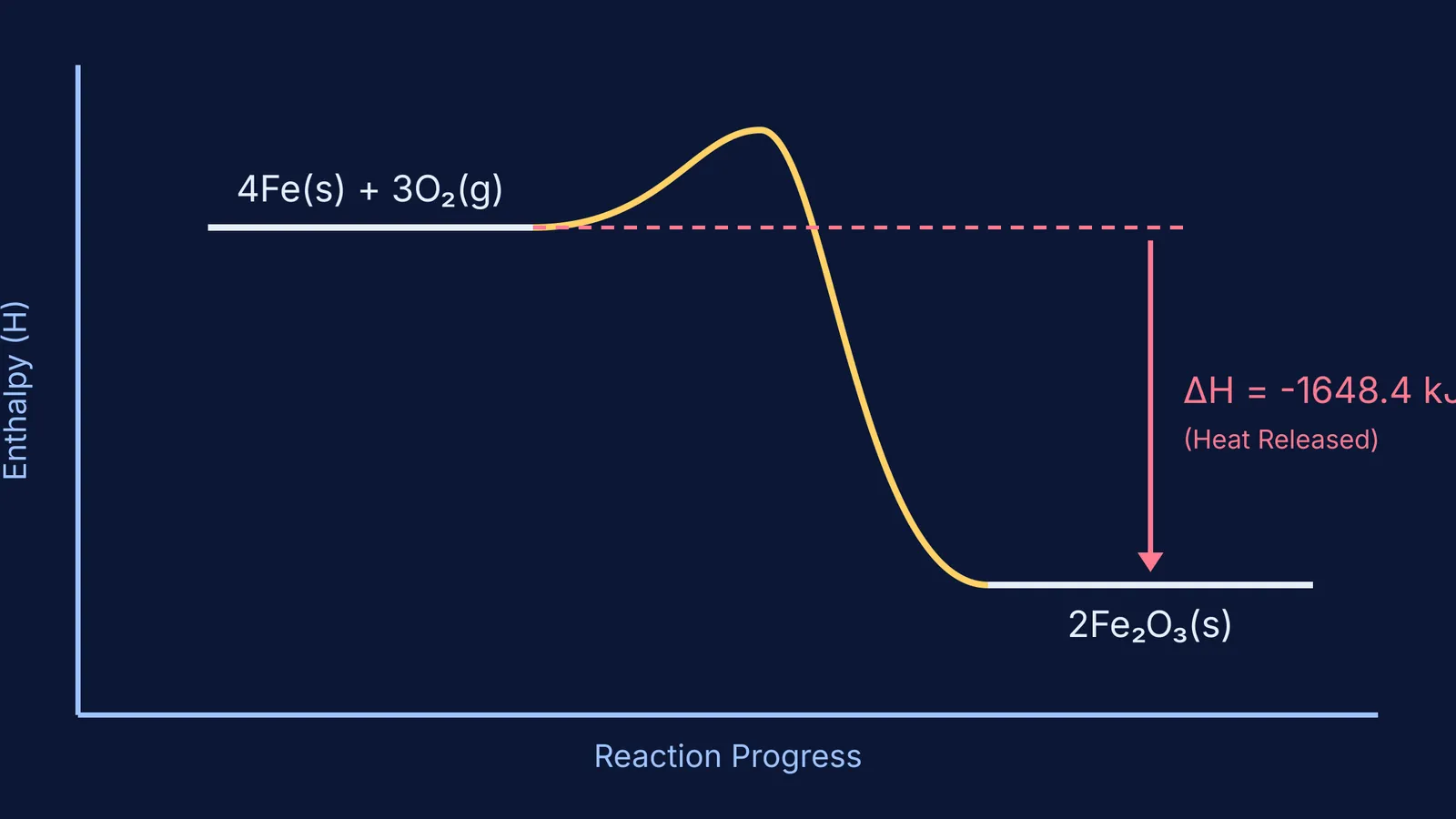
The balanced chemical equation is: 4Fe + 3O2 → 2Fe₂O₃ + heat
Because the reaction is exothermic, it releases significant thermal energy. The standard enthalpy of formation (ΔHf°) for iron(III) oxide is -824.2 kJ/mol 2. Since the reaction produces two moles of iron(III) oxide, the total enthalpy change (ΔH) is -1648.4 kJ, all of which is released as heat into your hands. If you are preparing for exams like the JEE and need to understand corrosion and rancidity in Class 10 science, this is a practical example of rapid oxidation.
Why don't they catch fire?
If the reaction releases that much energy, why doesn't the packet burst into flames? The secret lies in the packaging. The inner pouch is made of a microporous material that acts as a throttle.
By limiting the size and number of tiny holes, the manufacturer controls exactly how fast oxygen can enter the packet. This ensures a slow, steady rate of oxidation rather than a violent burst of heat. This controlled rate allows the hand warmer to reach its maximum temperature in about 20 minutes and maintain a modest level of heat for many hours 1.
How do reusable hand warmers compare?
Reusable hand warmers work on a completely different chemical principle. Instead of an iron oxidation reaction, they rely on a supersaturated solution of sodium acetate. Clicking the small metal disc inside the plastic pouch provides a nucleation site, triggering a rapid physical change where the liquid crystallizes into a solid.
This phase change is also exothermic and releases heat, but it does not require oxygen to function. Because it is a physical change rather than an irreversible chemical oxidation, you can reset the packet by boiling it in water until the solid crystals melt back into a liquid state. While disposable iron warmers offer longer-lasting heat, reusable ones are better for shorter trips and produce less waste over time.
Can you make them hotter?
If your hand warmer feels weak, you might be tempted to shake it or expose it to more air. While shaking can expose unreacted iron powder, the primary limit is oxygen flow. The exact speed of this reaction is highly dependent on environmental conditions, similar to how the temperature coefficient of reaction rate dictates that many reaction speeds double every 10 °C.
Be careful: these packets can reach temperatures up to 165°F (74°C) if given too much air 1. These temperatures can cause burns with prolonged skin contact, which is why you should always keep the warmer inside a glove or pocket rather than resting it directly against bare skin.
Understanding the enthalpies of atomisation, sublimation and phase change helps chemists control how energy is released in products like this. If you find it hard to picture how molecules collide and release heat, the Fermi Simulation Lab has interactive simulations for the ideas that are easier to see than to read. You can watch how reaction rates change with surface area and oxygen concentration, bringing the chemistry of a hand warmer to life.


